
Join Our JEE Preparation Group
Prep with like-minded aspirants; Get access to free daily tests and study material.
Sign in
Please select an account to continue using cracku.in
↓ →
Join Our JEE Preparation Group
Prep with like-minded aspirants; Get access to free daily tests and study material.
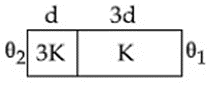
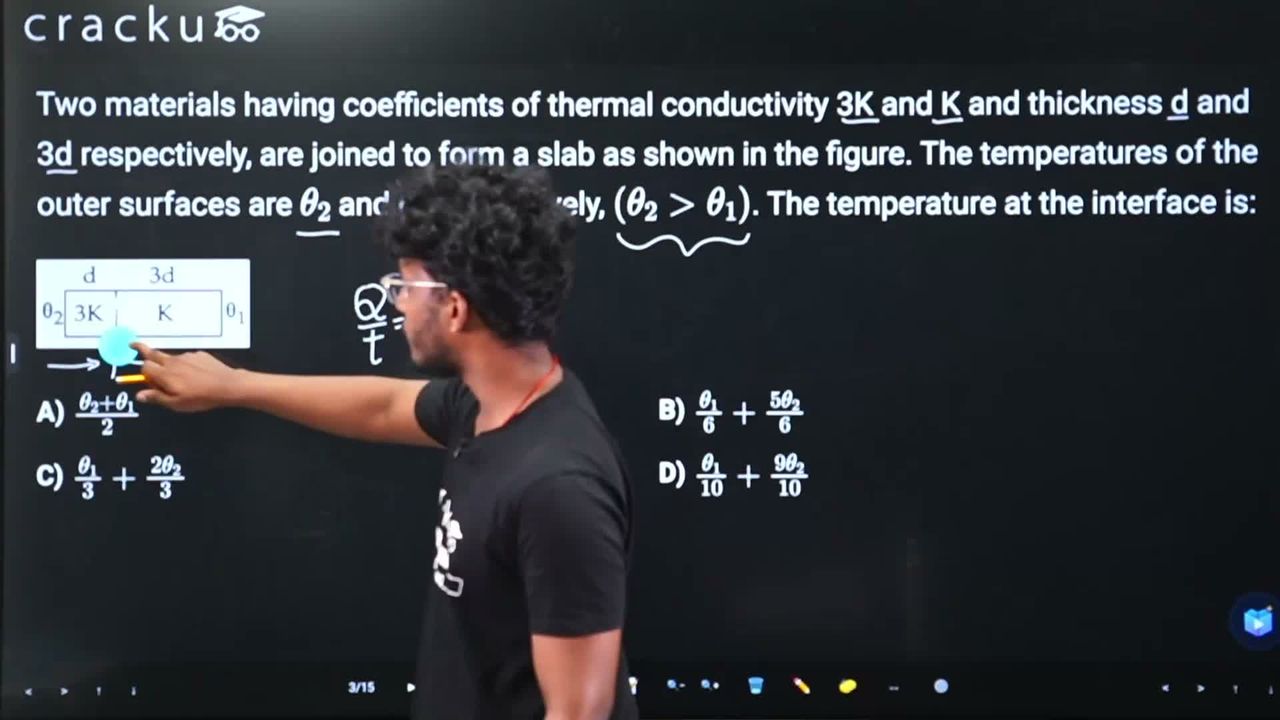
Two materials having coefficients of thermal conductivity 3K and K and thickness d and 3d respectively, are joined to form a slab as shown in the figure. The temperatures of the outer surfaces are $$\theta_2$$ and $$\theta_1$$ respectively, $$(\theta_2 > \theta_1)$$. The temperature at the interface is:
Step-by-Step Solution
1. Principle of Heat Conduction in Series
When two conducting layers are joined in series to form a composite slab under steady-state conditions, the rate of heat flow ($$\frac{Q}{t}$$) through both materials must be identical.
The rate of heat conduction is governed by Fourier's Law:
$$\frac{Q}{t} = \frac{KA(\Delta\theta)}{x}$$
Where:
2. Set Up the Heat Flow Balance Equation
Let the unknown interface temperature be $$T$$.
Equating the two heat flow rates:
$$\frac{3KA(\theta_2 - T)}{d} = \frac{KA(T - \theta_1)}{3d}$$
3. Simplify and Solve for $$T$$
Cancel out the common parameters ($$K, A,$$ and $$d$$) from both sides:
$$3(\theta_2 - T) = \frac{1}{3}(T - \theta_1)$$
Multiply the entire equation by $$3$$ to eliminate the fraction:
$$9(\theta_2 - T) = T - \theta_1$$
Expand the left side:
$$9\theta_2 - 9T = T - \theta_1$$
Group the terms containing $$T$$ onto one side:
$$9\theta_2 + \theta_1 = T + 9T$$
$$10T = 9\theta_2 + \theta_1$$
$$T = \frac{9\theta_2 + \theta_1}{10}$$
Separating the terms yields:
$$T = \frac{\theta_1}{10} + \frac{9\theta_2}{10}$$
Final Answer
The temperature at the interface is $$\frac{\theta_1 + 9\theta_2}{10}$$ (or $$\frac{\theta_1}{10} + \frac{9\theta_2}{10}$$).
Was this solution helpful?
Click on the Email ☝️ to Watch the Video Solution
Create a FREE account and get:
_1.webp)

Educational materials for JEE preparation

Ask our AI anything

AI can make mistakes. Please verify important information.
AI can make mistakes. Please verify important information.


