
Join Our JEE Preparation Group
Prep with like-minded aspirants; Get access to free daily tests and study material.
Sign in
Please select an account to continue using cracku.in
↓ →
Join Our JEE Preparation Group
Prep with like-minded aspirants; Get access to free daily tests and study material.
The specific heats, C$$_p$$ and C$$_v$$ of a gas of diatomic molecules, A, are given (in units of J mol$$^{-1}$$ K$$^{-1}$$) by 29 and 22, respectively. Another gas of diatomic molecules, B, has the corresponding values 30 and 21. If they are treated as ideal gases, then:
For an ideal gas the molar heat capacities at constant pressure and volume are related by the very first identity we always quote
$$C_p-C_v=R,$$
where $$R$$ is the universal gas constant. In addition, the total molar internal energy is written in the form
$$U=\dfrac{f}{2}RT,$$
with $$f$$ denoting the total number of quadratic degrees of freedom that are actually “active” at the temperature of the experiment. Because
$$C_v=\left(\dfrac{\partial U}{\partial T}\right)_V=\dfrac{f}{2}R,$$
we obtain immediately the useful pair of working formulae
$$C_v=\dfrac{f}{2}R\qquad\text{and}\qquad C_p=C_v+R=\left(\dfrac{f}{2}+1\right)R.$$
Finally we define the ratio of heat capacities
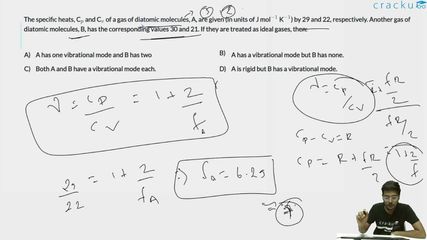
$$\gamma=\dfrac{C_p}{C_v}=1+\dfrac{R}{C_v}=\dfrac{f+2}{f}.$$
Now we recall the textbook values for a diatomic molecule:
Hence
With the theory organised, let us examine the two experimental gases.
Gas A. The given numbers are
$$C_p(A)=29\ \text{J mol}^{-1}\text{K}^{-1},\qquad C_v(A)=22\ \text{J mol}^{-1}\text{K}^{-1}.$$
We use the difference to obtain the effective $$R$$ that belongs to the same set of rounded data:
$$R_A=C_p-C_v=29-22=7\ \text{J mol}^{-1}\text{K}^{-1}.$$
With this value the effective number of degrees of freedom is
$$f_A=\dfrac{2C_v}{R_A}=\dfrac{2\times22}{7}=6.29\ (\text{approximately}).$$
This figure is distinctly larger than 5 and lies quite close to the ideal value 7 that one gets when a single vibrational mode is active. We confirm the same tendency by the ratio
$$\gamma_A=\dfrac{C_p}{C_v}=\dfrac{29}{22}=1.318,$$
which is very near the theoretical 1.29 for a diatomic possessing one vibrational mode, and markedly below 1.40 for a rigid diatomic. Hence Gas A does possess its vibrational mode.
Gas B. The quoted values are
$$C_p(B)=30\ \text{J mol}^{-1}\text{K}^{-1},\qquad C_v(B)=21\ \text{J mol}^{-1}\text{K}^{-1}.$$
First compute the rounded difference:
$$R_B=C_p-C_v=30-21=9\ \text{J mol}^{-1}\text{K}^{-1}.$$
Now derive the corresponding $$f$$:
$$f_B=\dfrac{2C_v}{R_B}=\dfrac{2\times21}{9}=4.67\ (\text{approximately}).$$
This result is very close to 5 and far from 7, so the only degrees of freedom effectively operating are the three translational and the two rotational ones; the vibrational mode is evidently still “frozen out.” The heat-capacity ratio reinforces the same conclusion:
$$\gamma_B=\dfrac{C_p}{C_v}=\dfrac{30}{21}=1.429,$$
essentially the theoretical 1.40 expected for a rigid diatomic with no vibrational contribution.
Putting the two discussions together we find that Gas A has its single vibrational mode active, whereas Gas B behaves as a rigid diatomic molecule with no vibrational contribution.
Hence, the correct answer is Option B.
Was this solution helpful?
Click on the Email ☝️ to Watch the Video Solution
Create a FREE account and get:
_1.webp)

Educational materials for JEE preparation

Ask our AI anything

AI can make mistakes. Please verify important information.
AI can make mistakes. Please verify important information.


