
Join Our JEE Preparation Group
Prep with like-minded aspirants; Get access to free daily tests and study material.
Sign in
Please select an account to continue using cracku.in
↓ →
Join Our JEE Preparation Group
Prep with like-minded aspirants; Get access to free daily tests and study material.
A massless spring (k = 800 N/m), attached with a mass (500 g) is completely immersed in 1 kg of water. The spring is stretched by 2 cm and released so that it starts vibrating. What would be the order of magnitude of the change in the temperature of water when the vibrations stop completely? (Assume that the water container and spring receive negligible heat and specific heat of mass = 400 J/kg K, water = 4184 J/kg K)
We begin by noting that when the spring is stretched and then released, the only mechanical energy stored in the system is the elastic potential energy of the spring. This energy will eventually be dissipated as heat in the surrounding water because the oscillations take place entirely inside the liquid and there is no other significant loss channel.
The elastic potential energy stored in a stretched spring is given by the standard formula
$$U = \dfrac{1}{2}\,k\,x^{2},$$
where $$k$$ is the spring constant and $$x$$ is the extension from the natural length.
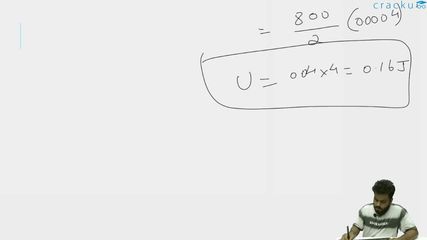
We have $$k = 800\;\text{N m}^{-1}$$ and the extension $$x = 2\;\text{cm} = 0.02\;\text{m}.$$ Substituting these values, we obtain
$$ U \;=\; \dfrac{1}{2}\times 800 \times (0.02)^{2} \;=\; 400 \times (0.0004) \;=\; 0.16\ \text{J}. $$
This $$0.16\ \text{J}$$ of mechanical energy is completely converted into heat inside the water once the vibrations cease. Let us call this heat $$Q$$, so
$$Q = 0.16\ \text{J}.$$
The rise in temperature of the water is obtained from the calorimetry relation
$$Q = m\,c\,\Delta T,$$
where $$m$$ is the mass of the water, $$c$$ is its specific heat capacity, and $$\Delta T$$ is the change in temperature.
Given $$m = 1\ \text{kg}$$ and $$c = 4184\ \text{J kg}^{-1}\text{K}^{-1},$$ we substitute:
$$ 0.16 \;=\; 1 \times 4184 \times \Delta T. $$
Solving for $$\Delta T$$ gives
$$ \Delta T \;=\; \dfrac{0.16}{4184} \;\approx\; 3.8 \times 10^{-5}\ \text{K}. $$
Thus the temperature rise is of the order of $$10^{-5}\ \text{K}$$.
Hence, the correct answer is Option A.
Was this solution helpful?
Click on the Email ☝️ to Watch the Video Solution
Create a FREE account and get:
_1.webp)

Educational materials for JEE preparation

Ask our AI anything

AI can make mistakes. Please verify important information.
AI can make mistakes. Please verify important information.


