
Join Our JEE Preparation Group
Prep with like-minded aspirants; Get access to free daily tests and study material.
Sign in
Please select an account to continue using cracku.in
↓ →
Join Our JEE Preparation Group
Prep with like-minded aspirants; Get access to free daily tests and study material.
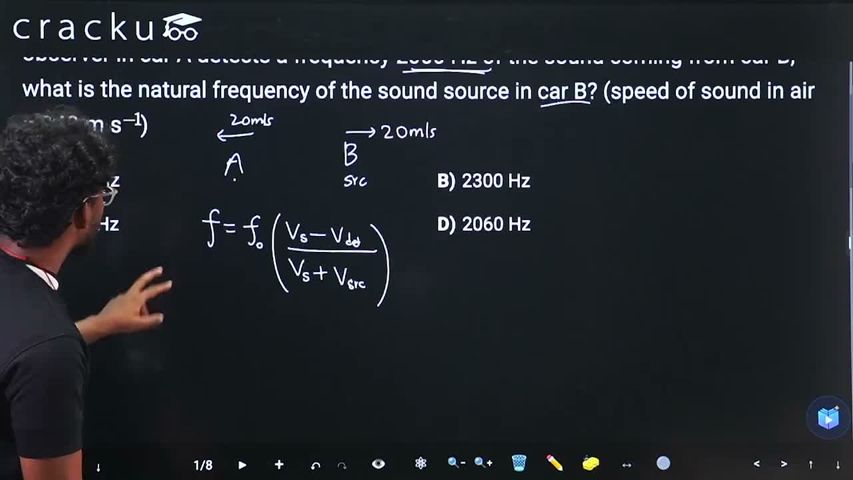
Two cars A and B are moving away from each other in opposite directions. Both the cars are moving with speed of 20 m s$$^{-1}$$ with respect to the ground. If an observer in car A detects a frequency 2000 Hz of the sound coming from car B, what is the natural frequency of the sound source in car B? (speed of sound in air = 340 m s$$^{-1}$$)
We are told that car A and car B are moving in opposite directions, each with a speed of $$20 \,\text{m s}^{-1}$$ relative to the ground. An observer sitting in car A hears a sound of frequency $$2000 \,\text{Hz}$$ coming from the horn of car B. The speed of sound in still air is given as $$340 \,\text{m s}^{-1}$$. Our goal is to determine the actual (natural) frequency $$f$$ of the horn in car B.
For sound waves, the Doppler-effect formula that links the heard (apparent) frequency $$f'$$ and the natural frequency $$f$$ is
$$ f' = f \, \dfrac{v \pm v_o}{\,v \mp v_s\,}, $$
where
In our situation both vehicles are receding from each other:
Hence the formula becomes
$$ f' \;=\; f \,\dfrac{v - v_o}{v + v_s}. $$
We know $$f' = 2000 \,\text{Hz}$$, $$v = 340 \,\text{m s}^{-1}$$, $$v_o = 20 \,\text{m s}^{-1}$$, and $$v_s = 20 \,\text{m s}^{-1}$$. Substituting these values gives
$$ 2000 \;=\; f \,\dfrac{340 - 20}{340 + 20}. $$
Simplifying the fractions step by step, we first work out the numerator and denominator:
$$ 340 - 20 = 320, \qquad 340 + 20 = 360. $$
So we now have
$$ 2000 \;=\; f \,\dfrac{320}{360}. $$
To isolate $$f$$, multiply both sides of the equation by the reciprocal of the fraction $$\dfrac{360}{320}$$:
$$ f \;=\; 2000 \,\times \dfrac{360}{320}. $$
Carrying out the multiplication in the numerator, we get
$$ 2000 \times 360 \;=\; 720\,000. $$
Dividing by the denominator:
$$ f \;=\; \dfrac{720\,000}{320}. $$
Performing the division:
$$ f \;=\; 2250 \,\text{Hz}. $$
Thus the natural frequency of the horn in car B is $$2250 \,\text{Hz}$$.
Hence, the correct answer is Option C.
Was this solution helpful?
Click on the Email ☝️ to Watch the Video Solution
Create a FREE account and get:
_1.webp)

Educational materials for JEE preparation

Ask our AI anything

AI can make mistakes. Please verify important information.
AI can make mistakes. Please verify important information.


