
Join Our JEE Preparation Group
Prep with like-minded aspirants; Get access to free daily tests and study material.
Sign in
Please select an account to continue using cracku.in
↓ →
Join Our JEE Preparation Group
Prep with like-minded aspirants; Get access to free daily tests and study material.
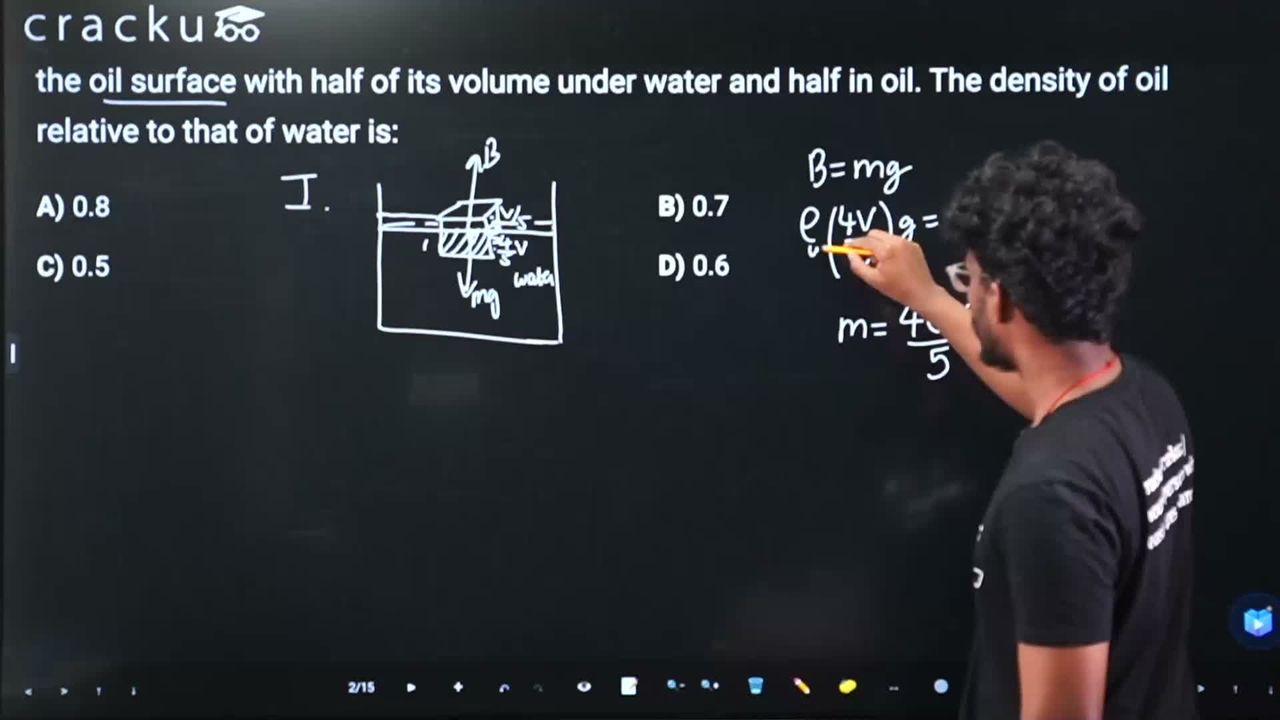
A wooden block floating in a bucket of water has $$\frac{4}{5}$$ of its volume submerged. When certain amount of an oil is poured into the bucket, it is found that the block is just under the oil surface with half of its volume under water and half in oil. The density of oil relative to that of water is:
Let the density of water be $$\rho_{w}$$, the density of the wooden block be $$\rho_{b}$$ and the density of oil be $$\rho_{o}$$. We denote the total volume of the block by $$V$$ and take $$g$$ as the acceleration due to gravity.
First, consider the initial situation when only water is present. The block floats with $$\dfrac{4}{5}$$ of its volume submerged. For a floating body, the condition of equilibrium is given by the principle of flotation:
$$\text{(buoyant force)} = \text{(weight of block)}.$$
The buoyant force is the weight of the displaced water, which equals $$\rho_{w}g \left(\dfrac{4}{5}V\right)$$, while the weight of the block is $$\rho_{b}gV$$. Setting these equal, we have
$$\rho_{w}g \left(\dfrac{4}{5}V\right)=\rho_{b}gV.$$
The factor $$gV$$ cancels from both sides, giving
$$\rho_{b}=\dfrac{4}{5}\rho_{w}.$$
Now oil is gently poured on top of the water until the block just touches the oil-air interface. At this stage, exactly half the block’s volume is under water and the remaining half is in oil. Thus the volumes in each liquid are $$\dfrac{V}{2}$$.
The total buoyant force is now the sum of the forces due to the displaced water and the displaced oil, so we write
$$\rho_{w}g\left(\dfrac{V}{2}\right)+\rho_{o}g\left(\dfrac{V}{2}\right)=\rho_{b}gV.$$
Again, we can cancel the common factor $$g$$ and also factor out $$\dfrac{V}{2}$$ from the left-hand side:
$$\dfrac{V}{2}\left(\rho_{w}+\rho_{o}\right)=\rho_{b}V.$$
Dividing both sides by $$\dfrac{V}{2}$$ yields
$$\rho_{w}+\rho_{o}=2\rho_{b}.$$
Substituting the value $$\rho_{b}=\dfrac{4}{5}\rho_{w}$$ obtained earlier, we get
$$\rho_{w}+\rho_{o}=2\left(\dfrac{4}{5}\rho_{w}\right)=\dfrac{8}{5}\rho_{w}.$$
Solving for $$\rho_{o}$$, we find
$$\rho_{o}=\dfrac{8}{5}\rho_{w}-\rho_{w}=\left(\dfrac{8}{5}-1\right)\rho_{w}=\dfrac{3}{5}\rho_{w}.$$
The ratio $$\dfrac{\rho_{o}}{\rho_{w}}$$ is therefore
$$\dfrac{\rho_{o}}{\rho_{w}}=\dfrac{3}{5}=0.6.$$
Hence, the correct answer is Option D.
Was this solution helpful?
Click on the Email ☝️ to Watch the Video Solution
Create a FREE account and get:
_1.webp)

Educational materials for JEE preparation

Ask our AI anything

AI can make mistakes. Please verify important information.
AI can make mistakes. Please verify important information.


