
Join Our JEE Preparation Group
Prep with like-minded aspirants; Get access to free daily tests and study material.
Sign in
Please select an account to continue using cracku.in
↓ →
Join Our JEE Preparation Group
Prep with like-minded aspirants; Get access to free daily tests and study material.
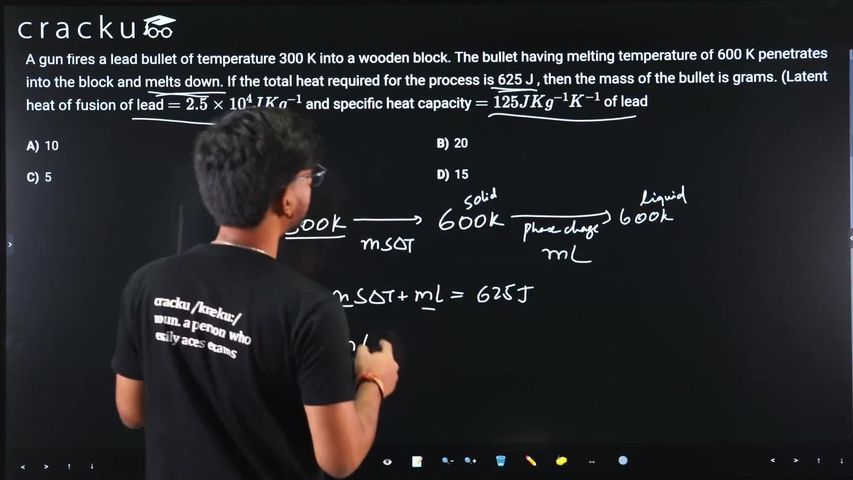
A gun fires a lead bullet of temperature 300 K into a wooden block. The bullet having melting temperature of 600 K penetrates into the block and melts down. If the total heat required for the process is 625 J , then the mass of the bullet is grams. (Latent heat of fusion of lead $$=2.5\times10^{4}JKg^{-1}$$ and specific heat capacity $$=125JKg^{-1}K^{-1}$$ of lead
We need to find the mass of the bullet that melts completely after penetrating the wooden block. Since the total heat required has two components, the first part is the heat to raise the temperature from 300 K to the melting point at 600 K, which is given by $$Q_1 = mc\Delta T$$, and the second part is the heat to melt the bullet at 600 K, given by $$Q_2 = mL$$.
Given that $$c = 125 \text{ J kg}^{-1}\text{K}^{-1}$$, $$L = 2.5 \times 10^{4} \text{ J kg}^{-1}$$, and $$\Delta T = 600 - 300 = 300 \text{ K}$$, the total heat supplied is $$Q = 625 \text{ J}$$.
Substituting these values into the expression for total heat, we have $$Q = mc\Delta T + mL$$, which becomes $$625 = m\bigl(125 \times 300 + 2.5 \times 10^{4}\bigr)$$. Therefore, $$625 = m(37500 + 25000)$$, leading to $$625 = m \times 62500$$. This gives $$m = \frac{625}{62500} = 0.01 \text{ kg} = 10 \text{ grams}$$.
Therefore, the correct answer is Option 1: 10 grams.
Was this solution helpful?
Click on the Email ☝️ to Watch the Video Solution
Create a FREE account and get:
_1.webp)

Educational materials for JEE preparation

Ask our AI anything

AI can make mistakes. Please verify important information.
AI can make mistakes. Please verify important information.
