
Join Our JEE Preparation Group
Prep with like-minded aspirants; Get access to free daily tests and study material.
Sign in
Please select an account to continue using cracku.in
↓ →
Join Our JEE Preparation Group
Prep with like-minded aspirants; Get access to free daily tests and study material.
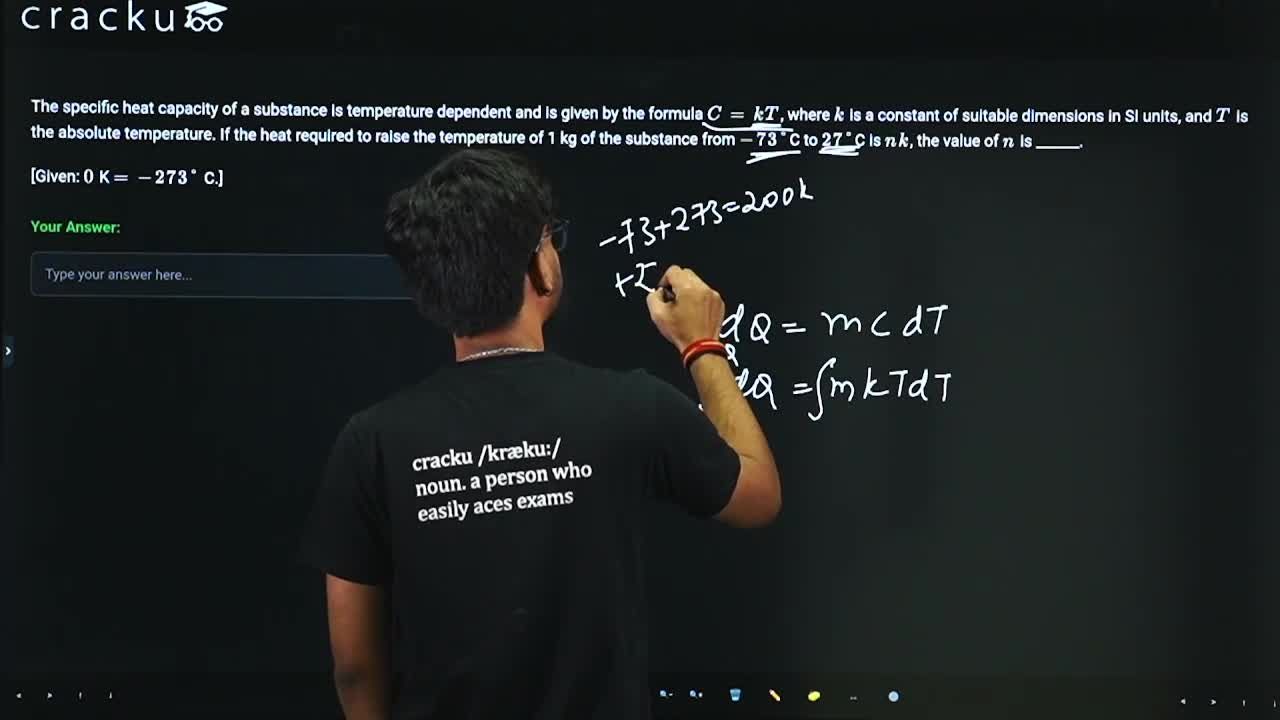
The specific heat capacity of a substance is temperature dependent and is given by the formula $$C = kT$$, where $$k$$ is a constant of suitable dimensions in SI units, and $$T$$ is the absolute temperature. If the heat required to raise the temperature of 1 kg of the substance from $$-73°$$C to $$27°$$C is $$nk$$, the value of $$n$$ is ______.
[Given: $$0$$ K $$= -273°$$ C.]
Correct Answer: 25000
The mass of the sample is $$m = 1 \text{ kg}$$ (given).
For a temperature-dependent specific heat capacity $$C = kT$$, the small amount of heat $$dQ$$ needed to raise the temperature by $$dT$$ is
$$dQ = m\,C\,dT = m\,(kT)\,dT = mkT\,dT.$$
Total heat supplied when the temperature rises from $$T_1$$ to $$T_2$$ is obtained by integration:
$$Q = \int_{T_1}^{T_2} mkT\,dT = mk \int_{T_1}^{T_2} T\,dT.$$
Evaluating the integral:
$$\int_{T_1}^{T_2} T\,dT = \left[\frac{T^{2}}{2}\right]_{T_1}^{T_2} = \frac{T_2^{2} - T_1^{2}}{2}.$$
Hence
$$Q = mk\,\frac{T_2^{2} - T_1^{2}}{2}.$$
The temperature limits must be in kelvin. Using the relation $$T(\text{K}) = T(^{\circ}\text{C}) + 273$$:
$$T_1 = -73^{\circ}\text{C} + 273 = 200 \text{ K},$$
$$T_2 = 27^{\circ}\text{C} + 273 = 300 \text{ K}.$$
Substituting $$m = 1 \text{ kg}$$, $$T_1 = 200 \text{ K}$$, $$T_2 = 300 \text{ K}$$:
$$Q = 1 \times k \times \frac{300^{2} - 200^{2}}{2}.$$
Calculate the bracketed term:
$$300^{2} - 200^{2} = 90000 - 40000 = 50000.$$
Therefore,
$$Q = k \times \frac{50000}{2} = 25000\,k.$$
The heat required is given in the problem as $$nk$$, so comparing,
$$n = 25000.$$
Final answer: 25000
Was this solution helpful?
Click on the Email ☝️ to Watch the Video Solution
Create a FREE account and get:
_1.webp)

Educational materials for JEE preparation

Ask our AI anything

AI can make mistakes. Please verify important information.
AI can make mistakes. Please verify important information.
