
Join Our JEE Preparation Group
Prep with like-minded aspirants; Get access to free daily tests and study material.
Sign in
Please select an account to continue using cracku.in
↓ →
Join Our JEE Preparation Group
Prep with like-minded aspirants; Get access to free daily tests and study material.
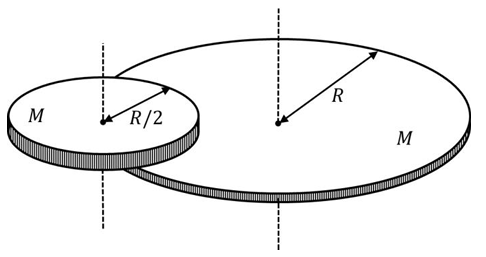
A disc of mass $$M$$ and radius $$R$$ is free to rotate about its vertical axis as shown in the figure. A battery operated motor of negligible mass is fixed to this disc at a point on its circumference. Another disc of the same mass $$M$$ and radius $$R/2$$ is fixed to the motor's thin shaft. Initially, both the discs are at rest. The motor is switched on so that the smaller disc rotates at a uniform angular speed $$\omega$$. If the angular speed at which the large disc rotates is $$\omega/n$$, then the value of $$n$$ is ______.
Correct Answer: 12
Take the vertical axis through the centre of the larger disc as the reference (positive sense anticlockwise).
Initially both discs are at rest ⇒ total angular momentum about this axis is zero and, because no external torque acts, it must remain zero.
Moments of inertia about the vertical axis
Large disc (mass $$M$$, radius $$R$$): $$I_L = \frac{1}{2}MR^{2}$$
Small disc (mass $$M$$, radius $$\dfrac{R}{2}$$) about its own centre:
$$I_{s,\;{\rm cm}} = \frac{1}{2}M\!\left(\frac{R}{2}\right)^{2}= \frac{1}{8}MR^{2}$$
The small disc is fixed to the circumference of the big disc, so its centre is at a distance $$R$$ from the main axis. Hence, using the parallel-axis theorem, the small disc’s moment of inertia about the main axis is
$$I_s = I_{s,\;{\rm cm}} + MR^{2}= \frac{1}{8}MR^{2}+MR^{2}= \frac{9}{8}MR^{2}$$
Angular velocities
Motor keeps the small disc spinning at a constant angular speed $$\omega$$ (anticlockwise) about its own axis.
Reaction torque makes the large disc rotate clockwise with angular speed $$\dfrac{\omega}{n}$$ (-ve sign).
Because the small disc is rigidly fixed to the large disc, its centre also moves in a circle of radius $$R$$ with the same angular speed as the large disc.
Angular momenta about the main axis
1. Large disc: $$L_L = I_L\!\left(-\frac{\omega}{n}\right)= -\frac{1}{2}MR^{2}\frac{\omega}{n}$$
2. Small disc (two parts)
a) Spin about its own axis: $$L_{s,\;{\rm spin}} = I_{s,\;{\rm cm}}\;\omega = \frac{1}{8}MR^{2}\,\omega$$ (anticlockwise)
b) Orbital motion of its centre: $$L_{s,\;{\rm orb}} = MR^{2}\!\left(-\frac{\omega}{n}\right)= -MR^{2}\frac{\omega}{n}$$
Total angular momentum must stay zero:
$$L_L + L_{s,\;{\rm spin}} + L_{s,\;{\rm orb}} = 0$$ $$-\frac{1}{2}MR^{2}\frac{\omega}{n} + \frac{1}{8}MR^{2}\,\omega - MR^{2}\frac{\omega}{n}=0$$
Divide by $$MR^{2}\omega$$:
$$-\frac{1}{2n} + \frac{1}{8} - \frac{1}{n}=0$$ $$-\frac{3}{2n} + \frac{1}{8}=0$$
$$\frac{1}{n}= \frac{1}{8}\times\frac{2}{3}= \frac{1}{12} \;\Longrightarrow\; n = 12$$
Hence, the large disc rotates with angular speed $$\dfrac{\omega}{12}$$ opposite to that of the smaller disc.
Final answer: 12
Was this solution helpful?
Create a FREE account and get:
_1.webp)

Educational materials for JEE preparation

Ask our AI anything

AI can make mistakes. Please verify important information.
AI can make mistakes. Please verify important information.
