
Join Our JEE Preparation Group
Prep with like-minded aspirants; Get access to free daily tests and study material.
Sign in
Please select an account to continue using cracku.in
↓ →
Join Our JEE Preparation Group
Prep with like-minded aspirants; Get access to free daily tests and study material.
A glass beaker has a solid, plano-convex base of refractive index 1.60, as shown in the figure. The radius of curvature of the convex surface (SPU) is 9 cm, while the planar surface (STU) acts as a mirror. This beaker is filled with a liquid of refractive index $$n$$ up to the level $$QPR$$. If the image of a point object $$O$$ at a height of $$h$$ ($$OT$$ in the figure) is formed onto itself, then, which of the following option(s) is (are) correct?
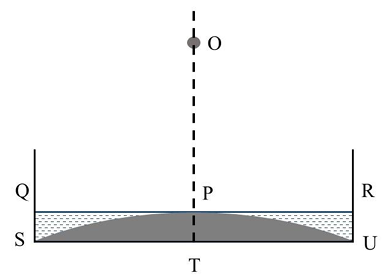
Using the power of a combined silvered thin lens system:
$$\frac{1}{F} = 2\left(\frac{n - 1}{R_1} + \frac{\mu_g - n}{R_2}\right) + \frac{1}{f_m}$$
Given parameters: flat air-liquid interface ($$R_1 = \infty$$), liquid-glass convex interface ($$R_2 = +9\text{ cm}$$), and flat mirror base ($$f_m = \infty$$):
$$\frac{1}{F} = 2\left(0 + \frac{1.60 - n}{9}\right) + 0 = \frac{2(1.60 - n)}{9}$$
Using the coincidence condition where the image reflects back to the object position ($$u = -h$$, $$v = -h$$):
$$\frac{1}{-h} + \frac{1}{-h} = -\frac{1}{F} \implies \frac{2}{h} = \frac{2(1.60 - n)}{9}$$
$$h = \frac{9}{1.60 - n}$$
For Option (A): $$n = 1.42 \implies h = \frac{9}{1.60 - 1.42} = \frac{9}{0.18} = 50\text{ cm}$$
For Option (B): $$n = 1.35 \implies h = \frac{9}{1.60 - 1.35} = \frac{9}{0.25} = 36\text{ cm}$$
For Option (C): $$n = 1.45 \implies h = \frac{9}{1.60 - 1.45} = \frac{9}{0.15} = 60\text{ cm}$$
For Option (D): $$n = 1.48 \implies h = \frac{9}{1.60 - 1.48} = \frac{9}{0.12} = 75\text{ cm}$$
Was this solution helpful?
Create a FREE account and get:
_1.webp)

Educational materials for JEE preparation

Ask our AI anything

AI can make mistakes. Please verify important information.
AI can make mistakes. Please verify important information.
