
Join Our JEE Preparation Group
Prep with like-minded aspirants; Get access to free daily tests and study material.
Sign in
Please select an account to continue using cracku.in
↓ →
Join Our JEE Preparation Group
Prep with like-minded aspirants; Get access to free daily tests and study material.
Two uniform strings of mass per unit length $$\mu$$ and $$4\mu$$, and length $$L$$ and $$2L$$, respectively, are joined at point $$O$$, and tied at two fixed ends $$P$$ and $$Q$$, as shown in the figure. The strings are under a uniform tension $$T$$. If we define the frequency $$\nu_0 = \frac{1}{2L}\sqrt{\frac{T}{\mu}}$$, which of the following statement(s) is(are) correct?
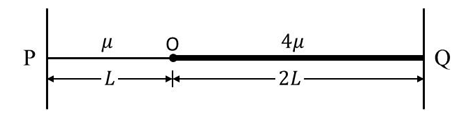
Standing wave boundary conditions require fixed ends to be nodes, and a junction point to either form a common node or satisfy displacement continuity and tension slope matching.
Given: $$\nu_0 = \frac{1}{2L}\sqrt{\frac{T}{\mu}}$$, String 1: $$\mu_1 = \mu, L_1 = L$$, String 2: $$\mu_2 = 4\mu, L_2 = 2L$$
Finding fundamental frequencies of individual isolated segments:
$$\nu_1 = \frac{1}{2L}\sqrt{\frac{T}{\mu}} = \nu_0$$
$$\nu_2 = \frac{1}{2(2L)}\sqrt{\frac{T}{4\mu}} = \frac{1}{4L}\cdot\frac{1}{2}\sqrt{\frac{T}{\mu}} = \frac{1}{4}\nu_0$$
Evaluating condition for a node at junction $$O$$:
$$\nu = n_1 \nu_1 = n_2 \nu_2 \implies \nu = n_1 \nu_0 = n_2 \left(\frac{1}{4}\nu_0\right) \implies 4n_1 = n_2$$
$$\text{For minimum frequency: } n_1 = 1 \implies n_2 = 4 \implies \nu_{\text{min, node}} = \nu_0$$
$$\text{Total nodes } = (n_1 + 1) + (n_2 + 1) - 1 = 2 + 5 - 1 = 6$$
Evaluating condition for an antinode at junction $$O$$:
$$\nu = \left(n_1 - \frac{1}{2}\right)\nu_1 = \left(n_2 - \frac{1}{2}\right)\nu_2 \implies \left(n_1 - \frac{1}{2}\right)\nu_0 = \left(n_2 - \frac{1}{2}\right)\frac{\nu_0}{4}$$
$$4n_1 - 2 = n_2 - 0.5 \implies 4n_1 - n_2 = 1.5 \text{ (no integer solutions)}$$
Answer: Option (A), Option (C), Option (D)
Create a FREE account and get:
_1.webp)

Educational materials for JEE preparation

Ask our AI anything

AI can make mistakes. Please verify important information.
AI can make mistakes. Please verify important information.


