
Join Our JEE Preparation Group
Prep with like-minded aspirants; Get access to free daily tests and study material.
Sign in
Please select an account to continue using cracku.in
↓ →
Join Our JEE Preparation Group
Prep with like-minded aspirants; Get access to free daily tests and study material.
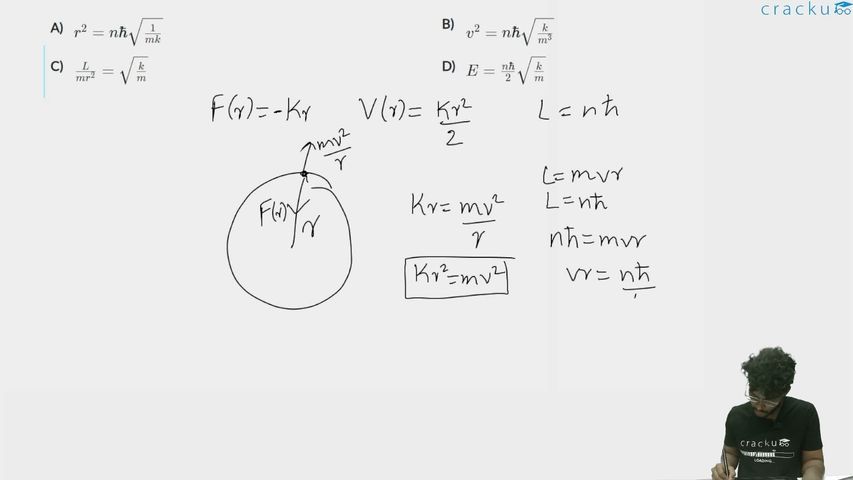
A particle of mass $$m$$ is moving in a circular orbit under the influence of the central force $$F(r) = -kr$$, corresponding to the potential energy $$V(r) = kr^2/2$$, where $$k$$ is a positive force constant and $$r$$ is the radial distance from the origin. According to the Bohr's quantization rule, the angular momentum of the particle is given by $$L = n\hbar$$, where $$\hbar = h/(2\pi)$$, $$h$$ is the Planck's constant, and $$n$$ a positive integer. If $$v$$ and $$E$$ are the speed and total energy of the particle, respectively, then which of the following expression(s) is(are) correct?
The given central force is $$F(r)=-kr$$, so the corresponding potential energy is $$V(r)=\dfrac{1}{2}kr^{2}$$.
For a stable circular orbit of radius $$r$$ and speed $$v$$, the required centripetal force is provided entirely by the central force:
$$\frac{mv^{2}}{r}=kr \qquad -(1)$$
From Bohr’s quantisation rule, the magnitude of the angular momentum is
$$L = n\hbar \qquad -(2)$$
But for circular motion, angular momentum is also
$$L = mvr \qquad -(3)$$
We now combine equations $$(1)$$ and $$(3)$$ to obtain relations among $$r$$, $$v$$, and $$L$$.
Step 1: Eliminate $$v$$ between $$(1)$$ and $$(3)$$
From $$(3)$$, $$v=\dfrac{L}{mr}$$. Substitute this in $$(1)$$:
$$\frac{m}{r}\left(\frac{L}{mr}\right)^{2}=kr \;\;\Longrightarrow\;\; \frac{L^{2}}{m r^{3}}=kr$$
$$\Longrightarrow\; L^{2}=km\,r^{4} \qquad -(4)$$
Step 2: Express $$r^{2}$$ in terms of $$L$$
From $$(4)$$,
$$r^{4}=\frac{L^{2}}{km}\;\;\Longrightarrow\;\; r^{2}=\frac{L}{\sqrt{km}} \qquad -(5)$$
Using $$(2)$$ ( $$L=n\hbar$$ ) in $$(5)$$ gives
$$r^{2}=n\hbar\sqrt{\frac{1}{mk}}$$
This is exactly Option A.
Step 3: Obtain $$v^{2}$$
Return to equation $$(1)$$: $$v^{2}=\frac{k}{m}r^{2}$$.
Insert the value of $$r^{2}$$ from $$(5)$$:
$$v^{2}=\frac{k}{m}\left(n\hbar\sqrt{\frac{1}{mk}}\right) =n\hbar\sqrt{\frac{k}{m^{3}}}$$
This is Option B.
Step 4: Evaluate $$\dfrac{L}{mr^{2}}$$
Using $$(2)$$ and $$(5)$$,
$$\frac{L}{mr^{2}}=\frac{n\hbar}{m\left(n\hbar/\sqrt{km}\right)} =\frac{\sqrt{km}}{m} =\sqrt{\frac{k}{m}}$$
This matches Option C.
Step 5: Compute the total mechanical energy $$E$$
Kinetic energy: $$T=\dfrac{1}{2}mv^{2}$$.
Using $$(1)$$, $$v^{2}=\dfrac{k}{m}r^{2}$$ gives
$$T=\frac{1}{2}m\left(\frac{k}{m}r^{2}\right)=\frac{1}{2}kr^{2}$$
Potential energy: $$V=\dfrac{1}{2}kr^{2}$$.
Total energy: $$E=T+V=kr^{2}$$.
Substituting $$r^{2}=n\hbar/\sqrt{km}$$:
$$E=k\left(\frac{n\hbar}{\sqrt{km}}\right)=n\hbar\sqrt{\frac{k}{m}}$$
The factor is $$1$$, not $$\tfrac{1}{2}$$, so Option D is incorrect.
Therefore the correct statements are:
Option A, Option B, and Option C.
Was this solution helpful?
Click on the Email ☝️ to Watch the Video Solution
Create a FREE account and get:
_1.webp)

Educational materials for JEE preparation

Ask our AI anything

AI can make mistakes. Please verify important information.
AI can make mistakes. Please verify important information.
