
Join Our JEE Preparation Group
Prep with like-minded aspirants; Get access to free daily tests and study material.
Sign in
Please select an account to continue using cracku.in
↓ →
Join Our JEE Preparation Group
Prep with like-minded aspirants; Get access to free daily tests and study material.
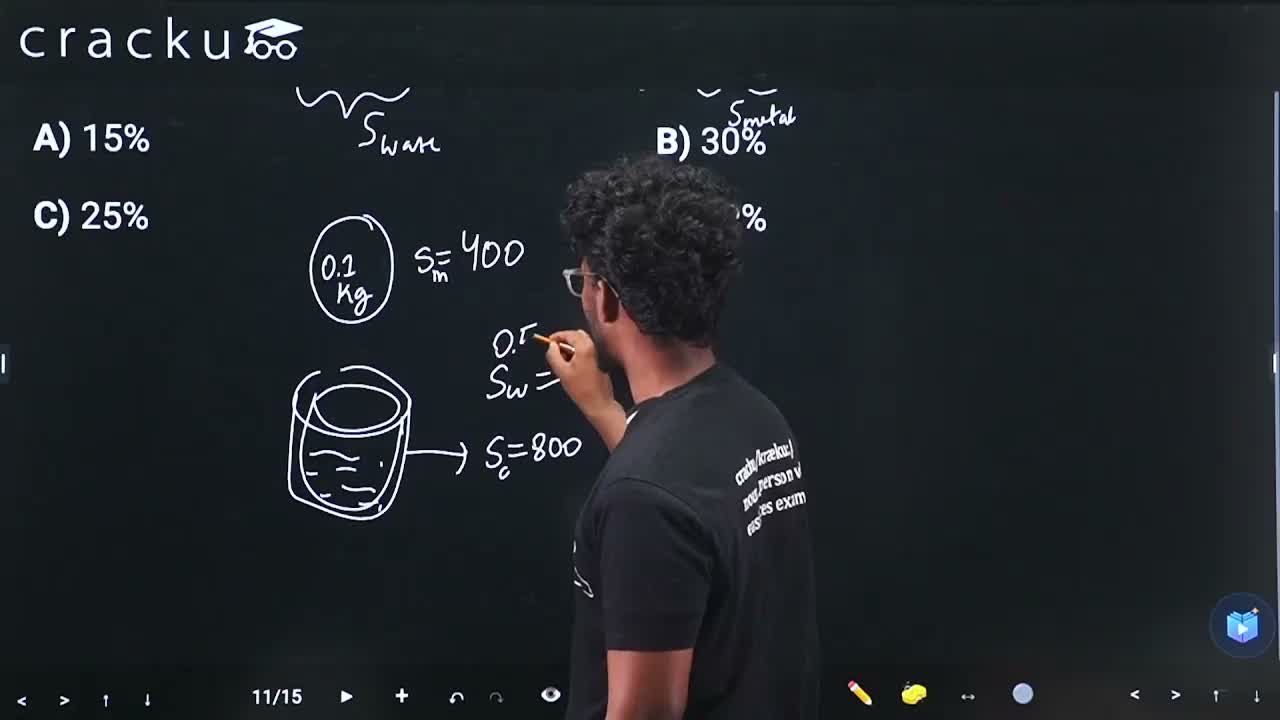
A metal ball of mass 0.1 kg is heated upto $$500°C$$ and dropped into a vessel of heat capacity $$800 \text{ JK}^{-1}$$ and containing 0.5 kg water. The initial temperature of water and vessel is $$30°C$$. What is the approximate percentage increment in the temperature of the water? [Specific Heat Capacities of water and metal are, respectively, $$4200 \text{ Jkg}^{-1} \text{K}^{-1}$$ and $$400 \text{ Jkg}^{-1} \text{K}^{-1}$$]
We apply the principle of calorimetry, which tells us that in an isolated system the heat lost by the hotter body equals the heat gained by the colder bodies:
$$\text{Heat lost by metal ball} = \text{Heat gained by water} + \text{Heat gained by vessel}.$$
First we write the general expressions. For any substance, the heat exchanged is given by $$Q = mc\Delta T$$ where $$m$$ is mass, $$c$$ is specific heat capacity and $$\Delta T$$ is the change in temperature. For a calorimeter (the vessel) whose heat capacity is already given as a whole number $$C$$, the heat taken is $$Q = C\Delta T.$$
Let the common final temperature after mixing be $$T_f$$ (in $$^\circ\text{C}$$ or K; the difference is the same). Initial data:
Metal ball: $$m_m = 0.1\ \text{kg}, \; c_m = 400\ \text{J kg}^{-1}\text{K}^{-1}, \; T_{mi}=500^\circ\text{C}.$$ Water: $$m_w = 0.5\ \text{kg}, \; c_w = 4200\ \text{J kg}^{-1}\text{K}^{-1}, \; T_{wi}=30^\circ\text{C}.$$ Vessel: $$C_v = 800\ \text{J K}^{-1}, \; T_{vi}=30^\circ\text{C}.$$
Because the water and the vessel start at the same temperature, their temperature rise is $$T_f - 30$$. The metal ball cools from $$500^\circ\text{C}$$ to $$T_f$$, so its temperature fall is $$500 - T_f$$.
Now we set up the energy balance:
$$ m_m c_m (500 - T_f) = m_w c_w (T_f - 30) + C_v(T_f - 30). $$
Substituting every numerical value:
$$ 0.1 \times 400 \,(500 - T_f) = 0.5 \times 4200 \,(T_f - 30) + 800\,(T_f - 30). $$
Compute each coefficient step by step:
Left hand coefficient: $$0.1 \times 400 = 40.$$ Right hand first term coefficient: $$0.5 \times 4200 = 2100.$$ Adding the vessel’s 800 gives a total right-hand coefficient $$2100 + 800 = 2900.$$
Thus the equation simplifies to
$$ 40(500 - T_f) = 2900(T_f - 30). $$
Expanding both sides:
$$ 40 \times 500 - 40T_f = 2900T_f - 2900 \times 30. $$
Calculate the plain numbers:
$$ 20000 - 40T_f = 2900T_f - 87000. $$
Collect all terms containing $$T_f$$ on the right and the pure numbers on the left:
$$ 20000 + 87000 = 2900T_f + 40T_f. $$
$$ 107000 = 2940T_f. $$
Solve for the final temperature:
$$ T_f = \frac{107000}{2940} \approx 36.4^\circ\text{C}. $$
The initial temperature of the water was $$30^\circ\text{C}$$, so the rise in temperature is
$$ \Delta T = 36.4 - 30 = 6.4^\circ\text{C}. $$
The percentage increment relative to the original $$30^\circ\text{C}$$ is
$$ \text{Percentage rise} = \frac{6.4}{30} \times 100 \approx 21.3\%. $$
The nearest option provided is $$20\%$$.
Hence, the correct answer is Option D.
Was this solution helpful?
Click on the Email ☝️ to Watch the Video Solution
Create a FREE account and get:
_1.webp)

Educational materials for JEE preparation

Ask our AI anything

AI can make mistakes. Please verify important information.
AI can make mistakes. Please verify important information.


