
Join Our JEE Preparation Group
Prep with like-minded aspirants; Get access to free daily tests and study material.
Sign in
Please select an account to continue using cracku.in
↓ →
Join Our JEE Preparation Group
Prep with like-minded aspirants; Get access to free daily tests and study material.
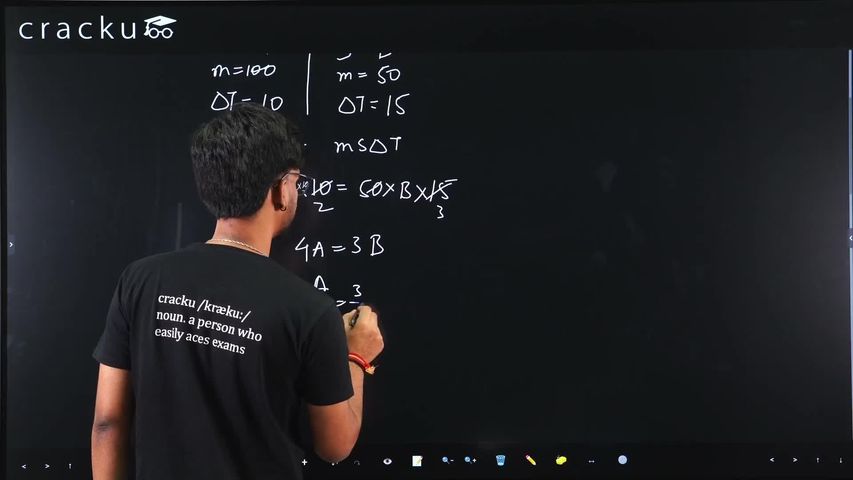
When 100 g of a liquid A at $$100°C$$ is added to 50 g of a liquid B at temperature $$75°C$$, the temperature of the mixture becomes $$90°C$$. The temperature of the mixture, if 100 g of liquid A at $$100°C$$ is added to 50 g of liquid B at $$50°C$$, will be:
Let us denote the specific heats of liquids A and B by $$c_A$$ and $$c_B$$ respectively (in $$\text{J g}^{-1}\,{}^{\circ}\text{C}^{-1}$$). We shall assume there is no heat loss to the surroundings, so the heat lost by the hotter liquid equals the heat gained by the colder liquid.
For any mixing process we shall use the principle of conservation of energy in the form
$$m_{\text{hot}}\,c_{\text{hot}}\,(T_{\text{hot}}-T_f)\;=\;m_{\text{cold}}\,c_{\text{cold}}\,(T_f-T_{\text{cold}}),$$
where the subscripts ‘hot’ and ‘cold’ refer to the initially warmer and cooler liquids, and $$T_f$$ is the final (equilibrium) temperature.
We first employ the given data of the first mixing:
Mass of A $$=100\text{ g},\;T_A=100^{\circ}\text{C},$$ Mass of B $$=50\text{ g},\;T_B=75^{\circ}\text{C},$$ Final temperature $$T_f=90^{\circ}\text{C}.$$
Applying the formula, the heat lost by A equals the heat gained by B:
$$100\,c_A\,(100-90)\;=\;50\,c_B\,(90-75).$$
Simplifying each side, we get
$$100\,c_A\,(10)\;=\;50\,c_B\,(15).$$
That is
$$1000\,c_A\;=\;750\,c_B.$$ Dividing by $$250$$ gives
$$4\,c_A\;=\;3\,c_B$$ or $$c_B=\frac{4}{3}\,c_A.$$
This relation between the specific heats will now be used for the second mixing.
In the second experiment we again take 100 g of A at $$100^{\circ}\text{C}$$, but the 50 g of B is now at $$50^{\circ}\text{C}$$. Let the new final temperature be $$T^{\prime}$$.
Using the conservation-of-energy equation once more:
$$100\,c_A\,(100-T^{\prime})\;=\;50\,c_B\,(T^{\prime}-50).$$
Substituting $$c_B=\dfrac{4}{3}\,c_A$$ obtained earlier:
$$100\,c_A\,(100-T^{\prime})\;=\;50\left(\frac{4}{3}c_A\right)(T^{\prime}-50).$$
The factor $$c_A$$ cancels from both sides, leaving
$$100\,(100-T^{\prime})\;=\;50\left(\frac{4}{3}\right)(T^{\prime}-50).$$
Compute the constant on the right:
$$50\left(\frac{4}{3}\right)=\frac{200}{3}.$$
Thus
$$100\,(100-T^{\prime})=\frac{200}{3}(T^{\prime}-50).$$
Eliminating the fraction by multiplying every term by 3:
$$300\,(100-T^{\prime})=200\,(T^{\prime}-50).$$
Expanding each side,
$$30000-300\,T^{\prime}=200\,T^{\prime}-10000.$$
Collecting the temperature terms on one side and the constants on the other:
$$-300\,T^{\prime}-200\,T^{\prime}=-10000-30000,$$ $$-500\,T^{\prime}=-40000.$$
Dividing by $$-500$$:
$$T^{\prime}=\frac{-40000}{-500}=80.$$
So the equilibrium temperature of the mixture in the second case is
$$80^{\circ}\text{C}.$$
Hence, the correct answer is Option C.
Was this solution helpful?
Click on the Email ☝️ to Watch the Video Solution
Create a FREE account and get:
_1.webp)

Educational materials for JEE preparation

Ask our AI anything

AI can make mistakes. Please verify important information.
AI can make mistakes. Please verify important information.


