
Join Our JEE Preparation Group
Prep with like-minded aspirants; Get access to free daily tests and study material.
Sign in
Please select an account to continue using cracku.in
↓ →
Join Our JEE Preparation Group
Prep with like-minded aspirants; Get access to free daily tests and study material.
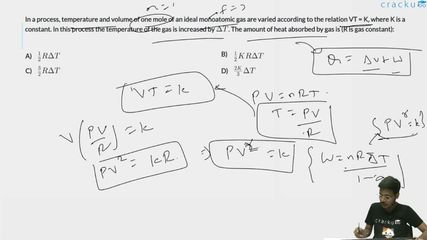
In a process, temperature and volume of one mole of an ideal monoatomic gas are varied according to the relation VT = K, where K is a constant. In this process the temperature of the gas is increased by $$\Delta T$$. The amount of heat absorbed by gas is (R is gas constant):
We have one mole of an ideal mono-atomic gas. Throughout the process the variables obey $$VT = K$$ where $$K$$ is a positive constant. Because the gas is ideal, the equation of state is also valid at every instant:
$$PV = RT \qquad\text{(for }n = 1\text{ mol).}$$
The temperature is raised by $$\Delta T,$$ so if we call the initial temperature $$T_i,$$ the final temperature is $$T_f = T_i + \Delta T.$$
First we express the volume in terms of temperature using the given relation:
$$VT = K \;\;\Longrightarrow\;\; V = \dfrac{K}{T}.$$
Next we write the pressure in terms of temperature alone. Substituting this $$V$$ into the ideal-gas equation gives
$$P = \dfrac{RT}{V} = \dfrac{RT}{K/T} = \dfrac{RT^{2}}{K}.$$
To find the work done by the gas we use the formula
$$W = \int_{V_i}^{V_f} P\,dV.$$
Because it is more convenient to integrate over temperature, we change variables. Differentiate the relation $$V = K/T$$:
$$dV = -\,\dfrac{K}{T^{2}}\;dT.$$
Now substitute both $$P$$ and $$dV$$ into the integral:
$$\displaystyle W = \int_{T_i}^{T_f} \Bigl(\dfrac{RT^{2}}{K}\Bigr)\,\Bigl(-\,\dfrac{K}{T^{2}}\;dT\Bigr) = \int_{T_i}^{T_f} \bigl(-R\bigr)\,dT = -R\,(T_f - T_i).$$
Since $$T_f - T_i = \Delta T,$$ the work done by the gas is
$$W = -\,R\Delta T.$$
The negative sign means the gas has been compressed (its volume decreased as temperature rose), so work is done on the gas; nevertheless, we keep the sign in further calculations exactly as obtained.
For a mono-atomic ideal gas the molar heat capacity at constant volume is
$$C_V = \dfrac{3}{2}R.$$
The change in internal energy is therefore, by the formula $$\Delta U = nC_V\Delta T,$$
$$\Delta U = (1)\Bigl(\dfrac{3}{2}R\Bigr)\Delta T = \dfrac{3}{2}R\Delta T.$$
Finally, we apply the first law of thermodynamics, $$Q = \Delta U + W.$$ Substituting the values just found gives
$$Q = \dfrac{3}{2}R\Delta T + \bigl(-R\Delta T\bigr) = \Bigl(\dfrac{3}{2} - 1\Bigr)R\Delta T = \dfrac{1}{2}R\Delta T.$$
This $$Q$$ is positive, so that amount of heat is indeed absorbed by the gas.
Hence, the correct answer is Option A.
Was this solution helpful?
Click on the Email ☝️ to Watch the Video Solution
Create a FREE account and get:
_1.webp)

Educational materials for JEE preparation

Ask our AI anything

AI can make mistakes. Please verify important information.
AI can make mistakes. Please verify important information.


