

 Group
Group
 Group
Group


 Preferred Source

 Google Discover

JEE Alternating Currents PYQs
JEE Alternating Currents PYQs are previous year questions that test alternating voltage and current, RMS values, reactance, impedance, phase difference, resonance, AC power, and transformers. Practising these questions helps you understand how resistors, inductors, and capacitors behave in an AC circuit and apply the correct principle to each problem.
JEE Alternating Currents questions can involve finding current in a series LCR circuit, calculating average power, or analysing how a change in frequency affects reactance. A useful starting point is to identify the circuit elements, check whether the given values are peak or RMS values, and note the supply frequency.
For phase relationships, remember that current and voltage are in phase in a pure resistor. In an ideal inductor, current lags voltage by 90°, while in an ideal capacitor, current leads voltage by 90°. Understanding these relationships makes circuit analysis easier than memorising results alone.
This page brings together a downloadable PYQ PDF, a formula reference, and common mistakes to avoid. You can also practise JEE Alternating Currents questions to check your understanding before moving to mixed-topic tests.
JEE Alternating Currents Important PYQs PDF
Download the Top 30 JEE Alternating Currents PYQ PDF for chapter-wise practice. Attempt the questions independently before checking the answers or solutions. For each problem, identify the relevant concept, write down the given quantities, and choose a formula that matches the circuit conditions.
While solving JEE Mains previous papers, pay attention to questions involving frequency changes, resonance, RMS values, and power factor. Review your mistakes to understand whether you selected the wrong formula, missed a phase relationship, or made a calculation error. Reattempting these questions can help you strengthen specific weak areas.
Important Formulas for JEE Alternating Currents PYQs
JEE Alternating Currents Formulas help you calculate RMS current and voltage, reactance, impedance, average power, and resonant frequency. Before substituting values, check the conditions under which the formula applies. For example, dividing the peak value by √2 gives the RMS value only for a sinusoidal waveform.
Use the following table as a quick reference alongside your JEE Study Material. The impedance and power factor expressions shown here apply to a series LCR circuit with ideal inductance and capacitance.
| Concept | Formula | Condition or Meaning |
|---|---|---|
| RMS Current | $$I_{\mathrm{rms}} = \frac{I_0}{\sqrt{2}}$$ | For sinusoidal current, where I₀ is the peak current. |
| RMS Voltage | $$V_{\mathrm{rms}} = \frac{V_0}{\sqrt{2}}$$ | For sinusoidal voltage, where V₀ is the peak voltage. |
| Angular Frequency | $$\omega = 2\pi f$$ | f is frequency in hertz; ω is angular frequency in radians per second. |
| Inductive Reactance | $$X_L = \omega L$$ | Increases with frequency for a fixed inductance. |
| Capacitive Reactance | $$X_C = \frac{1}{\omega C}$$ | Decreases with frequency for a fixed capacitance. |
| Impedance of a Series LCR Circuit | $$Z = \sqrt{R^2 + (X_L - X_C)^2}$$ | Accounts for resistance and net reactance. |
| RMS Current in an AC Circuit | $$I_{\mathrm{rms}} = \frac{V_{\mathrm{rms}}}{Z}$$ | Use the RMS supply voltage and circuit impedance. |
| Phase Angle in a Series LCR Circuit | $$\tan\phi = \frac{X_L - X_C}{R}$$ | φ is the phase of supply voltage relative to current. |
| Average Power | $$P_{\mathrm{avg}} = V_{\mathrm{rms}} I_{\mathrm{rms}} \cos\phi$$ | For sinusoidal voltage and current with phase difference φ. |
| Power Factor of a Series LCR Circuit | $$\cos\phi = \frac{R}{Z}$$ | Equals one at series resonance when R is non-zero. |
| Resonant Frequency | $$f_0 = \frac{1}{2\pi\sqrt{LC}}$$ | At resonance, inductive and capacitive reactances are equal. |
| Ideal Transformer Voltage Ratio | $$\frac{V_s}{V_p} = \frac{N_s}{N_p}$$ | The voltage ratio equals the secondary-to-primary turns ratio. |
| Ideal Transformer Current Ratio | $$\frac{I_s}{I_p} = \frac{N_p}{N_s}$$ | For an ideal transformer supplying a load, current changes inversely with the turns ratio. |
In these expressions, R is resistance, L is inductance, and C is capacitance. For transformers, the subscripts p and s refer to the primary and secondary coils, while N represents the number of turns. Use consistent units and distinguish RMS values from peak values throughout your calculation.
Top 5 Common Mistakes to Avoid in JEE Alternating Currents PYQs
Errors in Alternating Currents often come from mixing up values, phase relationships, or circuit conditions. Check these five points while solving questions:
1. Confusing RMS values with peak values
If the current is written as i = I₀ sin ωt, the coefficient I₀ represents peak current. For a sinusoidal waveform, convert it to RMS current before using the average power formula with RMS voltage. Do not combine a peak value with an RMS value in the same expression.
2. Interchanging inductive and capacitive reactance
Inductive reactance increases with frequency, while capacitive reactance decreases. Check whether your calculated result follows this relationship. In a series LCR circuit, use the difference between the reactances when calculating impedance.
3. Ignoring phase difference in power calculations
Average power depends on the power factor as well as RMS voltage and current. Using only their product gives apparent power. An ideal inductor or capacitor absorbs zero average power over a complete cycle, even though current flows through it.
4. Applying resonance results without checking the circuit
In a series LCR circuit with non-zero resistance, resonance occurs when inductive and capacitive reactances are equal. The impedance then equals R, the power factor is one, and current is maximum for a fixed supply voltage. The individual voltages across the inductor and capacitor can still be non-zero; they cancel in the phasor sum.
5. Making unit and frequency conversion errors
Convert inductance into henries and capacitance into farads before calculating reactance or resonant frequency. For example, millihenries and microfarads require different conversion factors. Also check whether a formula requires frequency f or angular frequency ω = 2πf.
After chapter-wise practice, attempt a JEE Mains Mock Test to assess your accuracy under time pressure. Review incorrect answers and slow attempts, then revise the relevant concept before solving similar questions again.
List of JEE Alternating Currents PYQs
Here is a short set of JEE-style Alternating Currents Questions for practice. These questions may include problems based on RMS values, reactance, impedance, resonance, transformers, phase difference, and average power.
Solving these JEE Questions regularly will help you understand the chapter better and improve your problem-solving speed. Try to solve each question on your own before checking the answer. You can also revise the Alternating Currents Formula Sheet after every practice session to strengthen your formula recall.
With consistent practice and clear concepts, Alternating Currents can become one of the more scoring chapters in JEE Physics.
Question 1
In a series LCR circuit, a resistor of 300Ω, a capacitor of 25 nF and an inductor of 100 mH are used. For maximum current in the circuit, the angular frequency of the ac source is _____$$\times 10^{4}\text{ radians }s^{-1}$$
correct answer:- 2
Question 2
An arc lamp requires a direct current of 10 A at 80 V to function. If it is connected to a 220 V (rms), 50 Hz AC supply, the series inductor needed for it to work is close to:
correct answer:- 2
Question 3
An oscillating LC circuit consists of a 75 mH inductor and a 1.2 $$\mu$$F capacitor. If the maximum charge to the capacitor is 2.7 $$\mu$$C. The maximum current in the circuit will be ______ mA.
correct answer:- 9
Question 4
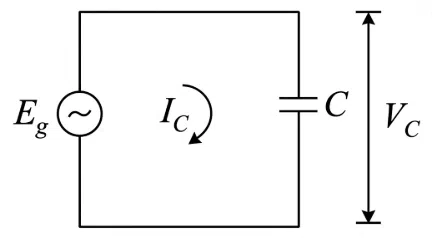
In a circuit consisting of a capacitance and a generator with alternating emf, $$E_g = E_{go}\sin\omega t$$, $$V_C$$ and $$I_C$$ are the voltage and current. Correct phasor diagram for such circuit is:
correct answer:- 3
Question 5
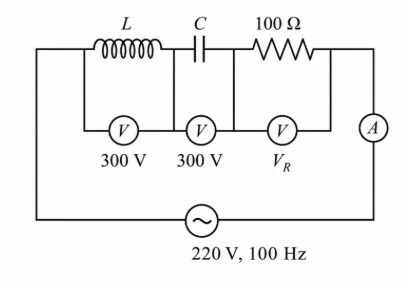
In an $$LCR$$ circuit shown in the following figure, what will be the readings of the voltmeter across the resistor and ammeter if an a.c. source of 220 V and 100 Hz is connected to it as shown?
correct answer:- 4

Question 6
For an RLC circuit driven with voltage of amplitude $$v_m$$ and frequency $$\omega_0 = \frac{1}{\sqrt{LC}}$$, the current exhibits resonance. The quality factor, Q is given by:
correct answer:- 2
Question 7
An alternating voltage source $$V = 260 \sin(628t)$$ is connected across a pure inductor of 5 mH. Inductive reactance in the circuit is:
correct answer:- 1
Question 8
A 750 Hz, 20 V(rms) source is connected to a resistance of 100 $$\Omega$$, an inductance of 0.1803 H and a capacitance of 10 $$\mu$$F all in series. The time in which the resistance (heat capacity 2 J/°C) will get heated by 10°C (assume no loss of heat to the surroundings) is close to:
correct answer:- 4
Question 9
A 100$$\Omega$$ resistance, a 0.1$$\mu$$F capacitor and an inductor are connected in series across a 250 V supply at variable frequency. Calculate the value of inductance of inductor at which resonance will occur. Given that the resonant frequency is 60 Hz.
correct answer:- 4
Question 10
A capacitor of capacitance $$C = 80 \mu\text{F}$$ is completely charged to a potential difference of $$V_0 = 20 \text{ V}$$. It is then connected across an ideal inductor of inductance $$L = 2 \text{ mH}$$ to form an LC circuit. The circuit undergoes undamped electromagnetic oscillations. Find the magnitude of the maximum current (in Amperes) flowing through the circuit.
correct answer:- 4

Question 11
A series LCR circuit with $$L = \frac{100}{\pi}$$ mH, $$C = \frac{10^{-3}}{\pi}$$ F and $$R = 10$$ $$\Omega$$, is connected across an AC source of 220 V, 50 Hz supply. The power factor of the circuit would be _____.
correct answer:- 1
Question 12
a
correct answer:- 1
Question 13
If wattless current flows in the AC circuit, then the circuit is :
correct answer:- 2
Question 14
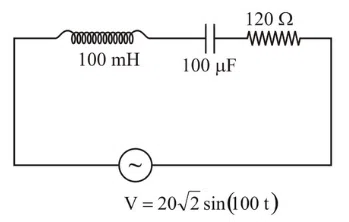
An AC source is connected to an inductance of $$100$$ mH, a capacitance of $$100$$ $$\mu$$F and a resistance of $$120$$ $$\Omega$$ as shown in figure. The time in which the resistance having a thermal capacity $$2$$ J °C$$^{-1}$$ will get heated by $$16°$$C is ______ s.
correct answer:- 15
Question 15
An inductor stores 16 J of magnetic field energy and dissipates 32 W of thermal energy due to its resistance when an a.c. current of 2 A (rms) and frequency 5O Hz nows through it. The ratio of inductive reactance to its resistance is_____.$$(\pi=3.14)$$
correct answer:- 314

Question 16
Given below are two statements :
Statement-I:
The reactance of an ac circuit is zero. It is possible that the circuit contains a capacitor and an inductor.
Statement-II:
In ac circuit, the average power delivered by the source never becomes zero.
In the light of the above statements, choose the correct answer from the options given below
correct answer:- 3
Question 17
A transmitting station releases waves of wavelength 960 m. A capacitor of 2.56 $$\mu$$F is used in the resonant circuit. The self-inductance of coil necessary for resonance is $$x \times 10^{-8}$$ H. Find $$x$$.
correct answer:- 10
Question 18
In a series LCR circuit, an inductor of inductance $$L = 10 \,\, \text{mH}$$, a capacitor of capacitance $$C = 10 \,\, \mu\text{F}$$, and a resistor of resistance $$R = 10 \,\, \Omega$$ are connected to an AC source of voltage $$V = 220 \,\, \text{V}$$. At resonance, the power dissipated in the circuit is $$P \times 10^2 \,\, \text{W}$$. The integer value of $$P$$ is:
correct answer:- 48
Question 19
A LCR circuit behaves like a clamped harmonic oscillator. Comparing it with a physical spring-mass damped oscillator having damping constant 'b', the correct equivalence would be:
correct answer:- 4
Question 20
A capacitor of capacitance $$100 \mu F$$ is charged to a potential of $$12$$ V and connected to a $$6.4$$ mH inductor to produce oscillations. The maximum current in the circuit would be :
correct answer:- 2

Question 21
A 0.07 H inductor and a 12 $$\Omega$$ resistor are connected in series to a 220 V, 50 Hz AC source. The approximate current in the circuit and the phase angle between current and source voltage are respectively. [Take $$\pi$$ as $$\frac{22}{7}$$]
correct answer:- 1
Question 22
A transformer operating at primary voltage 8 kV and secondary voltage 160 V serves a load of 80 kW. Assuming the transformer to be ideal with purely resistive load and working on unity power factor, the loads in the primary and secondary circuit would be
correct answer:- 3
Question 23
A sinusoidal voltage $$V(t) = 210\sin 3000t$$ volt is applied to a series LCR circuit in which $$L = 10$$ mH, $$C = 25$$ $$\mu$$F and $$R = 100\Omega$$. The phase difference $$\Phi$$ between the applied voltage and resultant current will be
correct answer:- 1
Question 24
A series LCR circuit has $$L = 0.01$$ H, $$R = 10 \ \Omega$$ and $$C = 1 \ \mu F$$ and it is connected to ac voltage of amplitude $$(V_m)$$ 50 V. At frequency 60% lower than resonant frequency, the amplitude of current will be approximately
correct answer:- 3
Question 25
To light, a $$50 \text{ W}$$, $$100 \text{ V}$$ lamp is connected, in series with a capacitor of capacitance $$\dfrac{50}{\pi\sqrt{x}} \mu F$$, with $$200 \text{ V}$$, $$50 \text{ Hz}$$ AC source. The value of $$x$$ will be ______.
correct answer:- 3

Question 26
Given below are two statements:
Statement I:
Maximum power is dissipated in a circuit containing an inductor, a capacitor and a resistor connected in series with an AC source, when resonance occurs.
Statement II:
Maximum power is dissipated in a circuit containing pure resistor due to zero phase difference between current and voltage.
In the light of the above statements, choose the correct answer from the options given below:
correct answer:- 2
Question 27
A series LCR circuit is subjected to an ac signal of $$200$$ V, $$50$$ Hz. If the voltage across the inductor $$(L = 10 \text{ mH})$$ is $$31.4$$ V, then the current in this circuit is :
correct answer:- 3
Question 28
An inductor of inductance $$2$$ $$\mu$$H is connected in series with a resistance, a variable capacitor and an AC source of frequency $$7$$ kHz. The value of capacitance for which maximum current is drawn into the circuit is $$\frac{1}{x}$$ F, where the value of $$x$$ is ______. (Take $$\pi = \frac{22}{7}$$)
correct answer:- 3872
Question 29
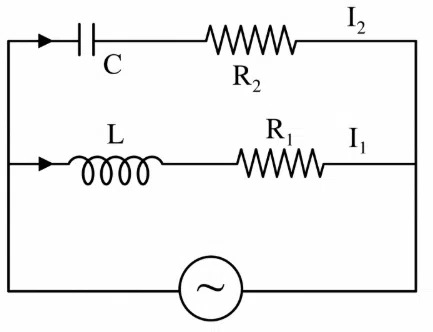
In the above circuit, $$C = \frac{\sqrt{3}}{2}\mu F$$, $$R_2 = 20 \Omega$$, $$L = \frac{\sqrt{3}}{10} H$$ and $$R_1 = 10 \Omega$$. Current in $$L$$-$$R_1$$ path is $$I_1$$ and in C-$$R_2$$ path it is $$I_2$$. The voltage of AC source is given by, $$V = 200\sqrt{2} \sin(100t)$$ volts. The phase difference between $$I_1$$ and $$I_2$$ is:
correct answer:- 4
Question 30
A series LCR circuit is designed to resonate at an angular frequency $$\omega_0 = 10^5$$ rad s$$^{-1}$$. The circuit draws 16 W power from 120 V source at resonance. The value of resistance $$R$$ in the circuit is ______ $$\Omega$$.
correct answer:- 900
.webp)