
Join Our JEE Preparation Group
Prep with like-minded aspirants; Get access to free daily tests and study material.
Sign in
Please select an account to continue using cracku.in
↓ →
Join Our JEE Preparation Group
Prep with like-minded aspirants; Get access to free daily tests and study material.
A 0.07 H inductor and a 12 $$\Omega$$ resistor are connected in series to a 220 V, 50 Hz AC source. The approximate current in the circuit and the phase angle between current and source voltage are respectively. [Take $$\pi$$ as $$\frac{22}{7}$$]
We have a series circuit containing an inductor of inductance $$L = 0.07\;\text{H}$$ and a resistor of resistance $$R = 12\;\Omega$$ connected to an AC source of root-mean-square (r.m.s.) voltage $$V = 220\;\text{V}$$ and frequency $$f = 50\;\text{Hz}$$.
First we need the inductive reactance. The formula for inductive reactance is stated as
$$X_L = \omega L$$
where $$\omega$$ is the angular frequency given by $$\omega = 2\pi f$$. Substituting the given frequency and taking $$\pi = \dfrac{22}{7}$$, we get
$$\omega = 2\pi f = 2 \times \dfrac{22}{7} \times 50 = \dfrac{44}{7} \times 50 = \dfrac{44 \times 50}{7} = \dfrac{2200}{7}\;\text{rad s}^{-1}.$$
Now substituting this value of $$\omega$$ and the given value of $$L$$ in the formula $$X_L = \omega L$$, we have
$$X_L = \left(\dfrac{2200}{7}\right) \times 0.07 = \dfrac{2200 \times 0.07}{7}.$$ Recognising that $$0.07 = \dfrac{7}{100}$$, we can write
$$X_L = \dfrac{2200}{7} \times \dfrac{7}{100} = \dfrac{2200}{100} = 22\;\Omega.$$
So, the inductive reactance is $$X_L = 22\;\Omega$$.
Next, the total impedance $$Z$$ of a series $$R\!-\!L$$ circuit is given by the relation
$$Z = \sqrt{R^2 + X_L^2}.$$
Substituting $$R = 12\;\Omega$$ and $$X_L = 22\;\Omega$$, we get
$$Z = \sqrt{(12)^2 + (22)^2} = \sqrt{144 + 484} = \sqrt{628}.$$
Evaluating the square root,
$$\sqrt{628} \approx 25.06\;\Omega.$$ For practical purposes this may be rounded to $$25.1\;\Omega$$.
The r.m.s. current $$I$$ in the circuit is obtained from Ohm’s law for AC circuits,
$$I = \dfrac{V}{Z}.$$
Substituting the numerical values,
$$I = \dfrac{220\;\text{V}}{25.06\;\Omega} \approx 8.78\;\text{A}.$$
Rounded to two significant figures, the current is $$I \approx 8.8\;\text{A}.$$
Finally, to find the phase angle $$\phi$$ between the current and the source voltage, we use the relation for a series $$R\!-\!L$$ circuit,
$$\tan\phi = \dfrac{X_L}{R}.$$
Substituting $$X_L = 22\;\Omega$$ and $$R = 12\;\Omega$$, we have
$$\tan\phi = \dfrac{22}{12} = \dfrac{11}{6}.$$
Therefore,
$$\phi = \tan^{-1}\!\left(\dfrac{11}{6}\right).$$
Because the circuit contains an inductor, the current lags the voltage by this angle.
Combining the two results, we conclude that the approximate current in the circuit is $$8.8\;\text{A}$$ and the phase angle between the current and the source voltage is $$\tan^{-1}\!\left(\dfrac{11}{6}\right).$$
Hence, the correct answer is Option A.
Was this solution helpful?
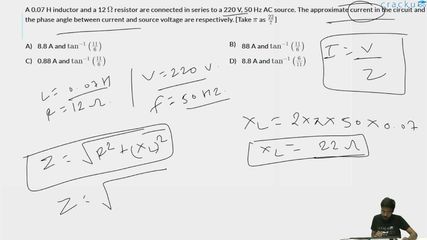
Click on the Email ☝️ to Watch the Video Solution
Create a FREE account and get:
_1.webp)

Educational materials for JEE preparation

Ask our AI anything

AI can make mistakes. Please verify important information.
AI can make mistakes. Please verify important information.
