For the following questions answer them individually
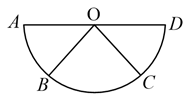
Assertion $$A$$ : If $$A, B, C, D$$ are four points on a semi-circular arc with a centre at $$O$$ such that $$\left|\overrightarrow{AB}\right| = \left|\overrightarrow{BC}\right| = \left|\overrightarrow{CD}\right|$$. Then, $$\overrightarrow{AB} + \overrightarrow{AC} + \overrightarrow{AD} = 4\overrightarrow{AO} + \overrightarrow{OB} + \overrightarrow{OC}$$
Reason $$R$$ : Polygon law of vector addition yields $$\overrightarrow{AB} + \overrightarrow{BC} + \overrightarrow{CD} = \overrightarrow{AD} = 2\overrightarrow{AO}$$
In the light of the above statements, choose the most appropriate answer from the options given below.
A ball is thrown up with a certain velocity so that it reaches a height $$h$$. Find the ratio of the two different times of the ball reaching $$\frac{h}{3}$$ in both the directions.
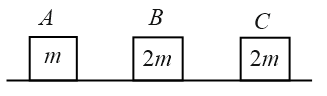
Three objects $$A$$, $$B$$ and $$C$$ are kept in a straight line on a frictionless horizontal surface. The masses of $$A$$, $$B$$ and $$C$$ are $$m$$, $$2m$$ and $$2m$$ respectively. $$A$$ moves towards $$B$$ with a speed of 9 m s$$^{-1}$$ and makes an elastic collision with it. Thereafter $$B$$ makes a completely inelastic collision with $$C$$. All motions occur along the same straight line. The final speed of $$C$$ is:
List-IÂ Â Â Â Â Â Â Â Â Â Â Â Â Â Â Â Â Â Â Â Â Â Â Â Â Â Â Â Â Â Â Â Â Â Â Â Â Â Â Â Â Â Â Â Â Â Â Â Â Â Â Â Â Â Â Â Â Â Â Â Â Â Â Â Â Â Â Â Â Â Â Â Â Â Â Â Â Â Â Â Â Â Â Â List-II
(a) MI of the rod (length $$L$$, Mass $$M$$, about an axis $$\perp$$ to the rod passing through the midpoint)Â Â Â Â Â Â (i) $$\frac{8ML^2}{3}$$
(b) MI of the rod (length $$L$$, Mass 2M, about an axis $$\perp$$ to the rod passing through one of its end)Â Â Â Â Â (ii) $$\frac{ML^2}{3}$$
(c) MI of the rod (length 2L, Mass $$M$$, about an axis $$\perp$$ to the rod passing through its midpoint)Â Â Â Â Â Â (iii) $$\frac{ML^2}{12}$$
(d) MI of the rod (Length 2L, Mass 2M, about an axis $$\perp$$ to the rod passing through one of its end)Â Â Â Â (iv) $$\frac{2ML^2}{3}$$
Choose the correct answer from the options given below:
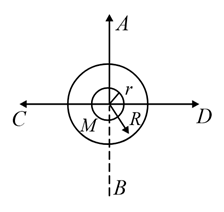
The figure shows two solid discs with radius $$R$$ and $$r$$ respectively. If mass per unit area is the same for both, what is the ratio of MI of bigger disc around axis $$AB$$ (Which is $$\perp$$ to the plane of the disc and passing through its centre) of MI of smaller disc around one of its diameters lying on its plane? Given $$M$$ is the mass of the larger disc.
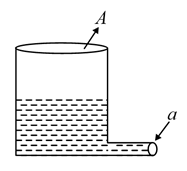
A light cylindrical vessel is kept on a horizontal surface. Area of the base is $$A$$. A hole of cross-sectional area $$a$$ is made just at its bottom side. The minimum coefficient of friction necessary to prevent sliding the vessel due to the impact force of the emerging liquid is
A body takes 4 min to cool from 61°C to 59°C. If the temperature of the surroundings is 30°C, the time taken by the body to cool from 51°C to 49°C is:
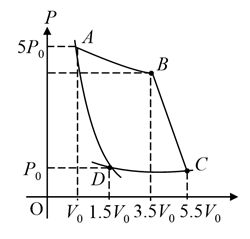
In the reported figure, there is a cyclic process $$ABCDA$$ on a sample of 1 mol of a diatomic gas. The temperature of the gas during the process $$A \rightarrow B$$ and $$C \rightarrow D$$ are $$T_1$$ and $$T_2$$ ($$T_1 > T_2$$) respectively.
Choose the correct option out of the following for work done if processes $$BC$$ and $$DA$$ are adiabatic.
The number of molecules in one litre of an ideal gas at 300 K and 2 atmospheric pressure with mean kinetic energy $$2 \times 10^{-9}$$ J per molecule is:
A particle starts executing simple harmonic motion (SHM) of amplitude $$a$$ and total energy $$E$$. At any instant, its kinetic energy is $$\frac{3E}{4}$$, then its displacement $$y$$ is given by: