
Join Our JEE Preparation Group
Prep with like-minded aspirants; Get access to free daily tests and study material.
Sign in
Please select an account to continue using cracku.in
↓ →
Join Our JEE Preparation Group
Prep with like-minded aspirants; Get access to free daily tests and study material.
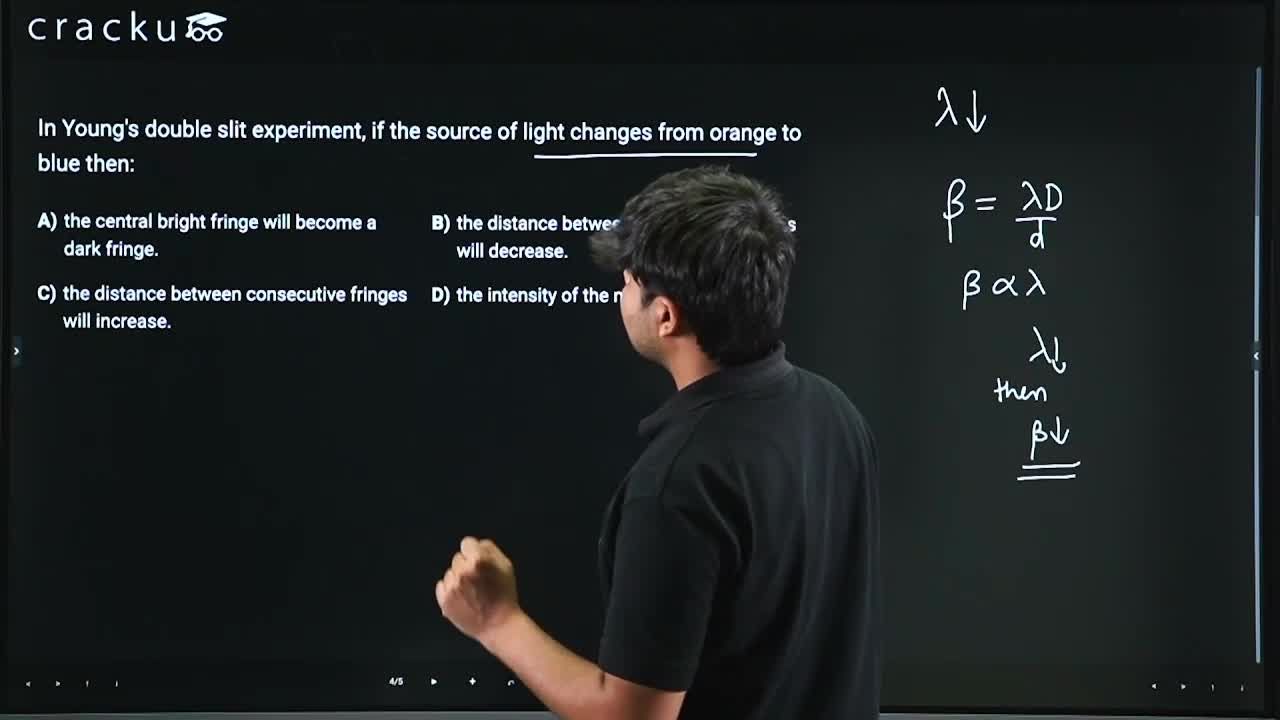
In Young's double slit experiment, if the source of light changes from orange to blue then:
We begin with the well-known formula for the Young’s double slit experiment that gives the linear separation between two consecutive bright (or dark) fringes on the screen, usually called the fringe width. The formula is stated as
$$\beta \;=\;\dfrac{\lambda\,D}{d}$$
where
$$\lambda$$ is the wavelength of the monochromatic light used,
$$D$$ is the distance between the double-slit plane and the screen, and
$$d$$ is the separation between the two slits.
In the present question, the experimental arrangement is not altered; that means $$D$$ and $$d$$ stay exactly the same when we switch the colour of light. Therefore, the only quantity in the expression for $$\beta$$ that is going to change is the wavelength $$\lambda$$.
Now, orange light has a wavelength toward the longer-wavelength part of the visible spectrum, typically about $$\lambda_\text{orange}\approx 600\text{ nm}$$, while blue light lies toward the shorter-wavelength side, roughly $$\lambda_\text{blue}\approx 450\text{ nm}$$. Hence we have a clear inequality
$$\lambda_\text{blue}\;<\;\lambda_\text{orange}$$
Substituting each wavelength separately into the fringe-width formula gives
$$\beta_\text{orange}\;=\;\dfrac{\lambda_\text{orange}\,D}{d}$$
and
$$\beta_\text{blue}\;=\;\dfrac{\lambda_\text{blue}\,D}{d}.$$
Because the constants $$D$$ and $$d$$ are identical in both cases, we can compare the two fringe widths simply by comparing the two numerators, i.e. the wavelengths. Since $$\lambda_\text{blue}$$ is smaller than $$\lambda_\text{orange}$$, we get
$$\beta_\text{blue}\;<\;\beta_\text{orange}.$$
Thus, when the source of light is changed from orange (longer wavelength) to blue (shorter wavelength), the value of $$\beta$$ decreases. A smaller $$\beta$$ means that the linear distance between two successive fringes on the screen shrinks. In plain words, the fringes crowd closer together.
No other qualitative change among the listed options—such as the central bright fringe turning dark or an increase in the intensity of minima—follows directly from the basic theory when only the wavelength is altered. The uniquely correct consequence is the decrease in fringe spacing.
Hence, the correct answer is Option B.
Was this solution helpful?
Click on the Email ☝️ to Watch the Video Solution
Create a FREE account and get:
_1.webp)

Educational materials for JEE preparation

Ask our AI anything

AI can make mistakes. Please verify important information.
AI can make mistakes. Please verify important information.
