
Join Our JEE Preparation Group
Prep with like-minded aspirants; Get access to free daily tests and study material.
Sign in
Please select an account to continue using cracku.in
↓ →
Join Our JEE Preparation Group
Prep with like-minded aspirants; Get access to free daily tests and study material.
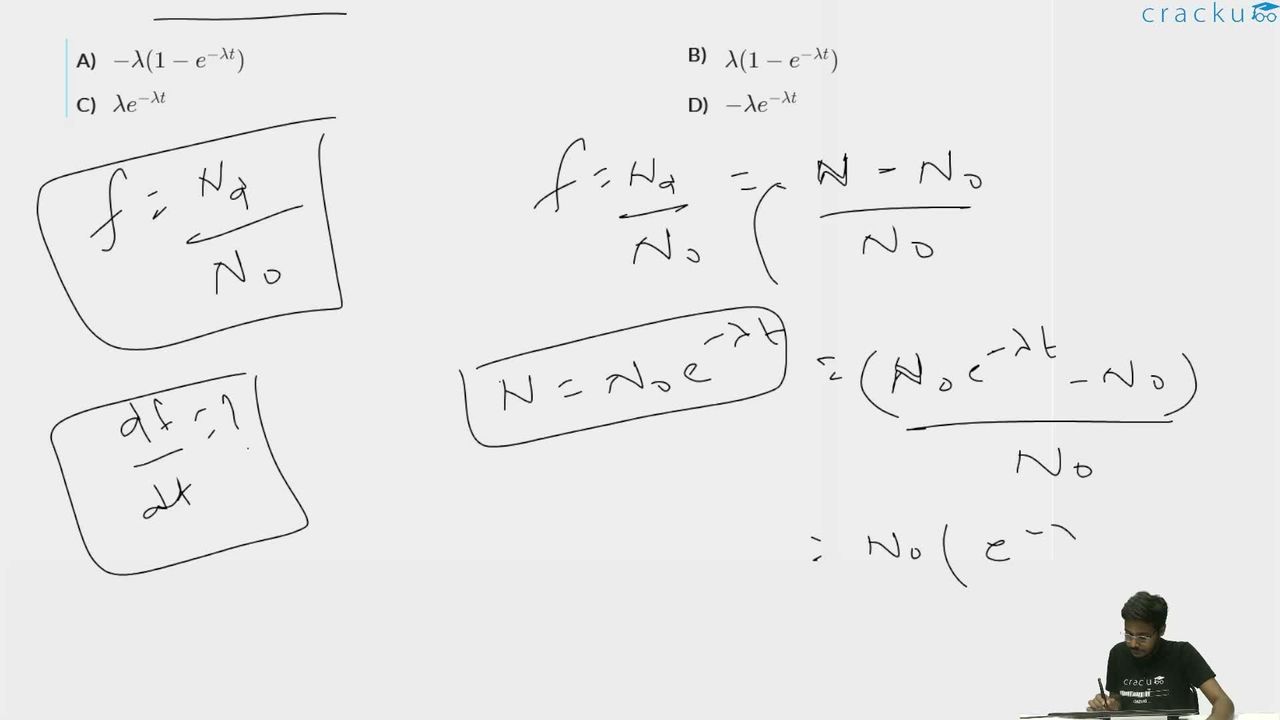
If $$f$$ denotes the ratio of the number of nuclei decayed $$(N_d)$$ to the number of nuclei at $$t = 0$$, $$(N_0)$$ then for a collection of radioactive nuclei, the rate of change of $$f$$ with respect to time is given as: [$$\lambda$$ is the radioactive decay constant]
We begin with the radioactive-decay law, which states that the number of undecayed nuclei at any time $$t$$ is
$$N = N_0 e^{-\lambda t},$$
where $$N_0$$ is the initial number of nuclei and $$\lambda$$ is the decay constant.
The problem introduces the quantity $$f$$ as the ratio of the number of nuclei that have already decayed, $$N_d$$, to the initial number, $$N_0$$. By definition,
$$f = \dfrac{N_d}{N_0}.$$
Now, the number of nuclei that have decayed by time $$t$$ is simply the difference between the original amount and what remains undecayed:
$$N_d = N_0 - N.$$
Substituting the exponential form of $$N$$ from the decay law, we have
$$N_d = N_0 - N_0 e^{-\lambda t} = N_0\bigl(1 - e^{-\lambda t}\bigr).$$
Dividing by $$N_0$$ to obtain $$f$$, we get
$$f \;=\; \dfrac{N_d}{N_0} \;=\; 1 - e^{-\lambda t}.$$
To find the rate of change of $$f$$ with respect to time, we differentiate this expression term by term. The constant “1” has zero derivative, while the derivative of the exponential term follows directly from the standard rule $$\dfrac{d}{dt}\bigl(e^{at}\bigr)=a\,e^{at}$$:
$$\frac{df}{dt} = \frac{d}{dt}\!\left(1 - e^{-\lambda t}\right) = 0 - \bigl(-\lambda e^{-\lambda t}\bigr).$$
Simplifying the double negative yields
$$\frac{df}{dt} = \lambda e^{-\lambda t}.$$
This matches Option C in the list.
Hence, the correct answer is Option C.
Was this solution helpful?
Click on the Email ☝️ to Watch the Video Solution
Create a FREE account and get:
_1.webp)

Educational materials for JEE preparation

Ask our AI anything

AI can make mistakes. Please verify important information.
AI can make mistakes. Please verify important information.
