
Join Our JEE Preparation Group
Prep with like-minded aspirants; Get access to free daily tests and study material.
Sign in
Please select an account to continue using cracku.in
↓ →
Join Our JEE Preparation Group
Prep with like-minded aspirants; Get access to free daily tests and study material.
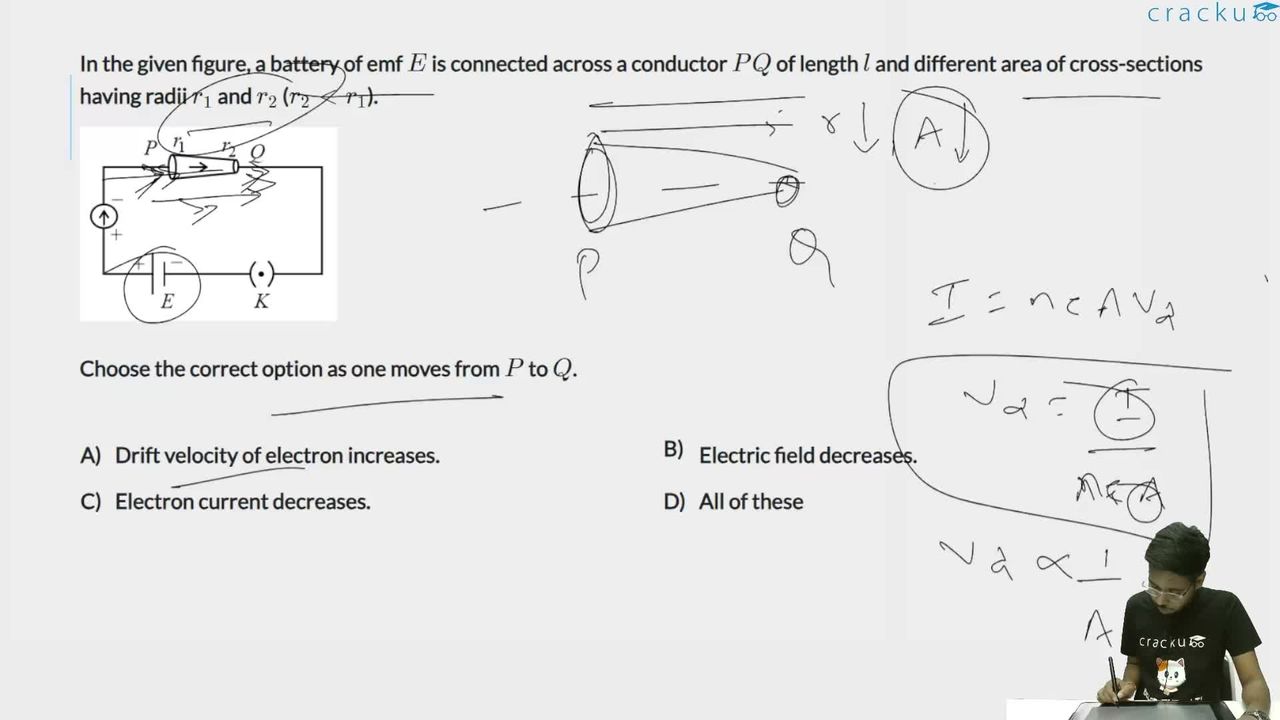
In the given figure, a battery of emf $$E$$ is connected across a conductor $$PQ$$ of length $$l$$ and different area of cross-sections having radii $$r_1$$ and $$r_2$$ ($$r_2 < r_1$$).
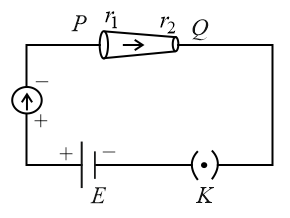
Choose the correct option as one moves from $$P$$ to $$Q$$.
We need to determine how physical properties like drift velocity, electric field, and electron current change as we move from point $$P$$ to point $$Q$$ along a non-uniform conductor.
From the problem details :
$$\text{Current } I = \text{constant}$$
Therefore, the statement "Electron current decreases" is incorrect.$$I = n e A v_d \implies v_d = \frac{I}{n e A}$$
Where $$n$$ is the free electron density and $$e$$ is the elementary charge (both constant for a given material). Since current $$I$$ is constant and the area $$A$$ decreases as we approach $$Q$$, the drift velocity must increase:$$v_d \propto \frac{1}{A}$$
$$E = \frac{I}{\sigma A} \implies E \propto \frac{1}{A}$$
As area $$A$$ decreases from $$P$$ to $$Q$$, the electric field strength must increase. Therefore, the statement "Electric field decreases" is incorrect.As one moves from $$P$$ to $$Q$$, the narrowing area causes the drift velocity of the electrons to increase.
Was this solution helpful?
Click on the Email ☝️ to Watch the Video Solution
Create a FREE account and get:
_1.webp)

Educational materials for JEE preparation

Ask our AI anything

AI can make mistakes. Please verify important information.
AI can make mistakes. Please verify important information.
