
Join Our JEE Preparation Group
Prep with like-minded aspirants; Get access to free daily tests and study material.
Sign in
Please select an account to continue using cracku.in
↓ →
Join Our JEE Preparation Group
Prep with like-minded aspirants; Get access to free daily tests and study material.
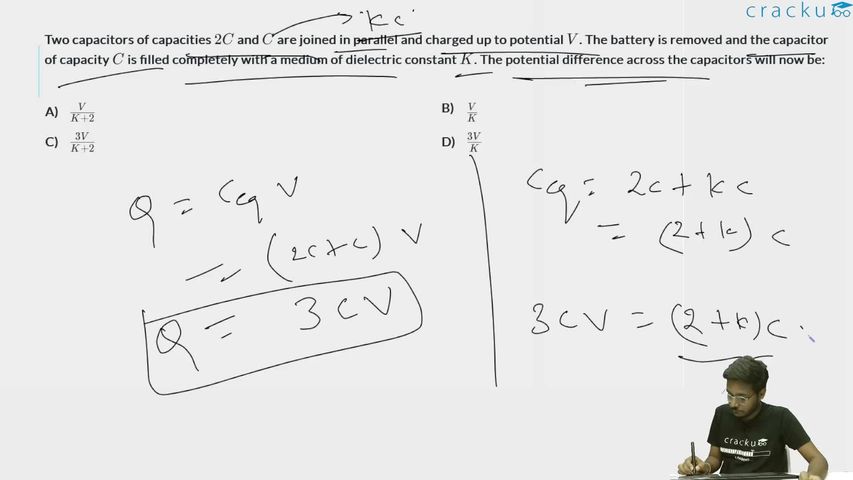
Two capacitors of capacities $$2C$$ and $$C$$ are joined in parallel and charged up to potential $$V$$. The battery is removed and the capacitor of capacity $$C$$ is filled completely with a medium of dielectric constant $$K$$. The potential difference across the capacitors will now be:
Initially, the two capacitors are joined in parallel and connected to a battery of potential difference $$V$$. For any capacitor we recall the basic formula
$$Q = C\,V,$$
where $$Q$$ is the charge stored, $$C$$ is the capacitance and $$V$$ is the potential across the plates.
Because the capacitors are in parallel, the same potential $$V$$ appears across each of them while the battery is connected. Hence, using the above formula, we find the individual charges:
For the $$2C$$ capacitor, the charge is
$$Q_1 = (2C)\,V = 2CV.$$
For the $$C$$ capacitor, the charge is
$$Q_2 = C\,V = CV.$$
Adding these two charges gives the total charge present on the combination just before the battery is detached:
$$Q_{\text{total}} = Q_1 + Q_2 = 2CV + CV = 3CV.$$
After the battery is removed, the wires still connect the two capacitors, so they must continue to share a common potential. At this stage the capacitor of initial capacitance $$C$$ is completely filled with a dielectric of constant $$K$$. The formula for a parallel-plate capacitor with a dielectric tells us that its new capacitance becomes
$$C_{\text{new}} = K\,C.$$
The other capacitor keeps its original value $$2C$$. Let the common potential difference after equilibrium be $$V_f$$. Using $$Q = C\,V$$ once more, we write the new charges:
On the $$2C$$ capacitor the charge is
$$Q_1' = (2C)\,V_f = 2C\,V_f.$$
On the capacitor now of value $$KC$$ the charge is
$$Q_2' = (KC)\,V_f = KC\,V_f.$$
No charge has any external path to escape because the entire system is isolated, so the total charge after inserting the dielectric must equal the total charge that was present before. Therefore we impose charge conservation:
$$Q_1' + Q_2' = Q_{\text{total}}.$$
Substituting the expressions gives
$$2C\,V_f + KC\,V_f = 3CV.$$
We now take $$C$$ common on the left-hand side:
$$C\,(2 + K)\,V_f = 3C\,V.$$
Dividing both sides by $$C(2 + K)$$ yields the final potential difference:
$$V_f = \frac{3V}{K + 2}.$$
Thus, after the dielectric is inserted, the potential across both capacitors becomes $$\displaystyle\frac{3V}{K+2}$$.
Hence, the correct answer is Option C.
Was this solution helpful?
Click on the Email ☝️ to Watch the Video Solution
Create a FREE account and get:
_1.webp)

Educational materials for JEE preparation

Ask our AI anything

AI can make mistakes. Please verify important information.
AI can make mistakes. Please verify important information.
