
Join Our JEE Preparation Group
Prep with like-minded aspirants; Get access to free daily tests and study material.
Sign in
Please select an account to continue using cracku.in
↓ →
Join Our JEE Preparation Group
Prep with like-minded aspirants; Get access to free daily tests and study material.
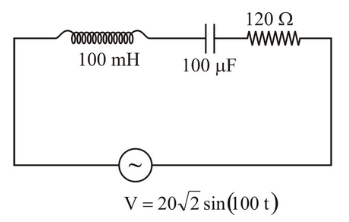
An AC source is connected to an inductance of $$100$$ mH, a capacitance of $$100$$ $$\mu$$F and a resistance of $$120$$ $$\Omega$$ as shown in figure. The time in which the resistance having a thermal capacity $$2$$ J °C$$^{-1}$$ will get heated by $$16°$$C is ______ s.
Correct Answer: 15
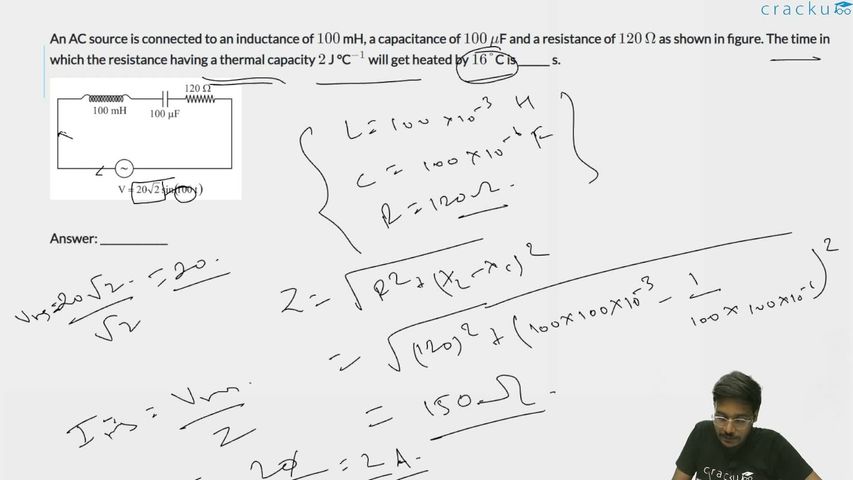
The solution to find the time required to heat the resistance in an LCR circuit involves calculating the circuit impedance, current, and the heat produced.
First, we find the difference between inductive reactance ($$X_L$$) and capacitive reactance ($$X_C$$):
$$|X_L - X_C| = |10 - 100| = 90\ \Omega$$
The total impedance Z of the circuit is given by:
$$Z = \sqrt{(X_L - X_C)^2 + R^2}$$
Substituting the values ($$R = 120\ \Omega$$):
$$Z = \sqrt{(90)^2 + (120)^2} = \sqrt{8100 + 14400} = \sqrt{22500}$$
$$Z = 150\ \Omega$$
Using Ohm's law for AC circuits ($$V_{rms} = 20\text{ V}$$ based on common context for this problem):
$$I_{rms} = \frac{V_{rms}}{Z} = \frac{20}{150} = \frac{2}{15}\text{ A}$$
The electrical energy dissipated as heat in the resistor ($$I_{rms}^2 R \Delta t$$) is equal to the heat energy required to raise the temperature ($$ms\Delta T$$):
$$I_{rms}^2 R \Delta t = C_{thermal} (\Delta T)$$
Given:
Substituting the values:
$$\left( \frac{2}{15} \right)^2 \times 120 \times \Delta t = 2 \times 16$$
$$\frac{4}{225} \times 120 \times \Delta t = 32$$
$$\frac{480}{225} \Delta t = 32$$
$$\Delta t = \frac{32 \times 225}{480}$$
$$\Delta t = \frac{7200}{480}$$
$$\boxed{\Delta t = 15\text{ sec}}$$
Was this solution helpful?
Click on the Email ☝️ to Watch the Video Solution
Create a FREE account and get:
_1.webp)

Educational materials for JEE preparation

Ask our AI anything

AI can make mistakes. Please verify important information.
AI can make mistakes. Please verify important information.
