
Join Our JEE Preparation Group
Prep with like-minded aspirants; Get access to free daily tests and study material.
Sign in
Please select an account to continue using cracku.in
↓ →
Join Our JEE Preparation Group
Prep with like-minded aspirants; Get access to free daily tests and study material.
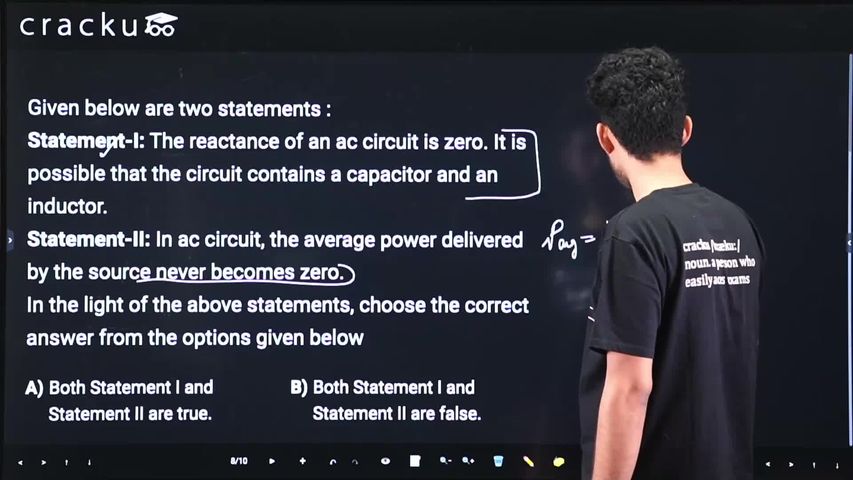
Given below are two statements :
Statement-I: The reactance of an ac circuit is zero. It is possible that the circuit contains a capacitor and an inductor.
Statement-II: In ac circuit, the average power delivered by the source never becomes zero.
In the light of the above statements, choose the correct answer from the options given below
We need to analyze both statements about AC circuits.
Statement I: The reactance of an AC circuit is zero. It is possible that the circuit contains a capacitor and an inductor. The net reactance of an AC circuit containing both an inductor and a capacitor is given by:
$$X_{net} = X_L - X_C = \omega L - \frac{1}{\omega C}$$
At resonance, when $$\omega = \frac{1}{\sqrt{LC}}$$, we get:
$$X_L = X_C \implies X_{net} = 0$$
Thus, it is indeed possible for the net reactance to be zero even when the circuit contains both a capacitor and an inductor. Therefore, Statement I is TRUE.
Statement II: In an AC circuit, the average power delivered by the source never becomes zero. The average power delivered in an AC circuit is given by:
$$P_{avg} = V_{rms} \cdot I_{rms} \cdot \cos\phi$$
where $$\cos\phi$$ is the power factor. For a purely inductive or purely capacitive circuit, the phase difference $$\phi = 90°$$, so:
$$\cos\phi = \cos 90° = 0$$
$$P_{avg} = V_{rms} \cdot I_{rms} \cdot 0 = 0$$
Hence, the average power can become zero. Thus, Statement II is FALSE.
From the above, since Statement I is true and Statement II is false, the correct option is Option C.
Was this solution helpful?
Click on the Email ☝️ to Watch the Video Solution
Create a FREE account and get:
_1.webp)

Educational materials for JEE preparation

Ask our AI anything

AI can make mistakes. Please verify important information.
AI can make mistakes. Please verify important information.
