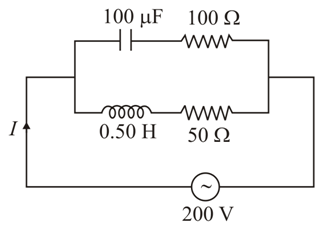
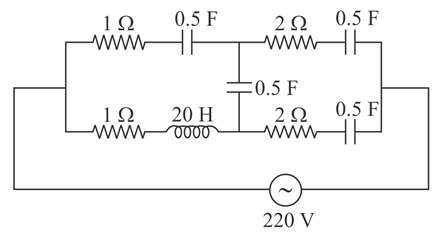
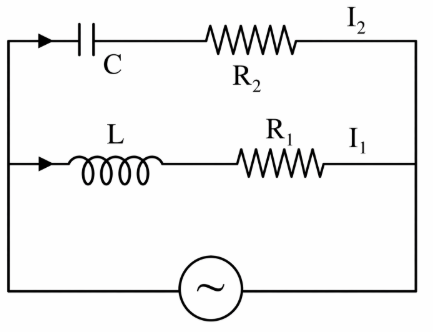
The electric current in the circuit is given as $$i=i_{\circ}(t/T)$$. The r.m.s cm1:ent for the period t = 0 to t = T is______.
JEE Alternating Currents Questions
We need to find the RMS current for $$i = i_0(t/T)$$ from t = 0 to t = T.
Formula for RMS current:
$$i_{rms} = \sqrt{\frac{1}{T}\int_0^T i^2 dt}$$
$$= \sqrt{\frac{1}{T}\int_0^T i_0^2 \frac{t^2}{T^2} dt} = \sqrt{\frac{i_0^2}{T^3}\int_0^T t^2 dt}$$
$$= \sqrt{\frac{i_0^2}{T^3} \cdot \frac{T^3}{3}} = \sqrt{\frac{i_0^2}{3}} = \frac{i_0}{\sqrt{3}}$$
Therefore, the RMS current is Option 2: $$\frac{i_0}{\sqrt{3}}$$.
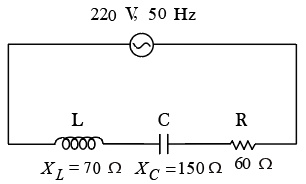
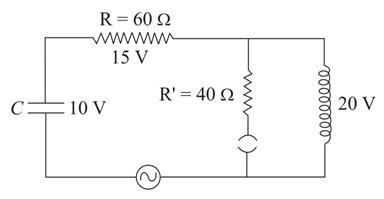
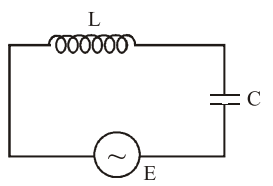
For the series LCR circuit connected with 220 V, 50 Hz a.c source as shown in the figure, the power factor is $$\frac{\alpha}{10}$$. The value of $$\alpha$$ is______.
$$ R = 60 \, \Omega, \quad X_L = 70 \, \Omega, \quad X_C = 150 \, \Omega $$
$$ Z = \sqrt{R^2 + (X_L - X_C)^2} $$
$$ Z = \sqrt{60^2 + (70 - 150)^2} $$
$$ Z = \sqrt{3600 + 6400} = \sqrt{10000} = 100 \, \Omega $$
power factor ($$\cos \phi$$)
$$ \cos \phi = \frac{R}{Z} $$
$$ \cos \phi = \frac{60}{100} = \frac{6}{10} $$
$$ \frac{\alpha}{10} = \frac{6}{10} $$
$$ \alpha = 6 $$
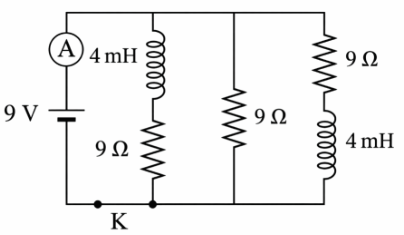
Figure shows the circuit that contains three resistances (9 $$\Omega$$ each) and two inductors (4 mH each). The reading of ammeter at the moment switch K is turned ON, is ____ A.
At the exact moment the switch K is turned ON ($$t = 0$$), the inductors oppose any sudden change in current. Therefore, they act as open circuits.
Because the left and right parallel branches both contain inductors, no current will flow through them initially. The entire current will flow only through the middle branch, which contains a pure resistor.
Supply Voltage, $$V = 9\text{ V}$$
Effective Resistance, $$R = 9\ \Omega$$ (only the middle branch is active)
According to Ohm's Law, the reading of the ammeter (initial current $$I$$) is:
$$ I = \frac{V}{R} $$
$$ I = \frac{9}{9} $$
$$ I = 1\text{ A} $$
A capacitor C is first charged fully with potential difference of $$V_{0}$$ and disconnected from the battery. The charged capacitor is connected across an inductor having inductance L. In t s 25% of the initial energy in the capacitor is transferred to the inductor. The value of t is ____________s.
A capacitor $$C$$ charged to voltage $$V_0$$ is disconnected from the battery and connected across an inductor $$L$$. We need to find the time $$t$$ at which 25% of the initial energy in the capacitor is transferred to the inductor.
We recall the LC oscillation equations. In an LC circuit, the charge on the capacitor oscillates as:
$$ q(t) = Q_0\cos(\omega t) $$
where $$Q_0 = CV_0$$ is the initial charge, and the angular frequency of oscillation is:
$$ \omega = \frac{1}{\sqrt{LC}} $$
Next, we write the expressions for the energies. The initial energy stored in the capacitor is:
$$ U_0 = \frac{1}{2}CV_0^2 = \frac{Q_0^2}{2C} $$
At time $$t$$, the energy in the capacitor is:
$$ U_C = \frac{q^2}{2C} = \frac{Q_0^2\cos^2(\omega t)}{2C} = U_0\cos^2(\omega t) $$
By conservation of energy (no resistance, so no energy loss), the energy in the inductor is:
$$ U_L = U_0 - U_C = U_0 - U_0\cos^2(\omega t) = U_0\sin^2(\omega t) $$
Applying the condition that 25% of the initial energy is in the inductor gives:
$$ U_L = 0.25 \times U_0 $$
$$ U_0\sin^2(\omega t) = 0.25 \times U_0 $$
$$ \sin^2(\omega t) = 0.25 $$
$$ \sin(\omega t) = 0.5 $$
(Taking the first positive solution)
Finally, solving for $$t$$ yields:
$$ \omega t = \frac{\pi}{6} $$
since $$\sin\left(\frac{\pi}{6}\right) = \frac{1}{2} = 0.5$$.
$$ t = \frac{\pi}{6\omega} = \frac{\pi}{6 \times \frac{1}{\sqrt{LC}}} = \frac{\pi\sqrt{LC}}{6} $$
Therefore, the correct answer is Option (3): $$\frac{\pi\sqrt{LC}}{6}$$.
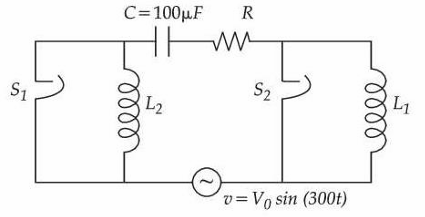
The figure given below shows an LCR series circuit with two switches $$S_1$$ and $$S_2$$. When switch $$S_1$$ is closed keeping $$S_2$$ open, the phase difference $$\phi$$ between the current and source voltage is $$30°$$ and phase difference is $$60°$$ when $$S_2$$ is closed keeping $$S_1$$ open. The value of $$(3L_1 - L_2)$$ is _________ H.
The source voltage is $$v = V_0 \sin 300 t$$, hence the angular frequency of the supply is
$$\omega = 300 \,\text{rad s}^{-1}$$.
The capacitance is given as $$C = 100 \,\mu\text{F} = 1 \times 10^{-4}\,\text{F}$$.
The capacitive reactance is therefore
$$X_C = \frac{1}{\omega C} = \frac{1}{300 \times 1 \times 10^{-4}} = 33.33 \,\Omega$$.
Let the resistance in the series circuit be $$R$$ (it remains the same in both cases).
For an LCR series circuit the phase angle $$\phi$$ between source voltage and current is given by
$$\tan\phi = \frac{X_L - X_C}{R} = \frac{\omega L - X_C}{R}\,\,\,\, -(1)$$
Switch $$S_1$$ closed (inductance $$L_1$$ active) and $$S_2$$ open gives $$\phi_1 = 30^\circ$$.
Using $$(1)$$:
$$\tan 30^\circ = \frac{\omega L_1 - X_C}{R}$$
$$\frac{1}{\sqrt 3} = \frac{\omega L_1 - X_C}{R}$$
$$R = \sqrt 3\;(\omega L_1 - X_C)\,\,\,\, -(2)$$
Switch $$S_2$$ closed (inductance $$L_2$$ active) and $$S_1$$ open gives $$\phi_2 = 60^\circ$$.
Again using $$(1)$$:
$$\tan 60^\circ = \frac{\omega L_2 - X_C}{R}$$
$$\sqrt 3 = \frac{\omega L_2 - X_C}{R}$$
$$R = \frac{\omega L_2 - X_C}{\sqrt 3}\,\,\,\, -(3)$$
Equate the two expressions for $$R$$ from $$(2)$$ and $$(3)$$:
$$\sqrt 3\,(\omega L_1 - X_C) \;=\; \frac{\omega L_2 - X_C}{\sqrt 3}$$
Multiplying by $$\sqrt 3$$,
$$3(\omega L_1 - X_C) = \omega L_2 - X_C$$
$$3\omega L_1 - \omega L_2 = 2X_C$$
$$\omega\,(3L_1 - L_2) = 2X_C\,\,\,\, -(4)$$
Substitute $$X_C = \dfrac{1}{\omega C}$$ into $$(4)$$:
$$\omega\,(3L_1 - L_2) = \frac{2}{\omega C}$$
$$3L_1 - L_2 = \frac{2}{\omega^2 C}$$
Insert the numerical values $$\omega = 300\,\text{rad s}^{-1}$$ and $$C = 1 \times 10^{-4}\,\text{F}$$:
$$\omega^2 = (300)^2 = 90000$$
$$\omega^2 C = 90000 \times 1 \times 10^{-4} = 9$$
Hence
$$3L_1 - L_2 = \frac{2}{9}\,\text{H}$$
Therefore, the required value is $$\dfrac{2}{9}\,\text{H}$$.
Option B which is: $$\dfrac{2}{9}$$
An a.c. source of angular frequency $$\omega$$ is connected across a resistor $$R$$ and a capacitor $$C$$ in series. The current is observed as $$I$$. Now the frequency of the source is changed to $$\omega/4$$, (keeping the voltage unchanged) the current is found to be $$I/3$$. The ratio of resistance to reactance at frequency $$\omega$$ is
For series RC circuit:
current $$I=\frac{V}{Z}$$, where
$$Z=\sqrt{R^2+X_C^2},\quad X_C=\frac{1}{\omega C}$$
At frequency ω\omegaω:
$$Z_1=\sqrt{R^2+X^2}$$
$$(where\ X=\frac{1}{\omega C})$$
At frequency $$\omega/4$$:
$$X'=\frac{1}{(\omega/4)C}=4X$$
$$Z_2=\sqrt{R^2+(4X)^2}=\sqrt{R^2+16X^2}$$
Given:
$$\frac{I_2}{I_1}=\frac{1/3}{1}=\frac{1}{3}\Rightarrow\frac{Z_1}{Z_2}=\frac{1}{3}$$
$$\frac{\sqrt{R^2+X^2}}{\sqrt{R^2+16X^2}}=\frac{1}{3}$$
Square:
$$\frac{R^2+X^2}{R^2+16X^2}=\frac{1}{9}$$
$$9(R^2+X^2)=R^2+16X^2$$
$$9R^2+9X^2=R^2+16X^2$$
$$8R^2=7X^2$$
$$\frac{R}{X}=\sqrt{\frac{7}{8}}$$
A LCR series circuit driven with $$E_{rms} = 90$$ V at frequency $$f_d = 30$$ Hz has resistance $$R = 80$$ $$\Omega$$, an inductance with inductive reactance $$X_L = 20.0$$ $$\Omega$$ and capacitance with capacitive reactance $$X_C = 80.0$$ $$\Omega$$. The power factor of the circuit is _______.
An inductor stores 16 J of magnetic field energy and dissipates 32 W of thermal energy due to its resistance when an a.c. current of 2 A (rms) and frequency 5O Hz nows through it. The ratio of inductive reactance to its resistance is_____.$$(\pi=3.14)$$
In a series LCR circuit with , $$R = 20\,\Omega$$, $$L = 1.6$$ H, $$C = 40\,\mu$$F is connected to a variable frequency a.c. source. The inductive reactance at resonant frequency is ____________ $$\Omega$$.
An inductor of 10 mH, capacitor of 0.1 $$\mu$$F and a resistor of 100 $$\Omega$$ are connected in series across an a.c power supply 220 V, 70 Hz. The power factor of the given circuit is 0.5. The difference in the inductive reactance and capacitance reactance is $$\sqrt{3}\,\alpha$$ $$\Omega$$. The value of $$\alpha$$ is _____.
For a series $$R$$-$$L$$-$$C$$ circuit driven by an a.c. source of angular frequency $$\omega$$, the impedance is $$Z=\sqrt{R^{2}+\left(X_L-X_C\right)^{2}}$$, where the reactances are
• Inductive: $$X_L=\omega L$$
• Capacitive: $$X_C=\dfrac{1}{\omega C}$$.
The power factor is defined as the cosine of the phase angle $$\phi$$ between voltage and current:
$$\cos\phi=\dfrac{R}{Z}\qquad -(1)$$
The tangent of the same angle is therefore
$$\tan\phi=\dfrac{X_L-X_C}{R}\qquad -(2)$$
The problem states that the power factor is $$0.5$$, so
$$\cos\phi=0.5\;\;\Longrightarrow\;\;\phi=60^{\circ}$$ (since $$\cos60^{\circ}=0.5$$).
Hence
$$\tan\phi=\tan60^{\circ}=\sqrt{3}$$.
Substituting $$\tan\phi$$ and the given resistance $$R=100\,\Omega$$ into equation $$(2)$$ gives
$$X_L-X_C = R\,\tan\phi = 100 \times \sqrt{3} = 100\sqrt{3}\;\Omega\qquad -(3)$$
The statement of the question further writes this difference as
$$X_L-X_C = \sqrt{3}\,\alpha\;\Omega\qquad -(4)$$
Comparing $$(3)$$ and $$(4)$$:
$$\sqrt{3}\,\alpha = 100\sqrt{3}\;\Longrightarrow\;\alpha = 100$$.
Therefore, the required value of $$\alpha$$ is 100.
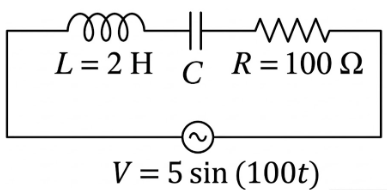
Using a variable frequency a.c. voltage source the maximum current measured in the given LCR circuit is 50 mA for V= 5 sin(100t) The values of L and R are shown in the figure. The capacitance of the capacitor (C) used is ____ µF.
($$Z$$) of a series LCR circuit
$$Z = \sqrt{R^2 + (X_L - X_C)^2}$$
($$X_L = \omega L$$) and ($$X_C = \frac{1}{\omega C}$$):
$$Z = \sqrt{R^2 + \left(\omega L - \frac{1}{\omega C}\right)^2}$$
$$I_0 = \frac{V_0}{Z}$$
$$I_0 = \frac{V_0}{\sqrt{R^2 + \left(\omega L - \frac{1}{\omega C}\right)^2}}$$
For the current $$I_0$$ to be maximum, the denominator (the impedance $$Z$$) must be at its least possible value.
Since $$R^2$$ is constant and positive, $$Z$$ is minimum when the squared term is zero:
$$\left(\omega L - \frac{1}{\omega C}\right)^2 = 0$$
$$\omega L = \frac{1}{\omega C}$$
$$100 \times 2 = \frac{1}{100 \times C}$$
$$C = \frac{1}{200 \times 100}$$
$$C = 5 \times 10^{-5} \text{ F}$$
$$C = 50 \ \mu\text{F}$$
Given below are two statements : one is labelled as Assertion (A) and the other is labelled as Reason (R). Assertion (A) : Choke coil is simply a coil having a large inductance but a small resistance. Choke coils are used with fluorescent mercury-tube fittings. If household electric power is directly connected to a mercury tube, the tube will be damaged. Reason (R): By using the choke coil, the voltage across the tube is reduced by a factor $$\left(R/\sqrt{R^{2}+\omega^{2}L^{2}}\right)$$, where ω frequency of the supply across resistor R and inductor L. If the choke coil were not used, the voltage across the resistor would be the same as the applied voltage. In the light of the above statements, choose the most appropriate answer from the options given below :
$$ \text{An alternating current is given by } I=I_A\sin\omega t + I_B\cos\omega t. \text{ The r.m.s. current will be:} $$
An alternating current is represented by the equation $$i = 100\sqrt{2} \sin(100\pi t)$$ ampere. The RMS value of current and the frequency of the given alternating current are
The instantaneous current of a sinusoidal a.c. source is generally written as$$i = I_0 \sin(\omega t)$$where
• $$I_0$$ is the peak (maximum) current.
• $$\omega$$ is the angular frequency related to the ordinary frequency $$f$$ by$$\omega = 2\pi f$$.
Comparing the given expression$$i = 100\sqrt{2}\,\sin(100\pi t)$$with$$i = I_0 \sin(\omega t)$$we identify
$$I_0 = 100\sqrt{2}\quad\text{and}\quad\omega = 100\pi\ \text{rad s}^{-1}$$.
Step 1: RMS (root-mean-square) value
For a pure sine wave, the RMS current is related to the peak current by$$I_{\text{rms}} = \frac{I_0}{\sqrt{2}}$$Applying this formula:
$$I_{\text{rms}} = \frac{100\sqrt{2}}{\sqrt{2}} = 100\ \text{A}$$.
Step 2: Frequency
Using the relation$$f = \frac{\omega}{2\pi}$$substitute $$\omega = 100\pi$$:
$$f = \frac{100\pi}{2\pi} = 50\ \text{Hz}$$.
Result
RMS current $$= 100\ \text{A}$$ and frequency $$= 50\ \text{Hz}$$.
These match Option C.
A series LCR circuit is connected to an alternating source of emf E. The current amplitude at resonant frequency is $$I_{\circ}$$. If the value of resistance R becomes twice of its initial value then amplitude of current at resonance will be
A series LCR circuit is connected to an AC source with emf $$E$$, and at resonance the current amplitude is $$I_0$$. Since the inductive and capacitive reactances cancel ($$X_L = X_C$$), the impedance equals the resistance alone, so $$Z = R$$ and the current amplitude at resonance is $$I_0 = \frac{E}{R}$$.
The resonance condition depends on $$L$$ and $$C$$ but not on $$R$$, so at the same resonant frequency with $$R' = 2R$$ the current becomes $$I' = \frac{E}{R'} = \frac{E}{2R} = \frac{I_0}{2}$$. From this, the new amplitude of current at resonance is $$\frac{I_0}{2}$$, which corresponds to Option 3.
An electric bulb rated as 100 W-220 V is connected to an ac source of rms voltage 220 V. The peak value of current through the bulb is:
The rating 100 W - 220 V means the bulb consumes power $$P = 100\ \text{W}$$ when an rms voltage $$V_{\text{rms}} = 220\ \text{V}$$ is applied.
Step 1: Find the resistance of the filament.
For an ac (or dc) load, $$P = \frac{V_{\text{rms}}^{\,2}}{R}$$ $$-(1)$$
Rearranging $$-(1)$$ gives $$R = \frac{V_{\text{rms}}^{\,2}}{P}$$.
Substituting the given values:
$$R = \frac{(220)^{2}}{100} = \frac{48400}{100} = 484\ \Omega$$.
Step 2: Calculate the rms current through the bulb.
Ohm’s law for rms values is $$I_{\text{rms}} = \frac{V_{\text{rms}}}{R}$$ $$-(2)$$.
Using $$R = 484\ \Omega$$:
$$I_{\text{rms}} = \frac{220}{484}\ \text{A} \approx 0.455\ \text{A}$$.
Step 3: Convert rms current to peak (maximum) current.
For a sinusoidal current, $$I_{0} = \sqrt{2}\,I_{\text{rms}}$$ $$-(3)$$.
Applying $$-(3)$$:
$$I_{0} = \sqrt{2}\times 0.455\ \text{A} \approx 1.414 \times 0.455\ \text{A} \approx 0.64\ \text{A}$$.
Hence, the peak value of current through the bulb is $$0.64\ \text{A}$$.
Option A is correct.
An inductor of reactance 100 $$\Omega$$, a capacitor of reactance 50 $$\Omega$$, and a resistor of resistance 50 $$\Omega$$ are connected in series with an AC source of 10 V, 50 Hz. Average power dissipated by the circuit is _____ W.
The given components are connected in series, so the circuit is a series $$R\text{-}L\text{-}C$$ combination.
Resistance: $$R = 50 \,\Omega$$
Inductive reactance: $$X_L = 100 \,\Omega$$
Capacitive reactance: $$X_C = 50 \,\Omega$$
Applied rms voltage: $$V_{\text{rms}} = 10 \text{ V}$$
Step 1 Find the net reactance.
For a series circuit, the net reactance is the algebraic difference of the individual reactances:
$$X = X_L - X_C = 100 - 50 = 50 \,\Omega$$
Step 2 Calculate the impedance.
For a series $$R\text{-}L\text{-}C$$ circuit, the impedance is
$$Z = \sqrt{R^{2} + X^{2}}$$
$$\Rightarrow Z = \sqrt{50^{2} + 50^{2}}$$
$$\Rightarrow Z = \sqrt{2500 + 2500}$$
$$\Rightarrow Z = \sqrt{5000}$$
$$\Rightarrow Z = 70.71 \,\Omega$$
Step 3 Find the rms current.
Ohm’s law for ac gives $$I_{\text{rms}} = \dfrac{V_{\text{rms}}}{Z}$$.
$$I_{\text{rms}} = \dfrac{10}{70.71} = 0.1414 \text{ A}$$
Step 4 Determine the power factor.
Power factor in a series circuit is $$\cos\phi = \dfrac{R}{Z}$$.
$$\cos\phi = \dfrac{50}{70.71} = 0.707$$
Step 5 Calculate the average (true) power.
Average power dissipated is
$$P = V_{\text{rms}} I_{\text{rms}} \cos\phi$$
Substitute the values:
$$P = 10 \times 0.1414 \times 0.707$$
$$P = 1.0 \text{ W}$$
Hence, the average power dissipated by the circuit is 1 W.
In a series LCR circuit, a resistor of 300Ω, a capacitor of 25 nF and an inductor of 100 mH are used. For maximum current in the circuit, the angular frequency of the ac source is _____$$\times 10^{4}\text{ radians }s^{-1}$$
For a series LCR circuit, the current in the circuit is maximum at the resonant frequency. This condition occurs when the inductive reactance is exactly equal to the capacitive reactance:
$$ X_L = X_C $$
$$ \omega L = \frac{1}{\omega C} $$
From this, the resonant angular frequency $$\omega$$ is given by the formula:
$$ \omega = \frac{1}{\sqrt{LC}} $$
$$ \omega = \frac{1}{\sqrt{10^{-1} \times 25 \times 10^{-9}}} $$
$$ \omega = \frac{1}{\sqrt{25 \times 10^{-10}}} $$
$$ \omega = \frac{1}{5 \times 10^{-5}} $$
$$ \omega = 2 \times 10^4 \text{ rad s}^{-1} $$
An inductor of self inductance 1 H connected in series with a resistor of $$100\pi$$ ohm and an ac supply of $$100\pi$$ volt, 50 Hz. Maximum current flowing in the circuit is ______ A.
Given
Self-inductance $$L = 1 \text{ H}$$, Resistance $$R = 100\pi \, \Omega$$, Frequency $$f = 50 \text{ Hz}$$, RMS supply voltage $$V_{rms}=100\pi \text{ V}$$.
First find the angular frequency.
Formula: $$\omega = 2\pi f$$ $$-(1)$$
Using $$f = 50$$ Hz,
$$\omega = 2\pi \times 50 = 100\pi \text{ rad s}^{-1}$$.
Inductive reactance $$X_L$$ is
$$X_L = \omega L$$ $$-(2)$$
Substituting $$\omega = 100\pi$$ and $$L = 1$$ H,
$$X_L = 100\pi \, \Omega$$.
The impedance of an $$R-L$$ series circuit is
$$Z = \sqrt{R^2 + X_L^2}$$ $$-(3)$$.
Here $$R = 100\pi$$ and $$X_L = 100\pi$$, so
$$Z = \sqrt{(100\pi)^2 + (100\pi)^2} = 100\pi\sqrt{2}\, \Omega$$.
RMS current:
$$I_{rms} = \frac{V_{rms}}{Z}$$ $$-(4)$$.
Putting $$V_{rms}=100\pi$$ V and $$Z = 100\pi\sqrt{2}$$ Ω,
$$I_{rms} = \frac{100\pi}{100\pi\sqrt{2}} = \frac{1}{\sqrt{2}} \text{ A}$$.
Maximum (peak) current relates to RMS current by
$$I_0 = \sqrt{2}\, I_{rms}$$ $$-(5)$$.
Hence
$$I_0 = \sqrt{2} \times \frac{1}{\sqrt{2}} = 1 \text{ A}$$.
Therefore, the maximum current flowing in the circuit is 1 A.
A capacitor of capacitance $$100 \mu F$$ is charged to a potential of $$12$$ V and connected to a $$6.4$$ mH inductor to produce oscillations. The maximum current in the circuit would be :
We need to find the maximum current in an LC oscillation circuit where a capacitor of $$100 \, \mu F$$ charged to $$12$$ V is connected to a $$6.4$$ mH inductor.
In an LC circuit, energy oscillates between the electric field of the capacitor and the magnetic field of the inductor. The total energy is conserved:
$$\frac{1}{2}CV^2 = \frac{1}{2}LI_{max}^2$$
The left side is the maximum energy stored in the capacitor (when current is zero), and the right side is the maximum energy stored in the inductor (when the capacitor is fully discharged).
From the energy conservation equation:
$$I_{max} = V\sqrt{\frac{C}{L}}$$
$$V = 12$$ V, $$C = 100 \, \mu F = 100 \times 10^{-6}$$ F, $$L = 6.4$$ mH $$= 6.4 \times 10^{-3}$$ H:
$$I_{max} = 12\sqrt{\frac{100 \times 10^{-6}}{6.4 \times 10^{-3}}}$$
$$= 12\sqrt{\frac{10^{-4}}{6.4 \times 10^{-3}}} = 12\sqrt{\frac{1}{64}}$$
$$= 12 \times \frac{1}{8} = 1.5 \text{ A}$$
The correct answer is Option (2): 1.5 A.
An alternating voltage $$V(t) = 220\sin 100\pi t$$ volt is applied to a purely resistive load of $$50 \Omega$$. The time taken for the current to rise from half of the peak value to the peak value is:
$$V(t) = 220\sin(100\pi t)$$, $$R = 50\Omega$$.
Peak current: $$I_0 = V_0/R = 220/50 = 4.4$$ A.
Current: $$I = I_0\sin(100\pi t)$$.
Half peak: $$I_0/2$$ when $$\sin(100\pi t_1) = 1/2 \Rightarrow 100\pi t_1 = \pi/6 \Rightarrow t_1 = \frac{1}{600}$$ s.
Peak: when $$\sin(100\pi t_2) = 1 \Rightarrow 100\pi t_2 = \pi/2 \Rightarrow t_2 = \frac{1}{200}$$ s.
$$\Delta t = t_2 - t_1 = \frac{1}{200} - \frac{1}{600} = \frac{3-1}{600} = \frac{2}{600} = \frac{1}{300}$$ s $$= 3.33$$ ms.
The answer is Option (2): $$\boxed{3.3 \text{ ms}}$$.
A series LCR circuit is subjected to an ac signal of $$200$$ V, $$50$$ Hz. If the voltage across the inductor $$(L = 10 \text{ mH})$$ is $$31.4$$ V, then the current in this circuit is :
We are given a series LCR circuit with an AC signal of $$200$$ V and $$50$$ Hz. The inductor has inductance $$L = 10$$ mH, and the voltage across the inductor is $$V_L = 31.4$$ V. We need to find the current in the circuit.
Recall that the voltage across an inductor in an AC circuit is related to the current by $$V_L = I \times X_L$$, where $$X_L$$ is the inductive reactance.
The inductive reactance is given by the formula $$X_L = \omega L = 2\pi f L$$. Substituting the given values ($$f = 50$$ Hz, $$L = 10 \text{ mH} = 10 \times 10^{-3}$$ H) yields $$X_L = 2\pi \times 50 \times 10 \times 10^{-3}$$, so $$X_L = 2\pi \times 0.5 = \pi \approx 3.14 \, \Omega$$.
Using the relationship $$V_L = I \times X_L$$ and solving for $$I$$ gives $$I = \frac{V_L}{X_L} = \frac{31.4}{3.14} = 10 \text{ A}$$.
The correct answer is Option (3): 10 A.
A series $$LR$$ circuit connected with an ac source $$E = (25 \sin 1000t) \text{ V}$$ has a power factor of $$\frac{1}{\sqrt{2}}$$. If the source of emf is changed to $$E = (20 \sin 2000t) \text{ V}$$, the new power factor of the circuit will be :
For a series LR circuit, the power factor is given by:
$$\cos\phi = \frac{R}{Z} = \frac{R}{\sqrt{R^2 + \omega^2 L^2}}$$
Case 1: $$\omega_1 = 1000 \text{ rad/s}$$, power factor $$= \frac{1}{\sqrt{2}}$$
$$\frac{1}{\sqrt{2}} = \frac{R}{\sqrt{R^2 + (1000)^2 L^2}}$$
Squaring both sides:
$$\frac{1}{2} = \frac{R^2}{R^2 + 10^6 L^2}$$
$$R^2 + 10^6 L^2 = 2R^2$$
$$10^6 L^2 = R^2$$
$$\omega_1 L = R \implies L = \frac{R}{1000}$$
Case 2: $$\omega_2 = 2000 \text{ rad/s}$$
$$\omega_2 L = 2000 \times \frac{R}{1000} = 2R$$
The new power factor is:
$$\cos\phi' = \frac{R}{\sqrt{R^2 + (2R)^2}} = \frac{R}{\sqrt{R^2 + 4R^2}} = \frac{R}{\sqrt{5R^2}} = \frac{1}{\sqrt{5}}$$
The correct answer is $$\frac{1}{\sqrt{5}}$$.
An AC voltage $$V = 20\sin(200\pi t)$$ is applied to a series LCR circuit which drives a current $$I = 10\sin\left(200\pi t + \frac{\pi}{3}\right)$$. The average power dissipated is:
$$V_0=20$$V, $$I_0=10$$A. Phase difference $$\phi=\pi/3$$.
$$P_{avg}=\frac{V_0I_0}{2}\cos\phi=\frac{20\times10}{2}\cos60°=100\times0.5=50$$ W.
The answer is Option (4): 50 W.
Given below are two statements: Statement I: In an LCR series circuit, current is maximum at resonance. Statement II: Current in a purely resistive circuit can never be less than that in a series LCR circuit when connected to same voltage source. In the light of the above statements, choose the correct from the options given below:
We need to evaluate two statements about LCR circuits and resistive circuits.
Analysis of Statement I: "In an LCR series circuit, current is maximum at resonance."
At resonance in a series LCR circuit, the inductive reactance equals the capacitive reactance: $$X_L = X_C$$. The impedance becomes: $$Z = \sqrt{R^2 + (X_L - X_C)^2} = \sqrt{R^2 + 0} = R$$. Since impedance is minimum (equal to R alone), the current $$I = V/Z = V/R$$ is maximum. Statement I is TRUE.
Analysis of Statement II: "Current in a purely resistive circuit can never be less than that in a series LCR circuit when connected to same voltage source."
For a purely resistive circuit: $$I_R = V/R$$
For a series LCR circuit: $$I_{LCR} = V/Z = V/\sqrt{R^2 + (X_L - X_C)^2}$$
Since $$Z = \sqrt{R^2 + (X_L - X_C)^2} \geq R$$ for all values of $$X_L$$ and $$X_C$$, we always have $$I_R \geq I_{LCR}$$. The equality holds only at resonance when $$X_L = X_C$$. Statement II is TRUE.
The correct answer is Option (3): Both Statement I and Statement II are true.
In an a.c. circuit, voltage and current are given by: $$V = 100\sin(100t)$$ V and $$I = 100\sin\left(100t + \frac{\pi}{3}\right)$$ mA respectively. The average power dissipated in one cycle is:
The average power dissipated in an AC circuit is given by: $$P_{avg} = \frac{V_0 I_0}{2} \cos\phi$$, where $$V_0$$ is the peak voltage, $$I_0$$ is the peak current, and $$\phi$$ is the phase difference between voltage and current.
From the given equations:
$$V = 100\sin(100t)$$ V, so $$V_0 = 100$$ V
$$I = 100\sin\left(100t + \frac{\pi}{3}\right)$$ mA $$= 0.1\sin\left(100t + \frac{\pi}{3}\right)$$ A, so $$I_0 = 0.1$$ A
The phase difference is $$\phi = \frac{\pi}{3} = 60°$$, so $$\cos\phi = \cos 60° = \frac{1}{2}$$.
Substituting into the formula:
$$P_{avg} = \frac{100 \times 0.1}{2} \times \frac{1}{2} = \frac{10}{2} \times \frac{1}{2} = \frac{10}{4} = 2.5$$ W
Therefore, the average power dissipated is $$2.5$$ W, which is Option (3).
The primary side of a transformer is connected to 230 V, 50 Hz supply. The turn ratio of primary to secondary winding is 10 : 1. Load resistance connected to the secondary side is 46 $$\Omega$$. The power consumed in it is :
Primary voltage: $$V_p = 230$$ V. Turn ratio $$N_p : N_s = 10 : 1$$.
Secondary voltage: $$V_s = V_p \times \frac{N_s}{N_p} = 230 \times \frac{1}{10} = 23$$ V.
Load resistance: $$R_L = 46 \; \Omega$$.
Power consumed: $$P = \frac{V_s^2}{R_L} = \frac{23^2}{46} = \frac{529}{46} = 11.5$$ W.
The answer is $$11.5$$ W, which corresponds to Option (3).
A transformer has an efficiency of 80% and works at 10 V and 4 kW. If the secondary voltage is 240 V, then the current in the secondary coil is:
Find the secondary current of a transformer with 80% efficiency, 10 V primary, 4 kW input power, and 240 V secondary voltage.
Recall that efficiency $$\eta = \frac{P_{\text{output}}}{P_{\text{input}}}$$.
With an input power of 4000 W and an efficiency of 0.80, the output power is $$P_{\text{output}} = \eta \times P_{\text{input}} = 0.80 \times 4000 = 3200\text{ W}$$.
Applying $$P = VI$$ to the secondary winding gives $$I_2 = \frac{P_{\text{output}}}{V_2} = \frac{3200}{240} = 13.33\text{ A}$$.
The correct answer is Option B: 13.33 A.
In an ac circuit, the instantaneous current is zero, when the instantaneous voltage is maximum. In this case, the source may be connected to: A. pure inductor. B. pure capacitor. C. pure resistor. D. combination of an inductor and capacitor. Choose the correct answer from the options given below :
In an AC circuit, the instantaneous current is zero when the instantaneous voltage is maximum. This implies a 90-degree phase difference between voltage and current. We need to identify which circuit elements produce this behavior.
Recall: If $$V = V_0\sin(\omega t)$$ and $$I = I_0\sin(\omega t \pm 90°)$$, then when $$V$$ is at maximum ($$\sin(\omega t) = 1$$), $$I = I_0\sin(\omega t \pm 90°) = \pm I_0\cos(\omega t) = 0$$ (at the same instant).
A. Pure inductor: In a pure inductor, current lags voltage by 90°: $$I = I_0\sin(\omega t - 90°)$$. When voltage is maximum, current is zero. YES.
B. Pure capacitor: In a pure capacitor, current leads voltage by 90°: $$I = I_0\sin(\omega t + 90°)$$. When voltage is maximum, current is zero. YES.
C. Pure resistor: In a pure resistor, current and voltage are in phase: $$I = I_0\sin(\omega t)$$. When voltage is maximum, current is also maximum (not zero). NO.
D. Combination of inductor and capacitor (LC circuit): In a pure LC circuit (no resistance), the impedance is purely reactive: $$Z = j(\omega L - \frac{1}{\omega C})$$. The current either leads or lags the voltage by exactly 90°. Therefore, when voltage is maximum, current is zero. YES.
The correct answer is Option (4): A, B and D only.
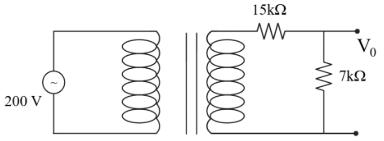
Primary coil of a transformer is connected to $$220 \text{ V AC}$$. Primary and secondary turns of the transforms are $$100$$ and $$10$$ respectively. Secondary coil of transformer is connected to two series resistances as shown in figure. The output voltage $$(V_0)$$ is :
The radius of third stationary orbit of electron for Bohr's atom is $$R$$. The radius of fourth stationary orbit will be:
In Bohr's model, the radius of the $$n$$th orbit is proportional to $$n^2$$:
$$r_n \propto n^2$$
For the third orbit: $$r_3 = R \propto 3^2 = 9$$
For the fourth orbit: $$r_4 \propto 4^2 = 16$$
$$\frac{r_4}{r_3} = \frac{16}{9}$$
$$r_4 = \frac{16}{9}R$$
The answer is $$\frac{16}{9}R$$, which corresponds to Option (2).
A alternating current at any instant is given by $$i = [6 + \sqrt{56}\sin(100\pi t + \pi/3)]\ A$$. The rms value of the current is ______ A.
The current is $$i = 6 + \sqrt{56}\sin(100\pi t + \pi/3)$$
This is a DC component plus an AC component.
DC component: $$I_{DC} = 6$$ A
AC peak value: $$I_0 = \sqrt{56}$$ A
RMS of AC component: $$I_{AC,rms} = \frac{\sqrt{56}}{\sqrt{2}} = \sqrt{28}$$ A
Total RMS: $$I_{rms} = \sqrt{I_{DC}^2 + I_{AC,rms}^2} = \sqrt{36 + 28} = \sqrt{64} = 8$$ A
The answer is 8.
A series LCR circuit with $$L = \frac{100}{\pi}$$ mH, $$C = \frac{10^{-3}}{\pi}$$ F and $$R = 10$$ $$\Omega$$, is connected across an AC source of 220 V, 50 Hz supply. The power factor of the circuit would be _____.
Given: $$L = \frac{100}{\pi}$$ mH $$= \frac{0.1}{\pi}$$ H, $$C = \frac{10^{-3}}{\pi}$$ F, $$R = 10 \; \Omega$$, $$f = 50$$ Hz.
$$\omega = 2\pi f = 100\pi$$ rad/s.
$$X_L = \omega L = 100\pi \times \frac{0.1}{\pi} = 10 \; \Omega$$
$$X_C = \frac{1}{\omega C} = \frac{1}{100\pi \times \frac{10^{-3}}{\pi}} = \frac{1}{100 \times 10^{-3}} = \frac{1}{0.1} = 10 \; \Omega$$
Since $$X_L = X_C$$, the circuit is at resonance.
Impedance: $$Z = \sqrt{R^2 + (X_L - X_C)^2} = \sqrt{100 + 0} = 10 \; \Omega$$
Power factor: $$\cos\phi = \frac{R}{Z} = \frac{10}{10} = 1$$
The answer is $$\boxed{1}$$.
When a coil is connected across a $$20$$ V dc supply, it draws a current of $$5$$ A. When it is connected across $$20$$ V, $$50$$ Hz ac supply, it draws a current of $$4$$ A. The self inductance of the coil is ______ mH. (Take $$\pi = 3$$)
From DC supply: $$V = 20$$ V, $$I = 5$$ A. Resistance of coil: $$R = V/I = 4\Omega$$.
From AC supply: $$V = 20$$ V, $$I = 4$$ A. Impedance: $$Z = V/I = 5\Omega$$.
For a coil (R-L circuit): $$Z = \sqrt{R^2 + (\omega L)^2}$$
$$25 = 16 + \omega^2 L^2$$
$$\omega^2 L^2 = 9$$
$$\omega L = 3$$
$$\omega = 2\pi f = 2\pi \times 50 = 2 \times 3 \times 50 = 300$$ rad/s (using $$\pi = 3$$).
$$L = \frac{3}{300} = 0.01 \text{ H} = 10 \text{ mH}$$
The answer is $$\boxed{10}$$ mH.
When a dc voltage of $$100 \text{ V}$$ is applied to an inductor, a dc current of $$5 \text{ A}$$ flows through it. When an ac voltage of peak value $$200 \text{ V}$$ is connected to inductor, its inductive reactance is found to be $$20\sqrt{3} \Omega$$. The power dissipated in the circuit is _______ W.
An inductor is connected first to DC (100 V, 5 A) and then to AC (peak 200 V, $$X_L = 20\sqrt{3} \Omega$$). Under DC the inductor acts as a pure resistance at zero frequency, so the resistance is $$ R = \frac{V_{DC}}{I_{DC}} = \frac{100}{5} = 20 \,\Omega $$.
Under AC the impedance is $$ Z = \sqrt{R^2 + X_L^2} = \sqrt{20^2 + (20\sqrt{3})^2} = \sqrt{400 + 1200} = \sqrt{1600} = 40 \,\Omega $$.
The RMS voltage is $$V_{rms} = \frac{V_0}{\sqrt{2}} = \frac{200}{\sqrt{2}}$$ V, so the RMS current is $$ I_{rms} = \frac{V_{rms}}{Z} = \frac{200}{\sqrt{2}\times 40} = \frac{200}{40\sqrt{2}} = \frac{5}{\sqrt{2}} \text{ A} $$.
Since power is dissipated only in the resistance, $$ P = I_{rms}^2 \times R = \frac{25}{2} \times 20 = 250 \text{ W} $$. Therefore the answer is $$250$$ W.
A capacitor of reactance $$4\sqrt{3} \Omega$$ and a resistor of resistance $$4\Omega$$ are connected in series with an ac source of peak value $$8\sqrt{2} \text{ V}$$. The power dissipation in the circuit is ______ W.
We need to find the power dissipation in a series RC circuit connected to an AC source.
Capacitive reactance: $$X_C = 4\sqrt{3} \text{ } \Omega$$
Resistance: $$R = 4 \text{ } \Omega$$
Peak voltage: $$V_0 = 8\sqrt{2} \text{ V}$$
For a series RC circuit, the impedance is given by:
$$Z = \sqrt{R^2 + X_C^2}$$
Substituting the values:
$$Z = \sqrt{(4)^2 + (4\sqrt{3})^2} = \sqrt{16 + 48} = \sqrt{64} = 8 \text{ } \Omega$$
The relationship between peak and RMS voltage is:
$$V_{rms} = \frac{V_0}{\sqrt{2}} = \frac{8\sqrt{2}}{\sqrt{2}} = 8 \text{ V}$$
Using Ohm's law for AC circuits:
$$I_{rms} = \frac{V_{rms}}{Z} = \frac{8}{8} = 1 \text{ A}$$
In an AC circuit, power is dissipated only in the resistive component (capacitors and inductors do not dissipate power on average). The power dissipation formula is:
$$P = I_{rms}^2 \times R$$
This can also be written as $$P = V_{rms} \cdot I_{rms} \cdot \cos\phi$$, where $$\cos\phi = R/Z$$ is the power factor. Both forms give the same result.
$$P = (1)^2 \times 4 = 4 \text{ W}$$
Verification using power factor:
$$\cos\phi = \frac{R}{Z} = \frac{4}{8} = 0.5$$
$$P = V_{rms} \times I_{rms} \times \cos\phi = 8 \times 1 \times 0.5 = 4$$ W. This confirms our answer.
The answer is 4 W.
A power transmission line feeds input power at 2.3 kV to a step down transformer with its primary winding having 3000 turns. The output power is delivered at 230 V by the transformer. The current in the primary of the transformer is 5 A and its efficiency is 90%. The winding of transformer is made of copper. The output current of transformer is ____ A.
Step-down transformer: $$V_p = 2300$$ V, $$N_p = 3000$$, $$V_s = 230$$ V, $$I_p = 5$$ A, efficiency = 90%.
$$\frac{N_s}{N_p} = \frac{V_s}{V_p} = \frac{230}{2300} = \frac{1}{10}$$, so $$N_s = 300$$.
Input power = $$V_p I_p = 2300 \times 5 = 11500$$ W.
Output power = $$0.9 \times 11500 = 10350$$ W.
$$I_s = \frac{P_s}{V_s} = \frac{10350}{230} = 45$$ A.
The output current is 45 A.
A capacitor of capacitance 150.0 $$\mu$$F is connected to an alternating source of emf given by $$E = 36 \sin(120\pi t)$$ V. The maximum value of current in the circuit is approximately equal to:
A capacitor of $$C = 150$$ $$\mu$$F is connected to an alternating voltage source described by $$E = 36\sin(120\pi t)$$ V.
From this expression, the peak emf is $$E_0 = 36$$ V, the angular frequency is $$\omega = 120\pi$$ rad/s, and the capacitance is $$C = 150 \times 10^{-6}$$ F.
Next, the capacitive reactance is given by
$$X_C = \dfrac{1}{\omega C} = \dfrac{1}{120\pi \times 150 \times 10^{-6}} = \dfrac{1}{120 \times 150 \times \pi \times 10^{-6}}$$
$$= \dfrac{1}{18000\pi \times 10^{-6}} = \dfrac{1}{0.018\pi} = \dfrac{1000}{18\pi} = \dfrac{500}{9\pi}$$
Having found $$X_C,$$ the maximum current is
$$I_0 = \dfrac{E_0}{X_C} = \dfrac{36}{\dfrac{500}{9\pi}} = \dfrac{36 \times 9\pi}{500} = \dfrac{324\pi}{500}$$
Using $$\pi \approx 3.14$$, one obtains $$I_0 \approx \dfrac{324 \times 3.14}{500} = \dfrac{1017.36}{500} \approx 2.03$$ A.
Thus the current is approximately 2 A, giving the final result $$2$$ A.
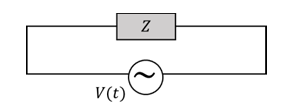
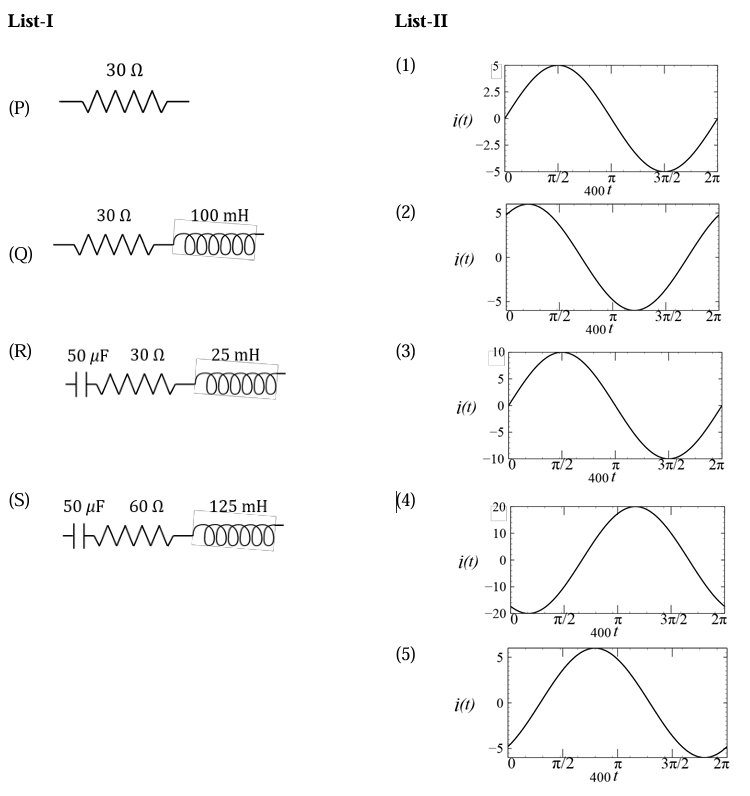
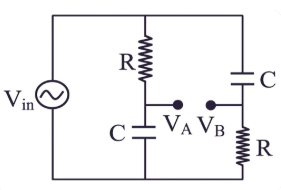
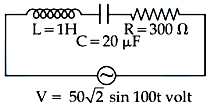
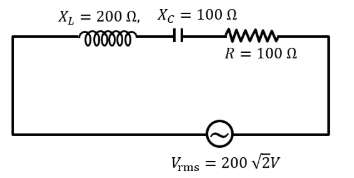
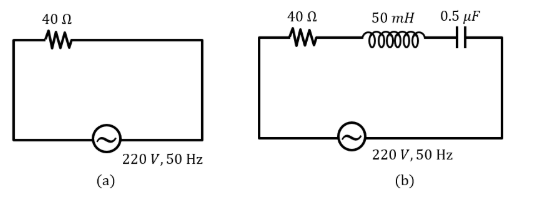
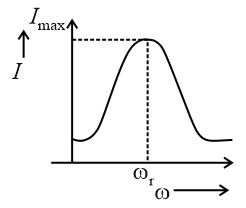
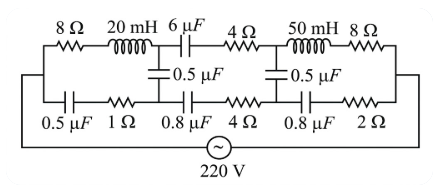
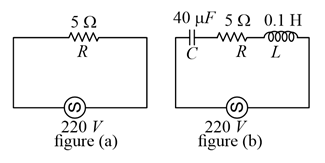
For the given figures, choose the correct options:
Given below are two statements:
Statement I : When the frequency of an AC source in a series LCR circuit increases, the current in the circuit first increases, attains a maximum value and then decreases.
Statement II : In a series LCR circuit, the value of power factor at resonance is one.
In the light of statements, choose the most appropriate answer from the options given below.
In an LC oscillator, if values of inductance and capacitance become twice and eight times, respectively, then the resonant frequency of oscillator becomes $$x$$ times its initial resonant frequency $$\omega_0$$. The value of $$x$$ is:
The resonant frequency of an LC oscillator is given by:
$$\omega_0 = \frac{1}{\sqrt{LC}}$$
When the inductance becomes twice ($$L' = 2L$$) and capacitance becomes eight times ($$C' = 8C$$):
$$\omega' = \frac{1}{\sqrt{L'C'}} = \frac{1}{\sqrt{2L \cdot 8C}} = \frac{1}{\sqrt{16LC}} = \frac{1}{4\sqrt{LC}} = \frac{\omega_0}{4}$$
Since $$\omega' = x \cdot \omega_0$$:
$$x = \frac{1}{4}$$
Therefore, the correct answer is Option A: $$\mathbf{\frac{1}{4}}$$.

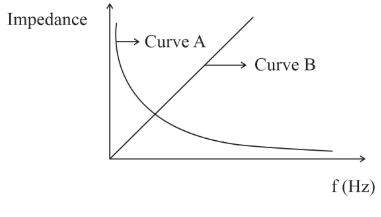
As per the given graph, choose the correct representation for curve A and curve B
{Where $$X_C$$ = Reactance of pure capacitive circuit connected with A.C. source
$$X_L$$ = Reactance of pure inductive circuit connected with A.C. source
$$R$$ = Impedance of pure resistive circuit connected with A.C. source
$$Z$$ = Impedance of the LCR series circuit}
We need to identify curves A and B from the graph, where the options involve $$X_C$$ (capacitive reactance), $$X_L$$ (inductive reactance), $$R$$ (resistance), and $$Z$$ (impedance of LCR circuit).
Recall how these quantities vary with frequency.
$$X_C = \dfrac{1}{\omega C} = \dfrac{1}{2\pi f C}$$ — decreases with increasing frequency (hyperbolic curve).
$$X_L = \omega L = 2\pi f L$$ — increases linearly with frequency.
$$R$$ — constant, independent of frequency (horizontal line).
$$Z = \sqrt{R^2 + (X_L - X_C)^2}$$ — has a minimum at resonance frequency.
Identify the curves.
Based on the graph description and the answer being Option 4:
Curve A (decreasing with frequency) = $$X_C$$ (capacitive reactance)
Curve B (increasing with frequency) = $$X_L$$ (inductive reactance)
The answer is $$\boxed{A = X_C, B = X_L}$$ (Option 4).
Given below are two statements:
Statement I: Maximum power is dissipated in a circuit containing an inductor, a capacitor and a resistor connected in series with an AC source, when resonance occurs.
Statement II: Maximum power is dissipated in a circuit containing pure resistor due to zero phase difference between current and voltage.
In the light of the above statements, choose the correct answer from the options given below:
We need to evaluate two statements about power dissipation in AC circuits.
Statement I: Maximum power is dissipated at resonance in a series RLC circuit.
In a series RLC circuit with an AC source, the power dissipated is:
$$ P = V_{rms} I_{rms} \cos\phi $$
where $$\cos\phi$$ is the power factor. At resonance, the inductive reactance equals the capacitive reactance ($$X_L = X_C$$), so the impedance is minimum ($$Z = R$$) and the phase angle $$\phi = 0$$. This means:
- The current is maximum: $$I = V/R$$ (since $$Z = R$$ is minimum)
- The power factor is maximum: $$\cos\phi = 1$$
Therefore, $$P = V^2/R$$ is maximum at resonance. Statement I is TRUE.
Statement II: Maximum power is dissipated in a pure resistor due to zero phase difference.
In a purely resistive circuit, voltage and current are always in phase ($$\phi = 0$$). The power dissipated is:
$$ P = V_{rms} I_{rms} \cos 0 = V_{rms} I_{rms} $$
The power factor is 1 (maximum possible). No energy is stored and returned (as happens with inductors and capacitors), so all the electrical energy supplied is dissipated as heat. This gives maximum power dissipation compared to circuits with reactive components. Statement II is TRUE.
Both statements are true.
The correct answer is Option 2: Both Statement I and Statement II are true.
In a series $$LR$$ circuit with $$X_L = R$$, power factor is $$P_1$$. If a capacitor of capacitance $$C$$ with $$X_C = X_L$$ is added to the circuit the power factor becomes $$P_2$$. The ratio of $$P_1$$ to $$P_2$$ will be:
We need to find the ratio of power factors $$P_1$$ to $$P_2$$ for a series LR circuit before and after adding a capacitor.
Case 1: Series LR circuit with $$X_L = R$$.
Impedance: $$Z_1 = \sqrt{R^2 + X_L^2} = \sqrt{R^2 + R^2} = R\sqrt{2}$$
Power factor: $$P_1 = \cos\phi_1 = \frac{R}{Z_1} = \frac{R}{R\sqrt{2}} = \frac{1}{\sqrt{2}}$$
Case 2: Series LCR circuit with $$X_C = X_L = R$$.
Net reactance: $$X_L - X_C = R - R = 0$$
Impedance: $$Z_2 = \sqrt{R^2 + 0} = R$$
Power factor: $$P_2 = \cos\phi_2 = \frac{R}{R} = 1$$
Ratio:
$$\frac{P_1}{P_2} = \frac{1/\sqrt{2}}{1} = \frac{1}{\sqrt{2}}$$
Therefore, $$P_1 : P_2 = 1 : \sqrt{2}$$.
The correct answer is Option 2: $$1 : \sqrt{2}$$.
An inductor of inductance $$2$$ $$\mu$$H is connected in series with a resistance, a variable capacitor and an AC source of frequency $$7$$ kHz. The value of capacitance for which maximum current is drawn into the circuit is $$\frac{1}{x}$$ F, where the value of $$x$$ is ______. (Take $$\pi = \frac{22}{7}$$)
We need to find the value of $$x$$ where the capacitance for maximum current is $$\dfrac{1}{x}$$ F.
Maximum current in a series LCR circuit occurs at resonance, where $$\omega^2 L C = 1 \implies C = \dfrac{1}{\omega^2 L}$$.
Given $$f = 7$$ kHz $$= 7000$$ Hz, $$L = 2\,\mu$$H $$= 2 \times 10^{-6}$$ H, and $$\pi = \dfrac{22}{7}$$, we have $$\omega = 2\pi f = 2 \times \dfrac{22}{7} \times 7000 = 2 \times 22000 = 44000 \text{ rad/s}$$.
Then $$\omega^2 = (44000)^2 = 1936 \times 10^6$$ and $$C = \dfrac{1}{\omega^2 L} = \dfrac{1}{1936 \times 10^6 \times 2 \times 10^{-6}} = \dfrac{1}{1936 \times 2} = \dfrac{1}{3872} \text{ F}$$.
Since $$C = \dfrac{1}{x}$$ F, it follows that $$x = 3872$$.
The answer is $$\boxed{3872}$$.
A series combination of resistor of resistance 100 $$\Omega$$, inductor of inductance 1 H and capacitor of capacitance 6.25 $$\mu$$F is connected to an ac source. The quality factor of the circuit will be _____.
We have resistance $$R = 100$$ $$\Omega$$, inductance $$L = 1$$ H, and capacitance $$C = 6.25$$ $$\mu$$F = $$6.25 \times 10^{-6}$$ F.
The quality factor of an RLC series circuit is given by:
$$Q = \frac{1}{R}\sqrt{\frac{L}{C}}$$
Substituting the values:
$$Q = \frac{1}{100}\sqrt{\frac{1}{6.25 \times 10^{-6}}}$$
$$Q = \frac{1}{100}\sqrt{\frac{10^6}{6.25}}$$
$$Q = \frac{1}{100}\sqrt{1.6 \times 10^5}$$
$$Q = \frac{1}{100} \times 400 = 4$$
So, the answer is $$4$$.
A series LCR circuit is connected to an ac source of 220 V, 50 Hz. The circuit contain a resistance $$R = 100$$ $$\Omega$$ and an inductor of inductive reactance $$X_L = 79.6$$ $$\Omega$$. The capacitance of the capacitor needed to maximize the average rate at which energy is supplied will be _____ $$\mu$$F.
We have an AC source of 220 V at 50 Hz, with $$R = 100$$ $$\Omega$$ and $$X_L = 79.6$$ $$\Omega$$.
The average rate of energy supplied (power) is maximized at resonance, when the impedance equals $$R$$. At resonance, $$X_C = X_L$$, so
$$\frac{1}{2\pi f C} = X_L$$
Solving for $$C$$,
$$C = \frac{1}{2\pi f X_L}$$
Now substituting the values,
$$C = \frac{1}{2\pi \times 50 \times 79.6} = \frac{1}{2 \times 3.14159 \times 50 \times 79.6} = \frac{1}{25000.5}$$
$$C \approx 4.0 \times 10^{-5} \text{ F} = 40 \text{ }\mu\text{F}$$
Hence, the correct answer is Option 2.
An inductor of 0.5 mH, a capacitor of 20 $$\mu$$F and resistance of 20 $$\Omega$$ are connected in series with a 220 V ac source. If the current is in phase with the emf, the amplitude of current of the circuit is $$\sqrt{x}$$ A. The value of $$x$$ is-
An LCR series circuit of capacitance 62.5 nF and resistance of 50 $$\Omega$$, is connected to an A.C. source of frequency 2.0 kHz. For maximum value of amplitude of current in circuit, the value of inductance is _____ mH. (Take $$\pi^2 = 10$$)
For maximum current amplitude in an LCR series circuit, the circuit must be at resonance, where $$X_L = X_C$$.
Given: $$C = 62.5$$ nF $$= 62.5 \times 10^{-9}$$ F, $$R = 50 \; \Omega$$, $$f = 2.0$$ kHz $$= 2000$$ Hz, and $$\pi^2 = 10$$.
At resonance:
$$\omega L = \frac{1}{\omega C}$$
$$L = \frac{1}{\omega^2 C}$$
The angular frequency:
$$\omega = 2\pi f = 2\pi \times 2000 = 4000\pi$$
Computing $$\omega^2$$:
$$\omega^2 = (4000\pi)^2 = 16 \times 10^6 \times \pi^2 = 16 \times 10^6 \times 10 = 1.6 \times 10^8$$
Therefore:
$$L = \frac{1}{1.6 \times 10^8 \times 62.5 \times 10^{-9}} = \frac{1}{1.6 \times 10^8 \times 6.25 \times 10^{-8}} = \frac{1}{10} = 0.1 \text{ H}$$
Converting to millihenry:
$$L = 0.1 \text{ H} = 100 \text{ mH}$$
Therefore, the answer is $$\mathbf{100}$$.
An oscillating LC circuit consists of a 75 mH inductor and a 1.2 $$\mu$$F capacitor. If the maximum charge to the capacitor is 2.7 $$\mu$$C. The maximum current in the circuit will be ______ mA.
We are given an oscillating LC circuit with inductance $$L = 75$$ mH $$= 75 \times 10^{-3}$$ H, capacitance $$C = 1.2$$ $$\mu$$F $$= 1.2 \times 10^{-6}$$ F, and maximum charge $$Q_0 = 2.7$$ $$\mu$$C $$= 2.7 \times 10^{-6}$$ C.
Apply energy conservation. At maximum charge, all energy is in the capacitor. At maximum current, all energy is in the inductor:
$$ \frac{Q_0^2}{2C} = \frac{LI_0^2}{2} $$
Solve for maximum current: $$ I_0 = \frac{Q_0}{\sqrt{LC}} $$
Calculate $$\sqrt{LC}$$: $$ LC = 75 \times 10^{-3} \times 1.2 \times 10^{-6} = 90 \times 10^{-9} = 9 \times 10^{-8} $$
$$ \sqrt{LC} = \sqrt{9 \times 10^{-8}} = 3 \times 10^{-4} \text{ s} $$
Find $$I_0$$: $$ I_0 = \frac{2.7 \times 10^{-6}}{3 \times 10^{-4}} = 0.9 \times 10^{-2} = 9 \times 10^{-3} \text{ A} = 9 \text{ mA} $$
The maximum current in the circuit is 9 mA.
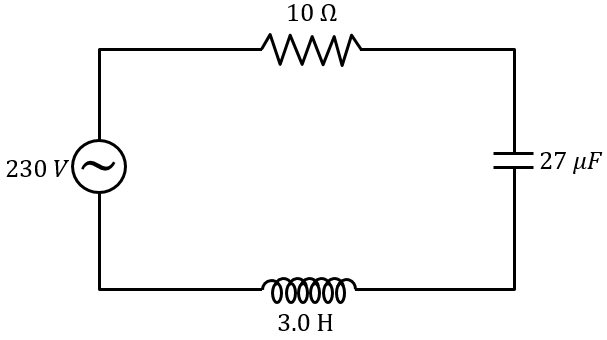
In the circuit shown in the figure, the ratio of the quality factor and the band width is _____ s.
R=10Ω,L=3H,C=27μF
Step 1: Bandwidth
$$\Delta \omega = \frac{R}{L}$$
Step 2: Quality factor
Q = $$\frac{\omega_0}{\Delta \omega} = \frac{\omega_0 L}{R}$$
Step 3: Required ratio
$$\frac{Q}{\Delta \omega} = \frac{\omega_0 L}{R} \cdot \frac{L}{R}$$
= $$\omega_0 \frac{L^2}{R^2}$$
$$\omega_0 = \frac{1}{\sqrt{LC}}$$1:
$$\frac{Q}{\Delta \omega} = \frac{1}{\sqrt{LC}} \cdot \frac{L^2}{R^2}$$
= $$\frac{L^2}{R^2 \sqrt{LC}}$$
Step 4: Substitute values
$$\sqrt{LC} = \sqrt{3 \times 27 \times 10^{-6}} = \sqrt{81 \times 10^{-6}} = 9 \times 10^{-3}$$
$$\frac{Q}{\Delta \omega} = \frac{3^2}{10^2 \times 9 \times 10^{-3}}$$
=$$ \frac{9}{100 \times 9 \times 10^{-3}}$$
= $$\frac{1}{10^{-1}} = 10\,\text{s}$$
Final Answer:
10
A series LCR circuit is connected to an AC source of 220 V, 50 Hz. The circuit contains a resistance $$R = 80$$ $$\Omega$$, an inductor of inductive reactance $$X_L = 70$$ $$\Omega$$, and a capacitor of capacitive reactance $$X_C = 130$$ $$\Omega$$. The power factor of circuit is $$\frac{x}{10}$$. The value of $$x$$ is:
For a series LCR circuit, power factor is:
$$\cos\phi=\frac{R}{Z}$$
where impedance,
$$Z=\sqrt{R^2+(X_L-X_C)^2}$$
Given:
- R=80 Ω
- XL=70 Ω
- XC=130 Ω
Net reactance:
$$X=X_L-X_C=70-130=-60$$
Impedance:
$$Z=\sqrt{80^2+60^2}$$
$$Z=\sqrt{6400+3600}$$
$$Z=\sqrt{10000}=100$$
Therefore,
$$\cos\phi=\frac{80}{100}=0.8$$
Given power factor is written as:
$$\frac{x}{10}$$
So,
$$\frac{x}{10}=0.8$$
x=8
A series LCR circuit is connected to a 45 sin($$\omega t$$) Volt source. The resonant angular frequency of the circuit is $$10^5$$ rad s$$^{-1}$$ and current amplitude at resonance is $$I_0$$. When the angular frequency of the source is $$\omega = 8 \times 10^4$$ rad s$$^{-1}$$, the current amplitude in the circuit is 0.05 $$I_0$$. If $$L = 50$$ mH, match each entry in List-I with an appropriate value from List-II and choose the correct option.
| List-I | List-II | ||
|---|---|---|---|
| (P) | $$I_0$$ in mA | (1) | 44.4 |
| (Q) | The quality factor of the circuit | (2) | 18 |
| (R) | The bandwidth of the circuit in rad s$$^{-1}$$ | (3) | 400 |
| (S) | The peak power dissipated at resonance in Watt | (4) | 2250 |
| (5) | 500 | ||
The applied voltage is $$v = 45 \sin \left( \omega t \right)\;{\rm V}$$, so its peak (amplitude) value is $$V_0 = 45\;{\rm V}$$.
For a series LCR circuit the current amplitude at any angular frequency $$\omega$$ is
$$I(\omega) = \frac{V_0}{Z},\qquad
Z = \sqrt{\,R^{2} + \left( \omega L - \frac{1}{\omega C} \right)^{2}}.$$
At resonance $$\omega_0 = \frac{1}{\sqrt{LC}} = 10^{5}\;{\rm rad\,s^{-1}}$$, the impedance is purely resistive, so
$$I_0 = I(\omega_0) = \frac{V_0}{R} \qquad -(1)$$
Using $$\omega_0^2 = \dfrac{1}{LC}\;$$ we get the capacitance
$$C = \frac{1}{L\omega_0^{2}}.$$
At $$\omega = 8\times10^{4}\;{\rm rad\,s^{-1}}$$ the current amplitude becomes $$I = 0.05\,I_0$$.
Hence
$$\frac{I}{I_0} = \frac{R}{\sqrt{\,R^{2} + \left(\omega L - \frac{1}{\omega C}\right)^{2}}} = 0.05.$$
Squaring and rearranging,
$$R^{2} = \frac{0.0025}{0.9975}\left(\omega L - \frac{1}{\omega C}\right)^{2}$$
$$\Longrightarrow\; R = 0.05006\left|\omega L - \frac{1}{\omega C}\right|.$$(2)
Now $$\omega L - \frac{1}{\omega C} = \,L\left(\omega - \frac{\omega_0^{2}}{\omega}\right) = L\frac{\omega^{2}-\omega_0^{2}}{\omega}.$$ For $$\omega = 8\times10^{4}\;{\rm rad\,s^{-1}}$$, $$\omega_0 = 10^{5}\;{\rm rad\,s^{-1}}$$ and $$L = 50\;{\rm mH}=0.05\;{\rm H}$$, $$\left|\omega^{2}-\omega_0^{2}\right| = \left| (8\times10^{4})^{2}-(10^{5})^{2}\right| = \left|6.4\times10^{9}-1.0\times10^{10}\right| = 3.6\times10^{9},$$ $$\left|\omega L - \frac{1}{\omega C}\right| = 0.05 \times \frac{3.6\times10^{9}}{8\times10^{4}} = 0.05 \times 4.5\times10^{4} = 2.25\times10^{3}\;\Omega.$$ Thus from (2) $$R = 0.05006 \times 2250 \approx 1.13\times10^{2}\;\Omega \approx 113\;\Omega.$$
Using $$I_0 = \dfrac{V_0}{R}$$ from (1): $$I_0 = \frac{45}{113}\,{\rm A} \approx 0.40\;{\rm A} = 400\;{\rm mA}.$$ So, P $$\to$$ 400 mA corresponding to List-II (3).
The quality factor is $$Q = \frac{\omega_0 L}{R} = \frac{10^{5}\times0.05}{113} \approx 44.4.$$ Thus, Q $$\to$$ 44.4 corresponding to List-II (1).
The bandwidth is $$\Delta\omega = \frac{\omega_0}{Q} = \frac{10^{5}}{44.4} \approx 2.25\times10^{3}\;{\rm rad\,s^{-1}}.$$ Hence, R $$\to$$ 2250 rad s$$^{-1}$$ corresponding to List-II (4).
At resonance the voltage and current are in phase, so the instantaneous power is $$p = v\,i.$$ Its maximum (peak) value is $$P_{\text{peak}} = V_0\,I_0 = 45 \times 0.40 = 18\;{\rm W}.$$ Therefore, S $$\to$$ 18 W corresponding to List-II (2).
Collecting the matches:
P $$\to$$ 3, Q $$\to$$ 1, R $$\to$$ 4, S $$\to$$ 2.
Hence the correct option is Option B: P $$\to$$ 3, Q $$\to$$ 1, R $$\to$$ 4, S $$\to$$ 2.
If wattless current flows in the AC circuit, then the circuit is :
We need to identify the type of AC circuit in which wattless current flows.
Wattless current refers to a current that does not consume any power. The average power in an AC circuit is given by:
$$P = V_{rms} \times I_{rms} \times \cos\phi$$
where $$\phi$$ is the phase difference between voltage and current. For $$P = 0$$, we need $$\cos\phi = 0$$, which means $$\phi = \frac{\pi}{2}$$ (i.e., $$90°$$). A phase difference of $$90°$$ between voltage and current occurs in both a purely inductive circuit (current lags voltage by $$90°$$) and a purely capacitive circuit (current leads voltage by $$90°$$).
In a purely resistive circuit, $$\phi = 0$$, so full power is dissipated. In LCR and RC circuits, the phase angle is generally not $$90°$$, so some power is dissipated.
Among the given options, a purely inductive circuit has wattless current. The correct answer is Option B: Purely Inductive circuit.
A sinusoidal voltage $$V(t) = 210\sin 3000t$$ volt is applied to a series LCR circuit in which $$L = 10$$ mH, $$C = 25$$ $$\mu$$F and $$R = 100\Omega$$. The phase difference $$\Phi$$ between the applied voltage and resultant current will be
Given: $$V(t) = 210\sin 3000t$$ volt, so the angular frequency is $$\omega = 3000$$ rad/s.
Given: $$L = 10$$ mH $$= 10 \times 10^{-3}$$ H, $$C = 25$$ $$\mu$$F $$= 25 \times 10^{-6}$$ F, $$R = 100$$ $$\Omega$$.
The inductive reactance is:
$$X_L = \omega L = 3000 \times 10 \times 10^{-3} = 30 \text{ }\Omega$$
The capacitive reactance is:
$$X_C = \frac{1}{\omega C} = \frac{1}{3000 \times 25 \times 10^{-6}} = \frac{1}{0.075} = 13.33 \text{ }\Omega$$
The net reactance is:
$$X_L - X_C = 30 - 13.33 = 16.67 \text{ }\Omega$$
The phase difference is:
$$\tan\phi = \frac{X_L - X_C}{R} = \frac{16.67}{100} = 0.1667 \approx 0.17$$
$$\phi = \tan^{-1}(0.17)$$
Hence, the correct answer is Option A.
An alternating emf $$E = 440\sin 100\pi t$$ is applied to a circuit containing an inductance of $$\frac{\sqrt{2}}{\pi}$$ H. If an a.c. ammeter is connected in the circuit, its reading will be:
We have an alternating emf $$E = 440\sin(100\pi t)$$ applied to a pure inductor of inductance $$L = \frac{\sqrt{2}}{\pi}$$ H.
From the emf expression, the peak voltage is $$E_0 = 440$$ V and the angular frequency is $$\omega = 100\pi$$ rad/s.
The inductive reactance is $$X_L = \omega L = 100\pi \times \frac{\sqrt{2}}{\pi} = 100\sqrt{2}$$ $$\Omega$$.
The peak current through the inductor is $$I_0 = \frac{E_0}{X_L} = \frac{440}{100\sqrt{2}} = \frac{4.4}{\sqrt{2}}$$ A.
An a.c. ammeter reads the rms value of current, which is $$I_{rms} = \frac{I_0}{\sqrt{2}} = \frac{4.4}{\sqrt{2} \times \sqrt{2}} = \frac{4.4}{2} = 2.2$$ A.
Hence, the correct answer is Option C.
A direct current of $$4 \text{ A}$$ and an alternating current of peak value $$4 \text{ A}$$ flow through resistance of $$3 \Omega$$ and $$2 \Omega$$ respectively. The ratio of heat produced in the two resistances in same interval of time will be:
A DC of 4 A flows through $$3 \Omega$$ and an AC of peak value 4 A flows through $$2 \Omega$$. We need the ratio of heat produced.
Since the DC current is 4 A, the heat produced in the resistor of $$R_1 = 3 \Omega$$ over time t is given by $$H_1 = I^2 R_1 t = (4)^2 \times 3 \times t = 48t$$.
For the AC circuit, heat is produced by the RMS current. Since the peak current is 4 A, we have $$I_{\text{rms}} = \frac{I_0}{\sqrt{2}} = \frac{4}{\sqrt{2}}$$. Substituting this into the power formula for the resistor $$R_2 = 2 \Omega$$ gives $$H_2 = I_{\text{rms}}^2 \times R_2 \times t = \frac{16}{2} \times 2 \times t = 16t$$.
From the above expressions, the ratio of the heat produced is $$\frac{H_1}{H_2} = \frac{48t}{16t} = \frac{3}{1}$$.
Therefore, the correct answer is Option B: $$3:1$$.
A series LCR circuit has $$L = 0.01$$ H, $$R = 10 \ \Omega$$ and $$C = 1 \ \mu F$$ and it is connected to ac voltage of amplitude $$(V_m)$$ 50 V. At frequency 60% lower than resonant frequency, the amplitude of current will be approximately
A series LCR circuit has $$L = 0.01$$ H, $$R = 10 \ \Omega$$, $$C = 1 \ \mu F$$, and amplitude $$V_m = 50$$ V. We are asked to find the current amplitude at a frequency 60% lower than the resonant frequency.
Since the resonant angular frequency is given by $$\omega_0 = \frac{1}{\sqrt{LC}},$$ substituting $$L = 0.01$$ and $$C = 10^{-6}$$ yields $$\omega_0 = \frac{1}{\sqrt{0.01 \times 10^{-6}}} = \frac{1}{\sqrt{10^{-8}}} = \frac{1}{10^{-4}} = 10^4 \text{ rad/s}.$$
Because the frequency of interest is 60% lower than resonance, we have $$\omega = \omega_0 - 0.6\omega_0 = 0.4\omega_0 = 0.4 \times 10^4 = 4000 \text{ rad/s}.$$
Next, the inductive reactance is $$X_L = \omega L = 4000 \times 0.01 = 40 \ \Omega,$$ and the capacitive reactance is $$X_C = \frac{1}{\omega C} = \frac{1}{4000 \times 10^{-6}} = \frac{1}{4 \times 10^{-3}} = 250 \ \Omega.$$
From the above reactances, the impedance of the circuit follows as $$Z = \sqrt{R^2 + (X_L - X_C)^2} = \sqrt{10^2 + (40 - 250)^2} = \sqrt{100 + (-210)^2} = \sqrt{100 + 44100} = \sqrt{44200} \approx 210.24 \ \Omega.$$
Therefore, the amplitude of the current is $$I_m = \frac{V_m}{Z} = \frac{50}{210.24} \approx 0.2378 \text{ A} \approx 238 \text{ mA}.$$
Answer: Option C: 238 mA
A transformer operating at primary voltage 8 kV and secondary voltage 160 V serves a load of 80 kW. Assuming the transformer to be ideal with purely resistive load and working on unity power factor, the loads in the primary and secondary circuit would be
We have an ideal transformer with primary voltage $$V_p = 8$$ kV $$= 8000$$ V, secondary voltage $$V_s = 160$$ V, and a load power of $$P = 80$$ kW $$= 80000$$ W. The load is purely resistive and operates at unity power factor.
For an ideal transformer, the input power equals the output power. The current in the secondary coil is $$I_s = \frac{P}{V_s} = \frac{80000}{160} = 500$$ A. The load resistance in the secondary circuit is therefore $$R_s = \frac{V_s}{I_s} = \frac{160}{500} = 0.32 \ \Omega$$. We can verify this using $$R_s = \frac{V_s^2}{P} = \frac{(160)^2}{80000} = \frac{25600}{80000} = 0.32 \ \Omega$$.
Now, the current in the primary coil is $$I_p = \frac{P}{V_p} = \frac{80000}{8000} = 10$$ A. The equivalent load resistance as seen from the primary side is $$R_p = \frac{V_p}{I_p} = \frac{8000}{10} = 800 \ \Omega$$. Alternatively, using $$R_p = \frac{V_p^2}{P} = \frac{(8000)^2}{80000} = \frac{64 \times 10^6}{80000} = 800 \ \Omega$$.
We can also verify using the impedance transformation relation: $$R_p = R_s \times \left(\frac{N_p}{N_s}\right)^2$$. The turns ratio is $$\frac{N_p}{N_s} = \frac{V_p}{V_s} = \frac{8000}{160} = 50$$. So $$R_p = 0.32 \times 50^2 = 0.32 \times 2500 = 800 \ \Omega$$, which is consistent.
So the loads in the primary and secondary circuits are 800 $$\Omega$$ and 0.32 $$\Omega$$ respectively.
Hence, the correct answer is Option C.
In a series $$LR$$ circuit $$X_L = R$$ and power factor of the circuit is $$P_1$$. When capacitor with capacitance $$C$$ such that $$X_L = X_C$$ is put in series, the power factor becomes $$P_2$$. The ratio $$\dfrac{P_1}{P_2}$$ is
In a series $$LR$$ circuit, $$X_L = R$$, and the power factor is $$P_1$$. When a capacitor with $$X_C = X_L$$ is added in series, the power factor becomes $$P_2$$. We need to find $$\dfrac{P_1}{P_2}$$.
The power factor is defined as:
$$P_1 = \cos\phi_1 = \frac{R}{Z_1}$$
For a series $$LR$$ circuit, the impedance is:
$$Z_1 = \sqrt{R^2 + X_L^2}$$
Given $$X_L = R$$:
$$Z_1 = \sqrt{R^2 + R^2} = R\sqrt{2}$$
$$P_1 = \frac{R}{R\sqrt{2}} = \frac{1}{\sqrt{2}}$$
When a capacitor with $$X_C = X_L$$ is added in series, resonance occurs since $$X_L = X_C$$:
$$Z_2 = \sqrt{R^2 + (X_L - X_C)^2} = \sqrt{R^2 + 0} = R$$
$$P_2 = \frac{R}{R} = 1$$
$$\frac{P_1}{P_2} = \frac{1/\sqrt{2}}{1} = \frac{1}{\sqrt{2}}$$
The correct answer is Option B: $$\dfrac{1}{\sqrt{2}}$$.
The equation of current in a purely inductive circuit is $$5\sin(49\pi t - 30°)$$. If the inductance is 30 mH then the equation for the voltage across the inductor, will be
We need to find the voltage equation across an inductor given the current equation $$i = 5\sin(49\pi t - 30°)$$ and inductance $$L = 30 \text{ mH}$$.
First, we identify the parameters: the peak current $$I_0 = 5$$ A, the angular frequency $$\omega = 49\pi$$ rad/s, and the inductance $$L = 30 \text{ mH} = 30 \times 10^{-3}$$ H.
Since the circuit is purely inductive, the peak voltage is given by $$V_0 = I_0 \times \omega L$$. Substituting the known values yields:
$$V_0 = 5 \times 49\pi \times 30 \times 10^{-3}$$
$$= 5 \times 49 \times 3.1416 \times 0.03$$
$$= 5 \times 4.618$$
$$= 23.09 \approx 23.1 \text{ V}$$
In a purely inductive circuit, the voltage leads the current by 90°. Therefore, the phase of the voltage is shifted by +90° relative to the current, giving:
$$V = V_0 \sin(\omega t - 30° + 90°) = V_0 \sin(49\pi t + 60°)$$
Substituting the calculated peak voltage into this expression provides the voltage equation:
$$V = 23.1\sin(49\pi t + 60°)$$
Hence, the correct answer is Option D: $$23.1\sin(49\pi t + 60°)$$.
To increase the resonant frequency in series LCR circuit,
We need to determine how to increase the resonant frequency in a series LCR circuit.
Recall that the resonant frequency of a series LCR circuit is given by: $$f_0 = \frac{1}{2\pi\sqrt{LC}}$$
To increase $$f_0$$, we need to decrease either $$L$$ or $$C$$ (or both).
Evaluating the options, Option A: Increasing source frequency does not change the resonant frequency; it only changes the operating frequency.
Option B: Adding resistance does not affect the resonant frequency, since $$f_0$$ is independent of $$R$$.
Option C: Adding another capacitor in series with the first capacitor. For capacitors in series:
$$\frac{1}{C_{eq}} = \frac{1}{C_1} + \frac{1}{C_2}$$
This gives $$C_{eq} < C_1$$, so the equivalent capacitance decreases. Since $$f_0 \propto \frac{1}{\sqrt{C}}$$, decreasing $$C$$ increases $$f_0$$. This is correct.
Option D: Decreasing source frequency does not change the resonant frequency.
Hence, the correct answer is Option C.
The current flowing through an ac circuit is given by $$I = 5\sin(120\pi t)$$ A. How long will the current take to reach the peak value starting from zero?
Given: $$I = 5\sin(120\pi t)$$ A.
Comparing with the standard form $$I = I_0 \sin(\omega t)$$:
$$\omega = 120\pi \text{ rad/s}$$
The current starts from zero (at $$t = 0$$, $$I = 0$$) and reaches its peak value when $$\sin(120\pi t) = 1$$.
$$120\pi t = \frac{\pi}{2}$$
$$t = \frac{\pi}{2 \times 120\pi} = \frac{1}{240} \text{ s}$$
The correct answer is Option D.
The RMS value of conduction current in a parallel plate capacitor is $$6.9 \mu A$$. The capacity of this capacitor, if it is connected to $$230 \text{ V}$$ AC supply with an angular frequency of $$600 \text{ rad s}^{-1}$$, will be
The RMS value of conduction current in a parallel plate capacitor is $$I_{rms} = 6.9 \text{ } \mu A$$. The supply voltage is $$V_{rms} = 230 \text{ V}$$ and the angular frequency is $$\omega = 600 \text{ rad/s}$$.
For a purely capacitive circuit, the rms current and voltage are related by $$I_{rms} = V_{rms} \times \omega C$$.
Rearranging this relation to solve for capacitance gives $$C = \frac{I_{rms}}{V_{rms} \times \omega}$$.
Substituting the given values, we get $$C = \frac{6.9 \times 10^{-6}}{230 \times 600}$$, which simplifies to $$C = \frac{6.9 \times 10^{-6}}{138000}$$ and can also be expressed as $$C = \frac{6.9 \times 10^{-6}}{1.38 \times 10^5}$$.
Thus, the capacitance is $$C = 5 \times 10^{-11} \text{ F}$$, or $$C = 50 \text{ pF}$$.
Hence, the correct answer is Option B.
A circuit element X when connected to an AC supply of peak voltage 100 V gives a peak current of 5 A which is in phase with the voltage. A second element Y when connected to the same AC supply also gives the same value of peak current which lags behind the voltage by $$\frac{\pi}{2}$$. If X and Y are connected in series to the same supply, what will be the rms value of the current in ampere?
We have element X which passes peak current 5 A in phase with the peak voltage 100 V, so X is a resistor with resistance $$R = \frac{100}{5} = 20\;\Omega$$.
Element Y passes the same peak current of 5 A but lagging the voltage by $$\frac{\pi}{2}$$, so Y is an inductor with inductive reactance $$X_L = \frac{100}{5} = 20\;\Omega$$.
When X and Y are connected in series, the total impedance is $$Z = \sqrt{R^2 + X_L^2} = \sqrt{20^2 + 20^2} = 20\sqrt{2}\;\Omega$$.
The peak current in the series circuit is $$I_0 = \frac{V_0}{Z} = \frac{100}{20\sqrt{2}} = \frac{5}{\sqrt{2}}$$ A.
The rms current is $$I_{\text{rms}} = \frac{I_0}{\sqrt{2}} = \frac{5}{\sqrt{2} \cdot \sqrt{2}} = \frac{5}{2}$$ A.
Hence, the correct answer is Option 4.
A resistance of $$40$$ $$\Omega$$ is connected to a source of alternating current rated $$220$$ V, $$50$$ Hz. Find the time taken by the current to change from its maximum value to the rms value :
We are given: resistance $$R = 40\ \Omega$$, AC source rated $$220$$ V, $$50$$ Hz. We need to find the time taken by the current to change from its maximum value to its rms value.
The current is given by $$i = I_0 \sin(\omega t)$$, where $$\omega = 2\pi f = 2\pi \times 50 = 100\pi$$ rad/s.
The maximum current occurs when $$\sin(\omega t_1) = 1$$, i.e., $$\omega t_1 = \frac{\pi}{2}$$. The rms value is $$I_{rms} = \frac{I_0}{\sqrt{2}}$$, so setting $$\frac{I_0}{\sqrt{2}} = I_0 \sin(\omega t_2)$$ gives $$\sin(\omega t_2) = \frac{1}{\sqrt{2}}$$. After the maximum (at $$\omega t = \frac{\pi}{2}$$), the next time this occurs is at $$\omega t_2 = \pi - \frac{\pi}{4} = \frac{3\pi}{4}$$.
The difference in phase is $$\Delta(\omega t) = \frac{3\pi}{4} - \frac{\pi}{2} = \frac{\pi}{4}$$, so the time difference is $$\Delta t = \frac{\pi}{4\omega} = \frac{\pi}{4 \times 100\pi} = \frac{1}{400} \text{ s} = 2.5 \times 10^{-3} \text{ s} = 2.5 \text{ ms}$$.
Therefore, the correct answer is Option A.
Given below are two statements :
Statement-I: The reactance of an ac circuit is zero. It is possible that the circuit contains a capacitor and an inductor.
Statement-II: In ac circuit, the average power delivered by the source never becomes zero.
In the light of the above statements, choose the correct answer from the options given below
We need to analyze both statements about AC circuits.
Statement I: The reactance of an AC circuit is zero. It is possible that the circuit contains a capacitor and an inductor. The net reactance of an AC circuit containing both an inductor and a capacitor is given by:
$$X_{net} = X_L - X_C = \omega L - \frac{1}{\omega C}$$
At resonance, when $$\omega = \frac{1}{\sqrt{LC}}$$, we get:
$$X_L = X_C \implies X_{net} = 0$$
Thus, it is indeed possible for the net reactance to be zero even when the circuit contains both a capacitor and an inductor. Therefore, Statement I is TRUE.
Statement II: In an AC circuit, the average power delivered by the source never becomes zero. The average power delivered in an AC circuit is given by:
$$P_{avg} = V_{rms} \cdot I_{rms} \cdot \cos\phi$$
where $$\cos\phi$$ is the power factor. For a purely inductive or purely capacitive circuit, the phase difference $$\phi = 90°$$, so:
$$\cos\phi = \cos 90° = 0$$
$$P_{avg} = V_{rms} \cdot I_{rms} \cdot 0 = 0$$
Hence, the average power can become zero. Thus, Statement II is FALSE.
From the above, since Statement I is true and Statement II is false, the correct option is Option C.
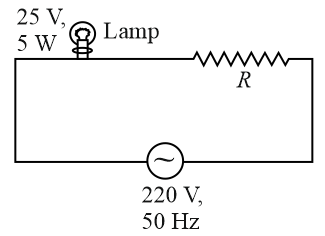
A $$220$$ V, $$50$$ Hz AC source is connected to a $$25$$ V, $$5$$ W lamp and an additional resistance $$R$$ in series (as shown in figure) to run the lamp at its peak brightness, then the value of $$R$$ (in ohm) will be
Given:
Source: 220 V,50 Hz
Lamp: 25 V,5 W
Step 1: Current through lamp
For rated operation:
$$P=VI⇒5=25⋅I⇒I=\ \frac{\ 5}{25}=\ \frac{\ 1}{5}A\ \ $$
Step 2: Voltage across resistance R
$$V_R=220−25=195V$$
Step 3: Calculate R
$$V_R=IR\Rightarrow195=\frac{1}{5}R\ ⇒R=195\times5=975Ω$$
Final Answer:
975 Ω
An inductor of 0.5 mH, a capacitor of 200 $$\mu$$F and a resistor of 2 $$\Omega$$ are connected in series with a 220 V ac source. If the current is in phase with the emf, the frequency of ac source will be ______ $$\times 10^2$$ Hz.
We need to find the frequency at which the current is in phase with the emf in an RLC series circuit (resonance condition). Current is in phase with emf when the circuit is at resonance. At resonance: $$\omega_0 = \frac{1}{\sqrt{LC}}$$ and $$f_0 = \frac{1}{2\pi\sqrt{LC}}$$.
Substituting the given values: $$L = 0.5$$ mH $$= 0.5 \times 10^{-3}$$ H, $$C = 200\ \mu$$F $$= 200 \times 10^{-6}$$ F gives $$LC = 0.5 \times 10^{-3} \times 200 \times 10^{-6} = 100 \times 10^{-9} = 10^{-7}$$ and $$\sqrt{LC} = \sqrt{10^{-7}} = 10^{-3.5} = \frac{10^{-3}}{\sqrt{10}}$$. Then $$f_0 = \frac{1}{2\pi \times \frac{10^{-3}}{\sqrt{10}}} = \frac{\sqrt{10}}{2\pi \times 10^{-3}}$$, which equals $$= \frac{3.162}{6.2832 \times 10^{-3}} = \frac{3.162}{6.2832} \times 10^3$$, yielding $$= 0.5033 \times 10^3 \approx 503.3 \text{ Hz}$$ or approximately $$\approx 5 \times 10^2 \text{ Hz}$$. The answer is 5 $$\times 10^2$$ Hz.
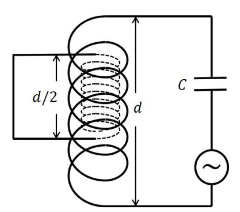
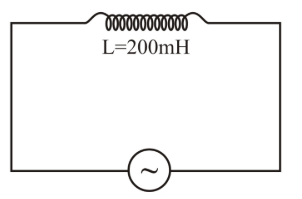
As shown in the figure an inductor of inductance $$200$$ mH is connected to an AC source of emf $$220$$ V and frequency $$50$$ Hz. The instantaneous voltage of the source is $$0$$ V when the peak value of current is $$\frac{\sqrt{a}}{\pi}$$ A. The value of $$a$$ is ______.
A capacitor of capacitance 500 $$\mu$$F is charged completely using a DC supply of 100 V. It is now connected to an inductor of inductance 50 mH to form an LC circuit. The maximum current in LC circuit will be _____ A.
We have a capacitor of capacitance $$C = 500 \, \mu\text{F} = 500 \times 10^{-6}$$ F charged to $$V = 100$$ V, now connected to an inductor of inductance $$L = 50$$ mH $$= 50 \times 10^{-3}$$ H to form an LC circuit.
In an LC circuit, energy oscillates between the capacitor and the inductor. By conservation of energy, the maximum energy stored in the inductor equals the initial energy stored in the capacitor: $$\frac{1}{2}LI_{\max}^2 = \frac{1}{2}CV^2$$
Solving for $$I_{\max}$$: $$I_{\max} = V\sqrt{\frac{C}{L}} = 100 \times \sqrt{\frac{500 \times 10^{-6}}{50 \times 10^{-3}}} = 100 \times \sqrt{\frac{500}{50000}} = 100 \times \sqrt{0.01} = 100 \times 0.1 = 10$$ A.
Hence, the correct answer is 10.
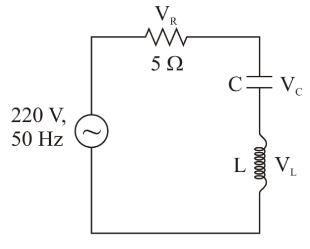
In the given circuit, the magnitude of $$V_L$$ and $$V_C$$ are twice that of $$V_R$$. Given that $$f = 50$$ Hz, the inductance of the coil is $$\frac{1}{K\pi}$$ mH. The value of $$K$$ is ______.
Given that $$|V_L| = |V_C| = 2|V_R|$$, it implies:
$$I \cdot X_L = I \cdot X_C = 2(I \cdot R)$$
$$X_L = X_C = 2R$$
$$X_L = 2 \times 5 = 10\ \Omega$$
$$X_L = 2\pi f L$$
$$10 = 2 \times \pi \times 50 \times L$$
$$L = \frac{1}{10\pi} \times 1000\ \text{mH} = \frac{100}{\pi}\ \text{mH}$$
$$\frac{100}{\pi} = \frac{1}{K\pi}$$
$$100 = \frac{1}{K} \implies \mathbf{K = 0.01}$$
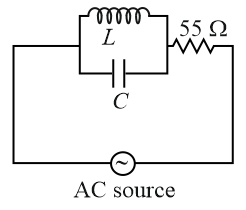
The effective current $$I$$ in the given circuit at very high frequencies will be ______ A.
The frequencies at which the current amplitude in an LCR series circuit becomes $$\frac{1}{\sqrt{2}}$$ times its maximum value, are 212 rad s$$^{-1}$$ and 232 rad s$$^{-1}$$. The value of resistance in the circuit is $$R = 5 \ \Omega$$. The self inductance in the circuit is _____ mH.
In an LCR series circuit, the current amplitude becomes $$\frac{1}{\sqrt{2}}$$ times its maximum value at the half-power frequencies $$\omega_1$$ and $$\omega_2$$. Here $$\omega_1 = 212$$ rad/s, $$\omega_2 = 232$$ rad/s, and the resistance is $$R = 5$$ $$\Omega$$.
The bandwidth of the circuit is given by the difference between these frequencies: $$\Delta\omega = \omega_2 - \omega_1 = 232 - 212 = 20 \text{ rad/s}.$$
In a series LCR circuit, the bandwidth is also related to $$R$$ and $$L$$ by $$\Delta\omega = \frac{R}{L}.$$ Solving for $$L$$ gives $$L = \frac{R}{\Delta\omega} = \frac{5}{20} = 0.25 \text{ H}.$$
Converting to millihenry yields $$L = 0.25 \text{ H} = 250 \text{ mH}.$$
Therefore, the self inductance in the circuit is 250 mH.
To light, a $$50 \text{ W}$$, $$100 \text{ V}$$ lamp is connected, in series with a capacitor of capacitance $$\dfrac{50}{\pi\sqrt{x}} \mu F$$, with $$200 \text{ V}$$, $$50 \text{ Hz}$$ AC source. The value of $$x$$ will be ______.
We have a $$50 \text{ W}$$, $$100 \text{ V}$$ lamp connected in series with a capacitor of capacitance $$C = \dfrac{50}{\pi\sqrt{x}} \text{ }\mu\text{F}$$ to a $$200 \text{ V}$$, $$50 \text{ Hz}$$ AC source. We need to find $$x$$.
The lamp is rated $$50 \text{ W}$$ at $$100 \text{ V}$$:
$$R = \frac{V^2}{P} = \frac{100^2}{50} = 200 \text{ }\Omega$$
For the lamp to glow at full brightness, the voltage across it must be $$100 \text{ V}$$:
$$I = \frac{P}{V} = \frac{50}{100} = 0.5 \text{ A}$$
The total voltage is $$200 \text{ V}$$, so the impedance is:
$$Z = \frac{V_s}{I} = \frac{200}{0.5} = 400 \text{ }\Omega$$
For a series R-C circuit:
$$Z = \sqrt{R^2 + X_C^2}$$
$$400 = \sqrt{200^2 + X_C^2}$$
$$160000 = 40000 + X_C^2$$
$$X_C^2 = 120000$$
$$X_C = 200\sqrt{3} \text{ }\Omega$$
$$X_C = \frac{1}{2\pi f C}$$
$$200\sqrt{3} = \frac{1}{2\pi \times 50 \times C}$$
$$C = \frac{1}{200\sqrt{3} \times 100\pi} = \frac{1}{20000\sqrt{3}\pi}$$
Converting to $$\mu\text{F}$$:
$$C = \frac{10^6}{20000\sqrt{3}\pi} = \frac{50}{\sqrt{3}\pi} \text{ }\mu\text{F}$$
Comparing with $$C = \dfrac{50}{\pi\sqrt{x}} \text{ }\mu\text{F}$$:
$$\frac{50}{\pi\sqrt{x}} = \frac{50}{\sqrt{3}\pi}$$
$$\sqrt{x} = \sqrt{3}$$
$$x = 3$$
The value of $$x$$ is $$3$$.
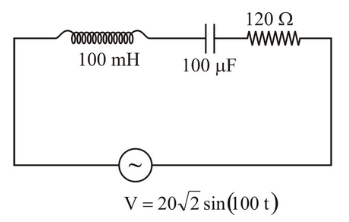
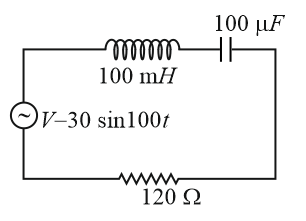
An AC source is connected to an inductance of $$100$$ mH, a capacitance of $$100$$ $$\mu$$F and a resistance of $$120$$ $$\Omega$$ as shown in figure. The time in which the resistance having a thermal capacity $$2$$ J °C$$^{-1}$$ will get heated by $$16°$$C is ______ s.
The solution to find the time required to heat the resistance in an LCR circuit involves calculating the circuit impedance, current, and the heat produced.
1. Calculation of Net Reactance and Impedance (Z)
First, we find the difference between inductive reactance ($$X_L$$) and capacitive reactance ($$X_C$$):
$$|X_L - X_C| = |10 - 100| = 90\ \Omega$$
The total impedance Z of the circuit is given by:
$$Z = \sqrt{(X_L - X_C)^2 + R^2}$$
Substituting the values ($$R = 120\ \Omega$$):
$$Z = \sqrt{(90)^2 + (120)^2} = \sqrt{8100 + 14400} = \sqrt{22500}$$
$$Z = 150\ \Omega$$
2. Calculation of RMS Current ($$I_{rms}$$)
Using Ohm's law for AC circuits ($$V_{rms} = 20\text{ V}$$ based on common context for this problem):
$$I_{rms} = \frac{V_{rms}}{Z} = \frac{20}{150} = \frac{2}{15}\text{ A}$$
3. Energy Balance and Time ($\Delta t$)
The electrical energy dissipated as heat in the resistor ($$I_{rms}^2 R \Delta t$$) is equal to the heat energy required to raise the temperature ($$ms\Delta T$$):
$$I_{rms}^2 R \Delta t = C_{thermal} (\Delta T)$$
Given:
- Thermal capacity (ms or $$C_{thermal}$$) $$= 2\text{ J °C}^{-1}$$
- Temperature change ($$\Delta T$$) = $$16\text{ °C}$$
Substituting the values:
$$\left( \frac{2}{15} \right)^2 \times 120 \times \Delta t = 2 \times 16$$
$$\frac{4}{225} \times 120 \times \Delta t = 32$$
$$\frac{480}{225} \Delta t = 32$$
$$\Delta t = \frac{32 \times 225}{480}$$
$$\Delta t = \frac{7200}{480}$$
$$\boxed{\Delta t = 15\text{ sec}}$$
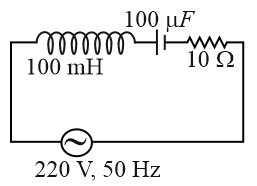
In a series LCR circuit, the inductance, capacitance and resistance are $$L = 100$$ mH, $$C = 100$$ $$\mu$$F and $$R = 10$$ $$\Omega$$ respectively. They are connected to an AC source of voltage $$220$$ V and frequency of $$50$$ Hz. The approximate value of current in the circuit will be ______ A.
A telegraph line of length $$100$$ km has a capacity of $$0.01$$ $$\mu$$F km$$^{-1}$$ and it carries an alternating current at $$0.5$$ kilo cycle per second. If minimum impedance is required, then the value of the inductance that needs to be introduced in series is ______ mH. (If $$\pi = \sqrt{10}$$)
We need to find the inductance required for minimum impedance (resonance condition) in a telegraph line. The line length is $$100$$ km and the capacitance per km is $$0.01$$ $$\mu$$F/km, so the total capacitance is $$C = 100 \times 0.01 = 1$$ $$\mu$$F $$= 10^{-6}$$ F. The frequency is $$f = 0.5$$ kHz $$= 500$$ Hz and $$\pi = \sqrt{10}$$.
The resonance condition for minimum impedance in a series LC circuit states that:
$$ \omega L = \frac{1}{\omega C} $$
This gives:
$$ L = \frac{1}{\omega^2 C} $$
Since $$\omega = 2\pi f = 2\sqrt{10} \times 500 = 1000\sqrt{10}$$, we have $$\omega^2 = (1000\sqrt{10})^2 = 1000000 \times 10 = 10^7$$. Substituting into the expression for $$L$$ with $$C = 10^{-6}$$ F yields:
$$ L = \frac{1}{10^7 \times 10^{-6}} = \frac{1}{10} = 0.1 \text{ H} = 100 \text{ mH} $$
Hence, the value of inductance required is 100 mH.
Match List I with List II.
| List I | List II |
|---|---|
| (a) Rectifier | (i) Used either for stepping up or stepping down the A.C. voltage |
| (b) Stabilizer | (ii) Used to convert A.C. voltage into D.C. voltage |
| (c) Transformer | (iii) Used to remove any ripple in the rectified output voltage |
| (d) Filter | (iv) Used for constant output voltage even when the input voltage or load current change |
Choose the correct answer from the options given below:
We match each device in List I with its correct description in List II.
(a) A rectifier is a device that converts alternating current (A.C.) voltage into direct current (D.C.) voltage. This matches description (ii).
(b) A stabilizer (voltage regulator) is a device used to maintain a constant output voltage even when the input voltage or load current changes. This matches description (iv).
(c) A transformer is a device used either for stepping up or stepping down the A.C. voltage. This matches description (i).
(d) A filter is a circuit used to remove any ripple in the rectified output voltage, producing a smoother D.C. output. This matches description (iii).
Therefore, the correct matching is (a)-(ii), (b)-(iv), (c)-(i), (d)-(iii).
A series LCR circuit driven by 300 V at a frequency of 50 Hz contains a resistance R = 3 k$$\Omega$$, an inductor of inductive reactance $$X_L = 250\pi$$ $$\Omega$$ and an unknown capacitor. The value of capacitance to maximise the average power should be: (take $$\pi^2 = 10$$)
We begin with the expression for the impedance of a series $$LCR$$ circuit
$$Z=\sqrt{R^{2}+\left(X_L-X_C\right)^{2}}.$$
The rms current is $$I=\dfrac{V}{Z},$$ so the average (true) power delivered to the circuit is
$$P_{\text{avg}} = V_{\text{rms}}\,I_{\text{rms}}\cos\phi = V_{\text{rms}} \left(\dfrac{V_{\text{rms}}}{Z}\right)\left(\dfrac{R}{Z}\right) = \dfrac{V_{\text{rms}}^{2}\,R}{Z^{2}}.$$
Because $$R$$ is fixed, $$P_{\text{avg}}$$ becomes maximum when the impedance $$Z$$ is minimum. Looking at the formula for $$Z,$$ the minimum value occurs when the bracketed term vanishes, that is, when
$$X_L = X_C.$$
This condition is called resonance, and at resonance the circuit behaves as a pure resistance: the phase angle $$\phi$$ becomes zero and $$\cos\phi = 1,$$ giving the greatest possible average power.
We are given the inductive reactance
$$X_L = 250\pi\; \Omega.$$
To satisfy $$X_L = X_C,$$ we must have
$$X_C = 250\pi\; \Omega.$$
The capacitive reactance is related to the capacitance by the formula
$$X_C = \frac{1}{\omega C},$$
where the angular frequency $$\omega$$ equals $$2\pi f.$$ The supply frequency is $$f = 50\;\text{Hz},$$ so
$$\omega = 2\pi f = 2\pi \times 50 = 100\pi\;\text{rad s}^{-1}.$$
Substituting $$X_C = 250\pi$$ and $$\omega = 100\pi$$ into $$X_C = \dfrac{1}{\omega C},$$ we get
$$250\pi = \frac{1}{100\pi\,C}.$$
Rearranging for $$C$$ gives
$$C = \frac{1}{100\pi \times 250\pi} = \frac{1}{25000\pi^{2}}\;\text{farad}.$$
The problem states that $$\pi^{2} = 10,$$ so
$$C = \frac{1}{25000 \times 10} = \frac{1}{250000}\;\text{F}.$$
To convert to microfarads, recall that $$1\;\text{F} = 10^{6}\;\mu\text{F},$$ therefore
$$C = \frac{10^{6}}{250000}\;\mu\text{F} = 4\;\mu\text{F}.$$
Hence, the correct answer is Option B.
An L.C.R. circuit contains resistance of 110 $$\Omega$$ and a supply of 220 V at 300 rad s$$^{-1}$$ angular frequency. If only capacitance is removed from the circuit, current lags behind the voltage by 45°. If on the other hand, only the inductor is removed the current leads by 45° with the applied voltage. The R.M.S. current flowing in the circuit will be:
We are given an LCR circuit with $$R = 110 \; \Omega$$, supply voltage $$V = 220$$ V, and angular frequency $$\omega = 300$$ rad/s.
When only the capacitance is removed (leaving R and L in series), the current lags the voltage by 45°. This means $$\tan 45° = \frac{\omega L}{R}$$, so $$\omega L = R = 110 \; \Omega$$.
When only the inductor is removed (leaving R and C in series), the current leads the voltage by 45°. This means $$\tan 45° = \frac{1/(\omega C)}{R}$$, so $$\frac{1}{\omega C} = R = 110 \; \Omega$$.
Since $$\omega L = \frac{1}{\omega C} = 110 \; \Omega$$, the inductive reactance equals the capacitive reactance. This is the condition for resonance in an LCR circuit.
At resonance, the impedance of the circuit equals the resistance alone: $$Z = R = 110 \; \Omega$$.
The RMS current is $$I = \frac{V}{Z} = \frac{220}{110} = 2$$ A.
For the given circuit, comment on the type of transformer used:
In a circuit consisting of a capacitance and a generator with alternating emf, $$E_g = E_{go}\sin\omega t$$, $$V_C$$ and $$I_C$$ are the voltage and current. Correct phasor diagram for such circuit is:
In a purely capacitive circuit with $$E_g = E_{g0}\sin\omega t$$, the current leads the voltage by $$90°$$. This is because in a capacitor, charge builds up as voltage rises, and maximum current flows when the voltage is zero (rate of change is maximum), while zero current flows when the voltage is at its peak.
Specifically, the current is: $$I_C = I_0\sin\left(\omega t + \frac{\pi}{2}\right) = I_0\cos(\omega t)$$
while the voltage across the capacitor is $$V_C = V_0\sin(\omega t)$$ (in phase with the applied emf).
In the phasor diagram, $$V_C$$ (or the emf $$E_g$$) is taken as the reference phasor, and $$I_C$$ leads $$V_C$$ by $$90°$$ (i.e., $$I_C$$ is drawn $$90°$$ ahead of $$V_C$$ in the direction of rotation). The correct phasor diagram shows $$I_C$$ perpendicular to and leading $$V_C$$, which corresponds to phasor diagram (3).
An AC current is given by $$I = I_1 \sin\omega t + I_2 \cos\omega t$$. A hot wire ammeter will give a reading:
The given current is $$I = I_1 \sin\omega t + I_2 \cos\omega t$$. A hot wire ammeter reads the RMS (root mean square) value of the current.
The RMS value is $$I_{\text{rms}} = \sqrt{\langle I^2 \rangle}$$, where $$\langle \cdot \rangle$$ denotes the time average. Expanding $$I^2 = I_1^2 \sin^2\omega t + I_2^2 \cos^2\omega t + 2I_1 I_2 \sin\omega t \cos\omega t$$.
Taking the time average: $$\langle \sin^2\omega t \rangle = \frac{1}{2}$$, $$\langle \cos^2\omega t \rangle = \frac{1}{2}$$, and $$\langle \sin\omega t \cos\omega t \rangle = 0$$. Therefore $$\langle I^2 \rangle = \frac{I_1^2}{2} + \frac{I_2^2}{2} = \frac{I_1^2 + I_2^2}{2}$$.
Thus $$I_{\text{rms}} = \sqrt{\frac{I_1^2 + I_2^2}{2}}$$, and the correct answer is option 2.
In a series LCR circuit, the inductive reactance $$(X_L)$$ is 10 $$\Omega$$ and the capacitive reactance $$(X_C)$$ is 4 $$\Omega$$. The resistance $$(R)$$ in the circuit is 6 $$\Omega$$. The power factor of the circuit is :
In a series LCR circuit, the impedance is $$Z = \sqrt{R^2 + (X_L - X_C)^2}$$.
Substituting the given values: $$Z = \sqrt{6^2 + (10 - 4)^2} = \sqrt{36 + 36} = \sqrt{72} = 6\sqrt{2}$$ $$\Omega$$.
The power factor is $$\cos\phi = \frac{R}{Z} = \frac{6}{6\sqrt{2}} = \frac{1}{\sqrt{2}}$$.
In an ac circuit, an inductor, a capacitor and a resistor are connected in series with $$X_L = R = X_C$$. Impedance of this circuit is:
We have an a.c. circuit in which a resistor of resistance $$R$$, an inductor offering inductive reactance $$X_L$$ and a capacitor offering capacitive reactance $$X_C$$ are all connected in series.
The impedance of any series $$R$$-$$L$$-$$C$$ circuit is defined by the formula
$$Z \;=\; \sqrt{\,R^{2} \;+\; \bigl(X_L - X_C\bigr)^{2}}.$$
This expression comes directly from phasor analysis: the resistor contributes a real component $$R$$, while the inductor and capacitor contribute imaginary components $$+jX_L$$ and $$-jX_C$$ respectively; their algebraic sum in the imaginary direction is $$j\,(X_L - X_C)$$. Taking the magnitude of the complex quantity $$R + j\,(X_L - X_C)$$ gives the above square-root relation.
Now the question states that the magnitudes of all three quantities are equal, that is
$$X_L \;=\; R \;=\; X_C.$$
Substituting $$X_L = X_C$$ straight into the impedance formula, we obtain
$$Z = \sqrt{\,R^{2} + \bigl(X_L - X_C\bigr)^{2}} = \sqrt{\,R^{2} + \bigl(X_L - X_L\bigr)^{2}} = \sqrt{\,R^{2} + 0^{2}} = \sqrt{\,R^{2}} = R.$$
Thus the magnitude of the impedance of the circuit reduces exactly to the resistance itself.
Hence, the correct answer is Option B.
Match List-I with List-II.
| List - I | List - II | |
|---|---|---|
| (a) $$\omega L > \frac{1}{\omega C}$$ | (i) | Current is in phase with emf |
| (b) $$\omega L = \frac{1}{\omega C}$$ | (ii) | Current lags behind the applied emf |
| (c) $$\omega L < \frac{1}{\omega C}$$ | (iii) | Maximum current occurs |
| (d) Resonant frequency | (iv) | Current leads the emf |
For a series $$RLC$$ circuit the impedance is $$Z = \sqrt{R^{2}+\left(\,\omega L-\frac{1}{\omega C}\right)^{2}}$$ and the phase angle $$\phi$$ between the current $$I$$ and the applied emf $$E$$ is given by
$$\tan \phi = \frac{\omega L-\dfrac{1}{\omega C}}{R}$$
Sign of $$\left(\omega L-\dfrac{1}{\omega C}\right)$$ decides whether the circuit behaves inductively or capacitively.
Case a: $$\omega L \gt \dfrac{1}{\omega C}$$ ⇒ $$\tan\phi \gt 0$$, so $$\phi$$ is positive. A positive phase angle means the current lags behind the emf.
Hence (a) matches with (ii) “Current lags behind the applied emf”.
Case b: $$\omega L = \dfrac{1}{\omega C}$$ ⇒ $$\tan\phi = 0$$, so $$\phi = 0$$. The current is exactly in phase with the emf and the circuit is at resonance.
Hence (b) matches with (i) “Current is in phase with emf”.
Case c: $$\omega L \lt \dfrac{1}{\omega C}$$ ⇒ $$\tan\phi \lt 0$$, so $$\phi$$ is negative. A negative phase angle means the current leads the emf.
Hence (c) matches with (iv) “Current leads the emf”.
Case d: “Resonant frequency” refers to the condition $$\omega L = \dfrac{1}{\omega C}$$, where the impedance is minimum ($$Z = R$$) and the circuit admits the largest current.
Hence (d) matches with (iii) “Maximum current occurs”.
Collecting all matches:
(a) - (ii); (b) - (i); (c) - (iv); (d) - (iii)
Therefore the correct option is Option A.
The angular frequency of alternating current in a L-C-R circuit is 100 rad s$$^{-1}$$. The components connected are shown in the figure. Find the value of inductance of the coil and capacity of condenser.
An $$RC$$ circuit as shown in the figure is driven by a $$AC$$ source generating a square wave. The output wave pattern monitored by $$CRO$$ would look close to:
Find the peak current and resonant frequency of the following circuit (as shown in figure).
In the given circuit the AC source has $$\omega = 100$$ rad s$$^{-1}$$. Considering the inductor and capacitor to be ideal, what will be the current $$I$$ flowing through the circuit?
Match List-I with List-II:
List-I | List-II
a. Phase difference between current and voltage in a purely resistive AC circuit | i. $$\frac{\pi}{2}$$; current leads voltage
b. Phase difference between current and voltage in a pure inductive AC circuit | ii. zero
c. Phase difference between current and voltage in a pure capacitive AC circuit | iii. $$\frac{\pi}{2}$$; current lags voltage
d. Phase difference between current and voltage in an LCR series circuit | iv. $$\tan^{-1}\left(\frac{X_C - X_L}{R}\right)$$
Choose the most appropriate answer from the options given below:
In a purely resistive AC circuit, the current and voltage are in phase, so the phase difference is zero. This matches (a) with (ii).
In a purely inductive AC circuit, the current lags the voltage by $$\frac{\pi}{2}$$. This matches (b) with (iii).
In a purely capacitive AC circuit, the current leads the voltage by $$\frac{\pi}{2}$$. This matches (c) with (i).
In an LCR series circuit, the phase difference between current and voltage is $$\phi = \tan^{-1}\left(\frac{X_C - X_L}{R}\right)$$. This matches (d) with (iv).
Therefore the correct matching is (a)-(ii), (b)-(iii), (c)-(i), (d)-(iv).
A 10 $$\Omega$$ resistance is connected across 220 V - 50 Hz AC supply. The time taken by the current to change from its maximum value to the rms value is:
For a purely resistive circuit the alternating current has the same waveform as the alternating voltage, only scaled by the resistance. Thus, if the instantaneous voltage is written as
$$v(t)=V_{\text m}\sin(\omega t),$$
then the instantaneous current is
$$i(t)=\dfrac{v(t)}{R}=I_{\text m}\sin(\omega t),\qquad\text{where }I_{\text m}= \dfrac{V_{\text m}}{R}.$$
First we express the maximum (peak) and rms values.
Formula: $$V_{\text m}=\sqrt{2}\,V_{\text{rms}},\qquad I_{\text{rms}}=\dfrac{I_{\text m}}{\sqrt{2}}.$$
The supply gives $$V_{\text{rms}}=220\ \text V,$$ so
$$V_{\text m}=\sqrt{2}\times220\ \text V=220\sqrt{2}\ \text V.$$
With the resistance $$R=10\ \Omega$$ we have
$$I_{\text m}=\dfrac{V_{\text m}}{R}=\dfrac{220\sqrt{2}}{10}=22\sqrt{2}\ \text A,$$
and correspondingly
$$I_{\text{rms}}=\dfrac{I_{\text m}}{\sqrt{2}}=22\ \text A.$$
Now we look at how the current changes with time. We write
$$i(t)=I_{\text m}\sin(\omega t).$$
The maximum value occurs when $$\sin(\omega t)=1.$$ The smallest positive angle giving this is $$\omega t=\dfrac{\pi}{2},$$ so the time at that instant is
$$t_1=\dfrac{\pi/2}{\omega}.$$
Next we want the time when the current has fallen to its rms value. We set
$$i(t_2)=I_{\text{rms}}=\dfrac{I_{\text m}}{\sqrt{2}}.$$
Substituting into the waveform,
$$I_{\text m}\sin(\omega t_2)=\dfrac{I_{\text m}}{\sqrt{2}} \;\Longrightarrow\; \sin(\omega t_2)=\dfrac{1}{\sqrt{2}}.$$
The principal angles whose sine equals $$1/\sqrt{2}$$ are $$\omega t_2=\dfrac{\pi}{4}\ \text{or}\ \dfrac{3\pi}{4}.$$
Since the current is decreasing after reaching its maximum at $$\omega t=\pi/2$$, we select the later angle
$$\omega t_2=\dfrac{3\pi}{4}.$$
The angular frequency is determined by the supply frequency
Formula: $$\omega = 2\pi f.$$
With $$f = 50\ \text{Hz},$$
$$\omega = 2\pi \times 50 = 100\pi\ \text{rad s}^{-1}.$$
Hence,
$$t_1=\dfrac{\pi/2}{100\pi}=\dfrac{1}{200}\ \text s=0.005\ \text s,$$
$$t_2=\dfrac{3\pi/4}{100\pi}=\dfrac{3}{400}\ \text s=0.0075\ \text s.$$
The required time interval for the current to drop from its maximum to its rms value is
$$\Delta t = t_2 - t_1 = \left(\dfrac{3}{400}-\dfrac{2}{400}\right)\text s=\dfrac{1}{400}\ \text s=0.0025\ \text s.$$
Converting to milliseconds,
$$\Delta t = 0.0025\ \text s = 2.5\ \text{ms}.$$
Hence, the correct answer is Option A.
A 100$$\Omega$$ resistance, a 0.1$$\mu$$F capacitor and an inductor are connected in series across a 250 V supply at variable frequency. Calculate the value of inductance of inductor at which resonance will occur. Given that the resonant frequency is 60 Hz.
At resonance in a series $$RLC$$ circuit the inductive reactance equals the capacitive reactance. We first state this resonance condition:
$$X_L = X_C \quad\Longrightarrow\quad \omega L = \dfrac{1}{\omega C}$$
Here $$\omega$$ is the angular resonant frequency, related to the ordinary frequency $$f$$ by the well-known formula $$\omega = 2\pi f$$. Solving the above equality for the inductance $$L$$ gives
$$L = \dfrac{1}{\omega^{2} C}.$$
We are given
$$f = 60\ \text{Hz}, \qquad C = 0.1\ \mu\text{F}.$$
First we convert the capacitance into farads, remembering that $$1\ \mu\text{F} = 10^{-6}\ \text{F}:$$
$$C = 0.1\ \mu\text{F} = 0.1 \times 10^{-6}\ \text{F} = 1 \times 10^{-7}\ \text{F}.$$
Now we calculate the angular frequency:
$$\omega = 2\pi f = 2\pi \times 60\ \text{rad s}^{-1} = 120\pi\ \text{rad s}^{-1}.$$
For numerical work we use $$\pi \approx 3.1416$$, so
$$\omega = 120 \times 3.1416\ \text{rad s}^{-1} \approx 376.99\ \text{rad s}^{-1}.$$
Next we square this angular frequency, showing each step:
$$\omega^{2} = (376.99)^{2}\ \text{rad}^{2}\text{s}^{-2}.$$
Working out the square:
$$376.99^{2} = 376.99 \times 376.99 = 142\,129\ (\text{to the nearest unit}).$$
So
$$\omega^{2} \approx 1.42129 \times 10^{5}\ \text{rad}^{2}\text{s}^{-2}.$$
We now substitute $$\omega^{2}$$ and $$C$$ into the inductance formula:
$$L = \dfrac{1}{\omega^{2} C} = \dfrac{1}{\left(1.42129 \times 10^{5}\right) \left(1 \times 10^{-7}\right)}.$$
First multiply the denominator:
$$(1.42129 \times 10^{5})(1 \times 10^{-7}) = 1.42129 \times 10^{5-7} = 1.42129 \times 10^{-2}.$$
So we have
$$L = \dfrac{1}{1.42129 \times 10^{-2}}\ \text{henry}.$$
The reciprocal is obtained as follows:
$$\dfrac{1}{1.42129 \times 10^{-2}} = \dfrac{1}{0.0142129} \approx 70.36\ \text{H}.$$
Rounding to three significant figures gives
$$L \approx 70.3\ \text{H}.$$
Hence, the correct answer is Option D.
What happens to the inductive reactance and the current in a purely inductive circuit if the frequency is halved?
The inductive reactance is given by $$X_L = 2\pi f L = \omega L$$. If the frequency is halved, the new reactance is $$X_L' = 2\pi \left(\frac{f}{2}\right) L = \frac{X_L}{2}$$. So the inductive reactance is halved.
In a purely inductive circuit, the current is $$I = \frac{V}{X_L}$$. When the reactance is halved, the current becomes $$I' = \frac{V}{X_L/2} = \frac{2V}{X_L} = 2I$$. So the current is doubled.
Therefore, when the frequency is halved, the inductive reactance is halved and the current is doubled.
A 0.07 H inductor and a 12 $$\Omega$$ resistor are connected in series to a 220 V, 50 Hz AC source. The approximate current in the circuit and the phase angle between current and source voltage are respectively. [Take $$\pi$$ as $$\frac{22}{7}$$]
We have a series circuit containing an inductor of inductance $$L = 0.07\;\text{H}$$ and a resistor of resistance $$R = 12\;\Omega$$ connected to an AC source of root-mean-square (r.m.s.) voltage $$V = 220\;\text{V}$$ and frequency $$f = 50\;\text{Hz}$$.
First we need the inductive reactance. The formula for inductive reactance is stated as
$$X_L = \omega L$$
where $$\omega$$ is the angular frequency given by $$\omega = 2\pi f$$. Substituting the given frequency and taking $$\pi = \dfrac{22}{7}$$, we get
$$\omega = 2\pi f = 2 \times \dfrac{22}{7} \times 50 = \dfrac{44}{7} \times 50 = \dfrac{44 \times 50}{7} = \dfrac{2200}{7}\;\text{rad s}^{-1}.$$
Now substituting this value of $$\omega$$ and the given value of $$L$$ in the formula $$X_L = \omega L$$, we have
$$X_L = \left(\dfrac{2200}{7}\right) \times 0.07 = \dfrac{2200 \times 0.07}{7}.$$ Recognising that $$0.07 = \dfrac{7}{100}$$, we can write
$$X_L = \dfrac{2200}{7} \times \dfrac{7}{100} = \dfrac{2200}{100} = 22\;\Omega.$$
So, the inductive reactance is $$X_L = 22\;\Omega$$.
Next, the total impedance $$Z$$ of a series $$R\!-\!L$$ circuit is given by the relation
$$Z = \sqrt{R^2 + X_L^2}.$$
Substituting $$R = 12\;\Omega$$ and $$X_L = 22\;\Omega$$, we get
$$Z = \sqrt{(12)^2 + (22)^2} = \sqrt{144 + 484} = \sqrt{628}.$$
Evaluating the square root,
$$\sqrt{628} \approx 25.06\;\Omega.$$ For practical purposes this may be rounded to $$25.1\;\Omega$$.
The r.m.s. current $$I$$ in the circuit is obtained from Ohm’s law for AC circuits,
$$I = \dfrac{V}{Z}.$$
Substituting the numerical values,
$$I = \dfrac{220\;\text{V}}{25.06\;\Omega} \approx 8.78\;\text{A}.$$
Rounded to two significant figures, the current is $$I \approx 8.8\;\text{A}.$$
Finally, to find the phase angle $$\phi$$ between the current and the source voltage, we use the relation for a series $$R\!-\!L$$ circuit,
$$\tan\phi = \dfrac{X_L}{R}.$$
Substituting $$X_L = 22\;\Omega$$ and $$R = 12\;\Omega$$, we have
$$\tan\phi = \dfrac{22}{12} = \dfrac{11}{6}.$$
Therefore,
$$\phi = \tan^{-1}\!\left(\dfrac{11}{6}\right).$$
Because the circuit contains an inductor, the current lags the voltage by this angle.
Combining the two results, we conclude that the approximate current in the circuit is $$8.8\;\text{A}$$ and the phase angle between the current and the source voltage is $$\tan^{-1}\!\left(\dfrac{11}{6}\right).$$
Hence, the correct answer is Option A.
For a series LCR circuit with $$R = 100$$ $$\Omega$$, $$L = 0.5$$ mH and $$C = 0.1$$ pF connected across 220 V - 50 Hz AC supply, the phase angle between current and supplied voltage and the nature of the circuit is:
For a series LCR circuit, the inductive reactance is $$X_L = 2\pi f L = 2\pi \times 50 \times 0.5 \times 10^{-3} \approx 0.157 \,\Omega$$.
The capacitive reactance is $$X_C = \frac{1}{2\pi f C} = \frac{1}{2\pi \times 50 \times 0.1 \times 10^{-12}} \approx 3.18 \times 10^{10} \,\Omega$$.
Since $$X_C \gg X_L$$, the net reactance is dominantly capacitive. The phase angle between the voltage and the current is given by $$\tan\phi = \frac{X_L - X_C}{R}$$. Here $$X_L - X_C \approx -3.18 \times 10^{10} \,\Omega$$ and $$R = 100 \,\Omega$$, so $$\tan\phi \approx -3.18 \times 10^8$$, giving $$\phi \approx -90^\circ$$. The negative sign means the current leads the voltage by $$\approx 90^\circ$$, which is characteristic of a predominantly capacitive circuit.
Therefore the phase angle between current and supplied voltage is $$\approx 90^\circ$$ and the circuit is predominantly capacitive.
A common transistor radio set requires 12 V D.C. for its operation. The D.C. source is constructed by using a transformer and a rectifier circuit, which are operated at 220 V A.C. on standard domestic A.C. supply. The number of turns of secondary coil are 24, then the number of turns of primary are ______
We have a transformer that converts 220 V A.C. to 12 V D.C. The secondary coil has 24 turns.
For an ideal transformer, the voltage ratio equals the turns ratio: $$\frac{V_1}{V_2} = \frac{N_1}{N_2}$$.
Here, $$V_1 = 220$$ V, $$V_2 = 12$$ V, and $$N_2 = 24$$.
Substituting, $$\frac{220}{12} = \frac{N_1}{24}$$.
$$N_1 = \frac{220 \times 24}{12} = \frac{5280}{12} = 440$$
Hence, the number of turns in the primary coil is 440.
So, the answer is $$440$$.
Two circuits are shown in figure (a) and (b). At a frequency of _________ rad s$$^{-1}$$ the average power dissipated in one cycle will be the same in both the circuits.
A resonance circuit having inductance $$2 \times 10^{-4}$$ H and resistance 6.28 $$\Omega$$ respectively oscillates at 10 MHz frequency. The value of quality factor of this resonator is ______. $$\pi = 3.14$$
We have a resonance circuit with inductance $$L = 2 \times 10^{-4}$$ H, resistance $$R = 6.28$$ $$\Omega$$, and resonant frequency $$f = 10$$ MHz $$= 10 \times 10^6$$ Hz.
The quality factor of a resonant circuit is given by $$Q = \frac{\omega L}{R}$$, where $$\omega = 2\pi f$$ is the angular frequency.
Calculating $$\omega$$: $$\omega = 2\pi \times 10 \times 10^6 = 2 \times 3.14 \times 10^7 = 6.28 \times 10^7$$ rad/s.
Now substituting into the quality factor formula: $$Q = \frac{6.28 \times 10^7 \times 2 \times 10^{-4}}{6.28}$$.
$$Q = \frac{6.28 \times 2 \times 10^3}{6.28} = 2 \times 10^3 = 2000$$
So, the answer is $$2000$$.
A series LCR circuit of $$R = 5$$ $$\Omega$$, $$L = 20$$ mH and $$C = 0.5$$ $$\mu$$F is connected across an AC supply of 250 V, having variable frequency. The power dissipated at resonance condition is ___ $$\times 10^2$$ W.
At resonance in a series LCR circuit, the impedance is purely resistive: $$Z = R$$. Therefore, the current at resonance is maximum and equals:
$$I_{\text{rms}} = \frac{V_{\text{rms}}}{R} = \frac{250}{5} = 50 \text{ A}$$
The power dissipated at resonance is:
$$P = I_{\text{rms}}^2 \times R = (50)^2 \times 5 = 2500 \times 5 = 12500 \text{ W}$$
Expressing in units of $$10^2$$ W: $$P = 125 \times 10^2$$ W.
Therefore the answer is $$125$$.
A sinusoidal voltage of peak value 250 V is applied to a series LCR circuit, in which $$R = 8$$ $$\Omega$$, $$L = 24$$ mH and $$C = 60$$ $$\mu$$F. The value of power dissipated at resonant condition is $$x$$ kW. The value of $$x$$ to the nearest integer is ________.
At resonance in a series LCR circuit, the inductive reactance equals the capacitive reactance, i.e., $$X_L = X_C$$. This means the impedance of the circuit is purely resistive, so $$Z = R = 8 \; \Omega$$.
The peak value of the voltage is given as $$V_0 = 250$$ V. The RMS voltage is $$V_{rms} = \frac{V_0}{\sqrt{2}} = \frac{250}{\sqrt{2}}$$ V.
The power dissipated at resonance is given by $$P = \frac{V_{rms}^2}{R}$$. Substituting the values, we get $$P = \frac{\left(\frac{250}{\sqrt{2}}\right)^2}{8} = \frac{\frac{250^2}{2}}{8} = \frac{62500}{16} = 3906.25$$ W.
Converting to kilowatts, $$P = 3906.25 \div 1000 \approx 3.9$$ kW. Therefore, to the nearest integer, $$x = 4$$.
At very high frequencies, the effective impedance of the given circuit will be _________ $$\Omega$$.
An AC circuit has an inductor and a resistor of resistance $$R$$ in series, such that $$X_L = 3R$$. Now, a capacitor is added in series such that $$X_C = 2R$$. The ratio of the new power factor with the old power factor of the circuit is $$\sqrt{5} : x$$. The value of $$x$$ is _________.
We begin with the original series circuit that contains only a resistor of resistance $$R$$ and an inductor whose inductive reactance is $$X_L = 3R$$. In any series $$R$$-$$L$$ circuit, the impedance is given by the formula
$$Z = \sqrt{R^{2} + X_L^{2}}.$$
Substituting $$X_L = 3R$$, we obtain
$$Z_{\text{old}} = \sqrt{R^{2} + (3R)^{2}} = \sqrt{R^{2} + 9R^{2}} = \sqrt{10R^{2}} = R\sqrt{10}.$$
The power factor of an AC circuit is the cosine of the phase angle between the voltage and the current, and in a series circuit it is given by
$$\cos\phi = \frac{R}{Z}.$$
So, for the original circuit,
$$\cos\phi_{\text{old}} = \frac{R}{R\sqrt{10}} = \frac{1}{\sqrt{10}}.$$
Now a capacitor is connected in series, having a capacitive reactance $$X_C = 2R$$. In a series $$R$$-$$L$$-$$C$$ circuit, the net reactance is the difference between the inductive and capacitive reactances:
$$X = X_L - X_C.$$
Substituting the given values, we get
$$X = 3R - 2R = R.$$
Using the impedance formula again, this time with the new net reactance $$X = R$$, we have
$$Z_{\text{new}} = \sqrt{R^{2} + X^{2}} = \sqrt{R^{2} + R^{2}} = \sqrt{2R^{2}} = R\sqrt{2}.$$
The new power factor is therefore
$$\cos\phi_{\text{new}} = \frac{R}{R\sqrt{2}} = \frac{1}{\sqrt{2}}.$$
We are asked for the ratio of the new power factor to the old power factor. Writing this ratio explicitly, we have
$$\frac{\cos\phi_{\text{new}}}{\cos\phi_{\text{old}}} = \frac{\dfrac{1}{\sqrt{2}}}{\dfrac{1}{\sqrt{10}}} = \frac{1}{\sqrt{2}}\times\frac{\sqrt{10}}{1} = \sqrt{\frac{10}{2}} = \sqrt{5}.$$
Hence,
$$\cos\phi_{\text{new}} : \cos\phi_{\text{old}} = \sqrt{5} : 1.$$
Comparing with the statement in the question, $$\sqrt{5} : x$$, we immediately identify $$x = 1.$$
Hence, the correct answer is Option 1.
A series LCR circuit is designed to resonate at an angular frequency $$\omega_0 = 10^5$$ rad s$$^{-1}$$. The circuit draws 16 W power from 120 V source at resonance. The value of resistance $$R$$ in the circuit is ______ $$\Omega$$.
In a series LCR circuit at resonance, the impedance of the circuit equals the resistance $$R$$ alone, because the inductive and capacitive reactances cancel each other out ($$X_L = X_C$$). Therefore, the circuit behaves as a purely resistive circuit at resonance.
The power drawn from the source at resonance is given by $$P = \frac{V^2}{R}$$, where $$V = 120$$ V is the source voltage and $$P = 16$$ W is the power consumed.
Solving for $$R$$: $$R = \frac{V^2}{P} = \frac{(120)^2}{16} = \frac{14400}{16} = 900 \; \Omega$$.
Therefore, the value of resistance $$R$$ in the circuit is $$900 \; \Omega$$.
In an $$LCR$$ series circuit, an inductor 30 mH and a resistor 1 $$\Omega$$ are connected to an AC source of angular frequency 300 rad s$$^{-1}$$. The value of capacitance for which the current leads the voltage by 45$$^\circ$$ is $$\frac{1}{x} \times 10^{-3}$$ F. Then the value of $$x$$ is ___.
In an LCR series circuit with $$L = 30$$ mH $$= 30 \times 10^{-3}$$ H, $$R = 1\ \Omega$$, and angular frequency $$\omega = 300$$ rad s$$^{-1}$$, we need to find the capacitance for which the current leads the voltage by $$45^\circ$$.
The inductive reactance is $$X_L = \omega L = 300 \times 30 \times 10^{-3} = 9\ \Omega$$.
For the current to lead the voltage, the circuit must be capacitively dominant, meaning $$X_C > X_L$$. The phase angle $$\phi$$ satisfies:
$$\tan\phi = \frac{X_C - X_L}{R}$$With $$\phi = 45^\circ$$, $$\tan 45^\circ = 1$$, so:
$$X_C - X_L = R \implies X_C - 9 = 1 \implies X_C = 10\ \Omega$$Since $$X_C = \frac{1}{\omega C}$$:
$$\frac{1}{\omega C} = 10 \implies C = \frac{1}{300 \times 10} = \frac{1}{3000} = \frac{1}{3} \times 10^{-3}\ \text{F}$$Comparing with $$C = \frac{1}{x} \times 10^{-3}$$ F, we get $$x = 3$$.
Therefore, the value of $$x$$ is $$\boxed{3}$$.
The alternating current is given by, $$i = \left\{\sqrt{42}\sin\left(\frac{2\pi}{T}t\right) + 10\right\}$$ A. The R.M.S. value of this current is _________ A.
We have the instantaneous current as
$$i(t)=\sqrt{42}\,\sin\!\left(\frac{2\pi}{T}\,t\right)+10.$$
To find its r.m.s. (root-mean-square) value, we begin with the basic definition: for a periodic current of period $$T$$, the r.m.s. value is
$$I_{\text{rms}}=\sqrt{\frac1T\int_0^T i^2(t)\,dt}.$$
So we must first square the given current:
$$i^2(t)=\Bigl(\sqrt{42}\,\sin\!\left(\tfrac{2\pi}{T}t\right)+10\Bigr)^2.$$
Expanding the square term-by-term, we obtain
$$i^2(t)=\left(\sqrt{42}\,\sin\!\left(\tfrac{2\pi}{T}t\right)\right)^2 +2\left(\sqrt{42}\,\sin\!\left(\tfrac{2\pi}{T}t\right)\right)(10) +10^2.$$
Simplifying each part separately gives
$$i^2(t)=42\,\sin^2\!\left(\tfrac{2\pi}{T}t\right) +20\sqrt{42}\,\sin\!\left(\tfrac{2\pi}{T}t\right) +100.$$
We now take the average of this expression over one complete cycle. To do so, we recall two standard time-averages for a pure sine wave over its period:
$$\frac1T\int_0^T\sin\!\left(\tfrac{2\pi}{T}t\right)\,dt=0,$$
$$\frac1T\int_0^T\sin^2\!\left(\tfrac{2\pi}{T}t\right)\,dt=\frac12.$$
Using these results, the mean (average) of each term is
$$\frac1T\int_0^T 42\,\sin^2\!\left(\tfrac{2\pi}{T}t\right)\,dt =42\left(\frac12\right)=21,$$
$$\frac1T\int_0^T 20\sqrt{42}\,\sin\!\left(\tfrac{2\pi}{T}t\right)\,dt =20\sqrt{42}\,(0)=0,$$
$$\frac1T\int_0^T 100\,dt=100.$$
Adding these average values we have the mean square of the current:
$$\langle i^2(t)\rangle =21+0+100=121.$$
Finally, the r.m.s. value is the square root of this mean square:
$$I_{\text{rms}}=\sqrt{121}=11\ \text{A}.$$
So, the answer is $$11\text{ A}.$$
A transmitting station releases waves of wavelength 960 m. A capacitor of 2.56 $$\mu$$F is used in the resonant circuit. The self-inductance of coil necessary for resonance is $$x \times 10^{-8}$$ H. Find $$x$$.
The transmitting station releases waves of wavelength $$\lambda = 960\,\text{m}$$. The frequency of the wave is $$f = \frac{c}{\lambda} = \frac{3 \times 10^8}{960}\,\text{Hz}$$.
For a resonant circuit, the resonant frequency is $$f = \frac{1}{2\pi\sqrt{LC}}$$. At resonance, this must equal the frequency of the transmitted wave.
Therefore: $$\frac{c}{\lambda} = \frac{1}{2\pi\sqrt{LC}}$$, which gives $$\sqrt{LC} = \frac{\lambda}{2\pi c}$$.
Squaring both sides: $$LC = \frac{\lambda^2}{4\pi^2 c^2}$$.
Solving for $$L$$: $$L = \frac{\lambda^2}{4\pi^2 c^2 C}$$.
Substituting $$\lambda = 960\,\text{m}$$, $$c = 3 \times 10^8\,\text{m/s}$$, and $$C = 2.56 \times 10^{-6}\,\text{F}$$:
$$L = \frac{(960)^2}{4\pi^2 \times (3 \times 10^8)^2 \times 2.56 \times 10^{-6}}$$
Computing the numerator: $$960^2 = 921600$$. Computing the denominator: $$4\pi^2 \approx 39.478$$, $$(3 \times 10^8)^2 = 9 \times 10^{16}$$. So the denominator is $$39.478 \times 9 \times 10^{16} \times 2.56 \times 10^{-6} = 39.478 \times 23.04 \times 10^{10} \approx 9.096 \times 10^{12}$$.
Therefore: $$L = \frac{921600}{9.096 \times 10^{12}} \approx 1.013 \times 10^{-7}\,\text{H} \approx 10 \times 10^{-8}\,\text{H}$$.
Comparing with $$x \times 10^{-8}$$ H, we get $$x = 10$$.
A 750 Hz, 20 V(rms) source is connected to a resistance of 100 $$\Omega$$, an inductance of 0.1803 H and a capacitance of 10 $$\mu$$F all in series. The time in which the resistance (heat capacity 2 J/°C) will get heated by 10°C (assume no loss of heat to the surroundings) is close to:
The source has frequency $$f = 750 \text{ Hz}$$ and rms voltage $$V_{\text{rms}} = 20 \text{ V}$$.
First we convert frequency to angular frequency using the relation $$\omega = 2\pi f$$. Hence
$$\omega = 2\pi \times 750 \; \text{rad s}^{-1} = 1500\pi \; \text{rad s}^{-1} \approx 4712 \; \text{rad s}^{-1}.$$
For the series combination we need the reactances. The inductive reactance is defined by the formula $$X_L = \omega L$$. Substituting $$L = 0.1803\ \text{H}$$,
$$X_L = 4712 \times 0.1803 \; \Omega \approx 849.6 \; \Omega.$$
The capacitive reactance is given by $$X_C = \dfrac{1}{\omega C}$$. With $$C = 10\ \mu\text{F} = 10 \times 10^{-6}\ \text{F},$$
$$X_C = \dfrac{1}{4712 \times 10 \times 10^{-6}} \; \Omega = \dfrac{1}{0.0471239} \; \Omega \approx 21.23 \; \Omega.$$
The net reactance of the series circuit is therefore
$$X = X_L - X_C = 849.6 \; \Omega - 21.23 \; \Omega \approx 828.4 \; \Omega.$$
The magnitude of the total impedance of a series $$RLC$$ circuit is obtained from the relation
$$Z = \sqrt{R^2 + X^2}.$$
Putting $$R = 100\ \Omega$$ and $$X = 828.4\ \Omega$$,
$$Z = \sqrt{(100)^2 + (828.4)^2} = \sqrt{10000 + 686263} = \sqrt{696263} \approx 834.5\ \Omega.$$
The rms current in the circuit is given by Ohm’s law $$I_{\text{rms}} = \dfrac{V_{\text{rms}}}{Z}$$. Using $$V_{\text{rms}} = 20\ \text{V},$$
$$I_{\text{rms}} = \dfrac{20}{834.5}\ \text{A} \approx 2.396 \times 10^{-2}\ \text{A}$$
or $$I_{\text{rms}} \approx 0.02396\ \text{A}.$$
The power actually dissipated (converted to heat) is only that in the resistor. The average power in the resistor is
$$P = I_{\text{rms}}^{2} R.$$
Substituting,
$$P = (0.02396)^2 \times 100\ \text{W} = 0.000574 \times 100\ \text{W} \approx 0.0574\ \text{W}.$$
The resistor has a heat capacity of $$2\ \text{J}/^{\circ}\text{C}$$. The energy needed to raise its temperature by $$\Delta T = 10^{\circ}\text{C}$$ is
$$Q = (\text{heat capacity}) \times \Delta T = 2 \times 10\ \text{J} = 20\ \text{J}.$$
If the whole of the electrical power goes into heating (no losses to the surroundings are assumed), the time required is
$$t = \dfrac{Q}{P} = \dfrac{20\ \text{J}}{0.0574\ \text{W}} \approx 3.47 \times 10^{2}\ \text{s} \approx 347\ \text{s}.$$
Rounded to the nearest whole second this is about $$348\ \text{s}$$.
Hence, the correct answer is Option D.
A LCR circuit behaves like a clamped harmonic oscillator. Comparing it with a physical spring-mass damped oscillator having damping constant 'b', the correct equivalence would be:
We first recall the loop equation for a series $$L\,C\,R$$ circuit. Applying Kirchhoff’s voltage law around the closed loop, the algebraic sum of the potential drops across the inductor, resistor and capacitor is zero, i.e.
$$V_L+V_R+V_C = 0.$$
For each element we write its constitutive relation: the inductor obeys $$V_L = L\,\dfrac{dI}{dt},$$ the resistor obeys Ohm’s law $$V_R = R\,I,$$ and the capacitor obeys $$V_C = \dfrac{q}{C},$$ where $$q$$ is the charge on the capacitor and $$I=\dfrac{dq}{dt}$$ is the circuit current. Substituting these three expressions into the loop equation gives
$$L\,\dfrac{dI}{dt}+R\,I+\dfrac{q}{C}=0.$$
Now we eliminate the current in favour of charge. Because $$I=\dfrac{dq}{dt},$$ we have $$\dfrac{dI}{dt}=\dfrac{d^2q}{dt^2}.$$ Writing everything in terms of $$q(t)$$ yields the second-order differential equation
$$L\,\dfrac{d^2q}{dt^2}+R\,\dfrac{dq}{dt}+\dfrac{1}{C}\,q=0.\qquad(1)$$
This equation is the electrical analogue of the mechanical damped spring-mass system. For the mechanical oscillator of mass $$m,$$ damping constant $$b$$ and spring constant $$k,$$ Newton’s second law gives
$$m\,\dfrac{d^2x}{dt^2}+b\,\dfrac{dx}{dt}+k\,x=0.\qquad(2)$$
Comparing equation (1) term by term with equation (2), we match the coefficients of the second derivative, the first derivative and the displacement/charge terms. We obtain
$$\begin{aligned} \text{Coefficient of }\dfrac{d^2}{dt^2}:&\quad L \longleftrightarrow m,\\[6pt] \text{Coefficient of }\dfrac{d}{dt}:&\quad R \longleftrightarrow b,\\[6pt] \text{Coefficient of the variable itself}:&\quad \dfrac{1}{C} \longleftrightarrow k. \end{aligned}$$
The last line tells us that $$\dfrac{1}{C}=k,$$ or equivalently $$C=\dfrac{1}{k}.$$ Therefore the complete correspondence is
$$L \leftrightarrow m,\qquad C \leftrightarrow \dfrac{1}{k},\qquad R \leftrightarrow b.$$
This mapping is precisely the one stated in Option D.
Hence, the correct answer is Option D.
An AC circuit has $$R = 100\,\Omega$$, $$C = 2\,\mu F$$ and $$L = 80\,\text{mH}$$, connected in series. The quality factor of the circuit is:
We have a series $$RLC$$ circuit whose resistance, capacitance and inductance are given as $$R = 100\,\Omega,\; C = 2\,\mu\text{F} = 2 \times 10^{-6}\,\text{F},\; L = 80\,\text{mH} = 0.08\,\text{H}.$$
The quality factor $$Q$$ of a series resonant circuit is defined by the standard relation
$$Q \;=\; \dfrac{\omega_0 L}{R},$$
where $$\omega_0$$ is the angular resonant frequency. First, we find $$\omega_0$$. For a series $$RLC$$ circuit, the resonance condition gives
$$\omega_0 = \dfrac{1}{\sqrt{LC}}.$$
Substituting the given inductance and capacitance, we get
$$\omega_0 = \dfrac{1}{\sqrt{\,L\,C\,}} = \dfrac{1}{\sqrt{\,0.08 \times 2 \times 10^{-6}\,}} = \dfrac{1}{\sqrt{1.6 \times 10^{-7}}}.$$
Now, $$1.6 \times 10^{-7} = 16 \times 10^{-8} = (4^2) \times 10^{-8},$$ so
$$\sqrt{1.6 \times 10^{-7}} = 4.0 \times 10^{-4}\; \text{(approximately)}.$$
Hence,
$$\omega_0 = \dfrac{1}{4.0 \times 10^{-4}} = 2.5 \times 10^{3}\,\text{rad s}^{-1}.$$
Now we return to the quality-factor formula:
$$Q = \dfrac{\omega_0 L}{R} = \dfrac{\left(2.5 \times 10^{3}\right)\left(0.08\right)}{100}.$$
Simplifying numerator first,
$$\left(2.5 \times 10^{3}\right)\left(0.08\right) = 2.5 \times 0.08 \times 10^{3} = 0.20 \times 10^{3} = 200.$$
Now dividing by the resistance:
$$Q = \dfrac{200}{100} = 2.$$
So, the quality factor of the given series $$RLC$$ circuit is $$2$$.
Hence, the correct answer is Option A.
In $$LC$$ circuit the inductance $$L = 40$$ mH and capacitance $$C = 100$$ $$\mu$$F. If a voltage $$V(t) = 10\sin(314t)$$ is applied to the circuit, the current in the circuit is given as:
We have an ideal series $$LC$$ circuit fed by the sinusoidal voltage
$$v(t)=10\sin(314t)\;{\rm volt}$$
Comparing with the standard form $$V_0\sin(\omega t)$$, we identify the angular frequency
$$\omega = 314\;{\rm rad\,s^{-1}}\; , \qquad V_0 = 10\;{\rm V}.$$
The given component values are
$$L = 40\;{\rm mH}=40\times10^{-3}\;{\rm H}=0.04\;{\rm H},$$
$$C = 100\;\mu{\rm F}=100\times10^{-6}\;{\rm F}=1.0\times10^{-4}\;{\rm F}.$$
For a series circuit containing only $$L$$ and $$C$$, the impedance is purely reactive. We must therefore find the inductive reactance $$X_L$$ and the capacitive reactance $$X_C$$ and then combine them.
Formulae stated first:
Inductive reactance: $$X_L = \omega L.$$
Capacitive reactance: $$X_C = \dfrac{1}{\omega C}.$$
Substituting the numerical values
$$X_L = 314 \times 0.04 = 12.56\;\Omega,$$
$$X_C = \dfrac{1}{314 \times 1.0\times10^{-4}} = \dfrac{1}{3.14\times10^{-2}} = 31.85\;\Omega.$$
Because the inductor and capacitor are in series, the combined reactance is
$$X = X_L - X_C.$$
So,
$$X = 12.56 - 31.85 = -19.29\;\Omega.$$
The negative sign shows that the net reactance is capacitive. Its magnitude (which is the impedance, since there is no resistance) is
$$Z = |X| = 19.29\;\Omega.$$
Current amplitude
Ohm’s law for AC gives $$I_0 = \dfrac{V_0}{Z}.$$ Substituting,
$$I_0 = \dfrac{10}{19.29} \approx 0.52\;{\rm A}.$$
Phase of the current
For a purely capacitive reactance, current leads voltage by $$\dfrac{\pi}{2}$$ (90°). Mathematically, if the voltage is $$\sin(\omega t)$$, the current will be $$\sin(\omega t + \dfrac{\pi}{2}) = \cos(\omega t).$$
Hence the complete time‐domain expression for the current is
$$i(t) = 0.52\cos(314t)\;{\rm A}.$$
Matching this with the options provided, we see that it corresponds to Option A.
Hence, the correct answer is Option A.
An inductance coil has a reactance of 100 $$\Omega$$. When an AC signal of frequency 1000 Hz is applied to the coil, the applied voltage leads the current by 45$$°$$. The self-inductance of the coil is:
We are told that the coil offers an opposition of $$100\ \Omega$$ to the alternating current and that the current lags behind the applied voltage by $$45^{\circ}$$. In AC circuit language the total opposition is called the impedance and is denoted by $$Z$$, while the opposition due purely to the inductance is called the inductive reactance and is denoted by $$X_L$$. The phase angle $$\phi$$ between voltage and current satisfies the trigonometric relations
$$\tan\phi = \dfrac{X_L}{R},\qquad\; X_L = Z\sin\phi,\qquad\; R = Z\cos\phi.$$
Here the given quantity $$100\ \Omega$$ is the magnitude of the impedance, so we write
$$Z = 100\ \Omega.$$
The phase angle is given as $$\phi = 45^{\circ}$$, and we recall that
$$\sin 45^{\circ} = \dfrac{1}{\sqrt2}.$$
Using the relation $$X_L = Z\sin\phi$$ we substitute the known values:
$$X_L = 100 \times \dfrac{1}{\sqrt2} = \dfrac{100}{\sqrt2}\ \Omega = 70.7\ \Omega$$
(the numerical value $$100/\sqrt2$$ is $$70.7$$ to three significant figures).
Next we connect the inductive reactance to the self-inductance by the standard formula
$$X_L = \omega L,$$
where $$\omega$$ is the angular frequency of the applied signal. Angular frequency is related to ordinary frequency $$f$$ by
$$\omega = 2\pi f.$$
The problem states that $$f = 1000\ \text{Hz}$$, so
$$\omega = 2\pi \times 1000 = 2000\pi\ \text{rad s}^{-1}.$$
Now we solve for the self-inductance $$L$$:
$$L = \dfrac{X_L}{\omega} = \dfrac{70.7}{2000\pi}\ \text{H}.$$
Carrying out the division,
$$L = \dfrac{70.7}{6283}\ \text{H} \approx 1.125 \times 10^{-2}\ \text{H}.$$
Writing this with two significant figures gives
$$L \approx 1.1 \times 10^{-2}\ \text{H}.$$
Hence, the correct answer is Option A.
In a series LR circuit, power of $$400\,\text{W}$$ is dissipated from a source of $$250\,\text{V}$$, $$50\,\text{Hz}$$. The power factor of the circuit is $$0.8$$. In order to bring the power factor to unity, a capacitor of value C is added in series to the L and R. Taking the value of C as $$\left(\frac{n}{3\pi}\right)\,\mu F$$, then value of n is___
We have an a.c. source of rms voltage $$V = 250\; \text{V}$$ and frequency $$f = 50\; \text{Hz}$$ feeding a series combination of a resistor $$R$$ and an inductor $$L$$.
The average power consumed in any a.c. circuit is given by the formula
$$P = V I \cos\phi = I^{2} R = \dfrac{V^{2} R}{R^{2} + X_{L}^{2}},$$
where $$\phi$$ is the phase angle and $$X_{L} = \omega L = 2\pi f L$$ is the inductive reactance. For the data given we know directly:
$$P = 400\; \text{W}, \qquad V = 250\; \text{V}, \qquad \cos\phi = 0.8.$$
First we calculate the current. From the definition of power factor,
$$\cos\phi = \dfrac{R}{Z},$$
where $$Z$$ is the magnitude of the series impedance. Therefore
$$R = Z\cos\phi = 0.8\,Z.$$
The power in terms of impedance is obtained by substituting $$I = V/Z$$ in the expression $$P = I^{2}R$$:
$$P = \left(\dfrac{V}{Z}\right)^{2} R = \dfrac{V^{2}}{Z^{2}}\,(0.8\,Z) = 0.8\,\dfrac{V^{2}}{Z}.$$
Re-arranging gives
$$Z = 0.8\,\dfrac{V^{2}}{P}.$$
Substituting the numerical values,
$$Z = 0.8\,\dfrac{(250)^{2}}{400} = 0.8\,\dfrac{62500}{400} = 0.8 \times 156.25 = 125\;\Omega.$$
Using $$R = 0.8\,Z$$, we find
$$R = 0.8 \times 125 = 100\;\Omega.$$
The inductive reactance is obtained from
$$Z^{2} = R^{2} + X_{L}^{2} \;\;\Longrightarrow\;\; X_{L} = \sqrt{Z^{2} - R^{2}} = \sqrt{125^{2} - 100^{2}} = \sqrt{15625 - 10000} = \sqrt{5625} = 75\;\Omega.$$
Now a capacitor is added in series to make the overall power factor unity. Unity power factor means the net reactance is zero, so the capacitive reactance must exactly cancel the inductive reactance:
$$X_{C} = X_{L} = 75\;\Omega.$$
For a capacitor, reactance is given by the formula
$$X_{C} = \dfrac{1}{\omega C}, \qquad \omega = 2\pi f = 2\pi \times 50 = 100\pi\;\text{rad/s}.$$
Setting $$X_{C} = 75\;\Omega$$, we get
$$75 = \dfrac{1}{\omega C} \;\;\Longrightarrow\;\; C = \dfrac{1}{\omega \times 75} = \dfrac{1}{100\pi \times 75} = \dfrac{1}{7500\pi}\;\text{F}.$$
To express the capacitance in micro-farads, we multiply by $$10^{6}$$:
$$C = \dfrac{10^{6}}{7500\pi}\;\mu\text{F}.$$
The problem statement writes the capacitance in the form
$$C = \left(\dfrac{n}{3\pi}\right)\,\mu\text{F}.$$
To match this with our value, equate the two numerators:
$$\dfrac{10^{6}}{7500} = \dfrac{n}{3} \;\;\Longrightarrow\;\; n = 3 \times \dfrac{10^{6}}{7500} = \dfrac{3000000}{7500} = 400.$$
So, the answer is $$400$$.
A power transmission line feeds input power at 2300 V to a step down transformer with its primary windings having 4000 turns. The output power is delivered at 230 V by the transformer. If the current in the primary of the transformer is 5 A and its efficiency is 90%, the output current would be:
We have a power transmission line that supplies an input (primary) voltage of $$V_p = 2300 \text{ V}$$ to a step-down transformer. The number of turns on the primary winding is given as $$N_p = 4000$$. The transformer delivers an output (secondary) voltage of $$V_s = 230 \text{ V}$$.
The current in the primary circuit is stated to be $$I_p = 5 \text{ A}$$. The transformer works with an efficiency of $$\eta = 90\% = 0.90$$. Our goal is to compute the secondary (output) current $$I_s$$.
First, we recall the definition of efficiency for a transformer:
$$\eta \;=\; \dfrac{P_{\text{out}}}{P_{\text{in}}}$$
Here, $$P_{\text{in}}$$ is the input power and $$P_{\text{out}}$$ is the output power.
We now calculate the input power using the elementary electric power formula $$P = V I$$:
$$P_{\text{in}} \;=\; V_p \, I_p$$
Substituting the given values,
$$P_{\text{in}} \;=\; 2300 \text{ V} \times 5 \text{ A} \;=\; 11500 \text{ W}$$
Next, we find the output power from the efficiency relation. Rearranging the efficiency formula, we get
$$P_{\text{out}} \;=\; \eta \, P_{\text{in}}$$
Putting the numbers in,
$$P_{\text{out}} \;=\; 0.90 \times 11500 \text{ W}$$
$$P_{\text{out}} \;=\; 10350 \text{ W}$$
The transformer’s secondary voltage is already given as $$V_s = 230 \text{ V}$$. Again using the power formula on the secondary side,
$$P_{\text{out}} \;=\; V_s \, I_s$$
We solve for the unknown secondary current $$I_s$$:
$$I_s \;=\; \dfrac{P_{\text{out}}}{V_s}$$
Substituting $$P_{\text{out}} = 10350 \text{ W}$$ and $$V_s = 230 \text{ V}$$, we obtain
$$I_s \;=\; \dfrac{10350}{230} \text{ A}$$
Performing the division,
$$I_s \;=\; 45 \text{ A}$$
So, the secondary winding of the transformer delivers a current of $$45 \text{ A}$$.
Hence, the correct answer is Option D.
A transformer consisting of 300 turns in the primary and 150 turns in the secondary gives output power of 2.2 kW. If the current in the secondary coil is 10 A, then the input voltage and current in the primary coil are:
We have a transformer with $$N_p = 300$$ turns in the primary winding and $$N_s = 150$$ turns in the secondary winding. For an ideal transformer, the voltage ratio is given by the basic transformer turns-ratio formula
$$\frac{V_s}{V_p} = \frac{N_s}{N_p}.$$
Here $$V_p$$ is the primary (input) voltage and $$V_s$$ is the secondary (output) voltage. Substituting the given numbers, we get
$$\frac{V_s}{V_p} = \frac{150}{300} = \frac12.$$
So the secondary voltage is precisely one-half of the primary voltage:
$$V_s = \frac12\,V_p \quad\Longrightarrow\quad V_p = 2\,V_s.$$
Now, the question supplies the output power of the transformer as $$P_{\text{out}} = 2.2\ \text{kW} = 2200\ \text{W}$$ and also tells us that the current in the secondary coil is $$I_s = 10\ \text{A}.$$ Using the definition of electrical power,
$$P_{\text{out}} = V_s I_s,$$
we can determine the secondary voltage:
$$V_s = \frac{P_{\text{out}}}{I_s} = \frac{2200\ \text{W}}{10\ \text{A}} = 220\ \text{V}.$$
With $$V_s = 220\ \text{V}$$ already in hand and the earlier relation $$V_p = 2\,V_s,$$ we immediately obtain the primary voltage:
$$V_p = 2 \times 220\ \text{V} = 440\ \text{V}.$$
For an ideal transformer (neglecting losses), the input power equals the output power:
$$P_{\text{in}} = P_{\text{out}}.$$
Therefore, $$P_{\text{in}} = V_p I_p,$$ where $$I_p$$ is the primary current. Substituting the known values,
$$V_p I_p = P_{\text{out}} \quad\Longrightarrow\quad 440\ \text{V}\, \times I_p = 2200\ \text{W}.$$
Solving for $$I_p$$ gives
$$I_p = \frac{2200\ \text{W}}{440\ \text{V}} = 5\ \text{A}.$$
So the transformer must be supplied with $$440\ \text{V}$$ and will draw $$5\ \text{A}$$ from the primary source.
Hence, the correct answer is Option C.

In the above circuit, $$C = \frac{\sqrt{3}}{2}\mu F$$, $$R_2 = 20 \Omega$$, $$L = \frac{\sqrt{3}}{10} H$$ and $$R_1 = 10 \Omega$$. Current in $$L$$-$$R_1$$ path is $$I_1$$ and in C-$$R_2$$ path it is $$I_2$$. The voltage of AC source is given by, $$V = 200\sqrt{2} \sin(100t)$$ volts. The phase difference between $$I_1$$ and $$I_2$$ is:
We first note that the source voltage is written as $$V = 200\sqrt{2}\,\sin(100t)$$. Comparing this with the standard form $$V = V_{0}\sin(\omega t)$$ we can at once read the angular frequency as $$\omega = 100\;{\rm rad\,s^{-1}}.$$
There are two independent series branches connected across this same source.
Branch 1 (R-L branch)
The impedance of a resistor $$R_1$$ in series with an inductor $$L$$ is, by definition,
$$Z_1 = R_1 + j\omega L,$$
where the symbol $$j$$ stands for $$\sqrt{-1}$$ (conventional electrical engineering notation).
Substituting the numerical data
$$R_1 = 10\;\Omega,\qquad L = \frac{\sqrt{3}}{10}\;{\rm H},\qquad \omega = 100\;{\rm rad\,s^{-1}},$$
we obtain
$$\omega L \;=\; 100 \times \frac{\sqrt{3}}{10}\;=\;10\sqrt{3}\;\Omega.$$
Hence
$$Z_1 = 10 + j\,10\sqrt{3}\;\Omega.$$
The phase angle by which the branch current lags its voltage for an R-L circuit is given by the well-known relation
$$\phi_1 = \tan^{-1}\!\Bigl(\frac{\omega L}{R_1}\Bigr).$$
Substituting,
$$\phi_1 \;=\; \tan^{-1}\!\Bigl(\frac{10\sqrt{3}}{10}\Bigr) \;=\; \tan^{-1}(\sqrt{3}) \;=\; 60^{\circ}.$$
Because the term $$+j\omega L$$ is inductive, this angle represents lag. Therefore
$$I_1 \;\text{lags}\; V \;\text{by}\; 60^{\circ},$$
or equivalently, the phase of $$I_1$$ is
$$\angle I_1 = -60^{\circ}.$$
Branch 2 (R-C branch)
The impedance of a resistor $$R_2$$ in series with a capacitor $$C$$ is
$$Z_2 = R_2 - \dfrac{j}{\omega C}.$$
Using the given values
$$R_2 = 20\;\Omega,\qquad C = \frac{\sqrt{3}}{2}\,\mu{\rm F} = \frac{\sqrt{3}}{2}\times 10^{-6}\;{\rm F},$$
we first compute the capacitive reactance $$X_C$$:
$$\omega C = 100 \times \frac{\sqrt{3}}{2}\times 10^{-6} \;=\; 50\sqrt{3}\times 10^{-6}.$$
Taking the reciprocal,
$$X_C \;=\; \frac{1}{\omega C} \;=\; \frac{1}{50\sqrt{3}\times 10^{-6}} \;=\; \frac{10^{6}}{50\sqrt{3}} \;=\; \frac{20\,000}{\sqrt{3}}\;\Omega \;=\; \frac{20\,000\sqrt{3}}{3}\;\Omega.$$
For later numerical clarity we also write
$$X_C \;\approx\; 11\,546.7\;\Omega.$$
Thus
$$Z_2 = 20 \;-\; j\,X_C = 20 - j\,11\,546.7\;\Omega.$$
The phase angle of the current with respect to the voltage for an R-C series circuit is given by
$$\phi_2 = \tan^{-1}\!\Bigl(\frac{X_C}{R_2}\Bigr),$$
and because the reactance term carries a minus sign, this angle represents a lead (capacitive currents lead the voltage).
Substituting,
$$\phi_2 \;=\; \tan^{-1}\!\Bigl(\frac{11\,546.7}{20}\Bigr) \;=\; \tan^{-1}(577.335) \;\approx\; 89.9^{\circ}.$$
To a very good approximation we may treat this as exactly
$$\angle I_2 = +90^{\circ}\;,$$
i.e. the current $$I_2$$ leads the source voltage by $$90^{\circ}.$$
Phase difference between the two branch currents
The current $$I_1$$ has phase $$-60^{\circ}$$, while $$I_2$$ has phase $$+90^{\circ}$$. The absolute phase difference $$\Delta\phi$$ is therefore
$$\Delta\phi = (+90^{\circ}) - (-60^{\circ}) = 90^{\circ} + 60^{\circ} = 150^{\circ}.$$
This is the required result.
Hence, the correct answer is Option D.
A series AC circuit containing an inductor (20 mH), a capacitor (120 $$\mu$$F) and a resistor (60 $$\Omega$$) is driven by an AC source of 24 V/50 Hz. The energy dissipated in the circuit in 60 s is:
We begin by recalling that in an AC circuit the average (real) power dissipated as heat in the resistor is given by the well-known relation
$$P = I_{\text{rms}}^{2}\,R,$$
where $$I_{\text{rms}}$$ is the root-mean-square current in the circuit and $$R$$ is the resistance. The total electrical energy converted into heat in a time interval $$t$$ is therefore
$$E = P\,t = I_{\text{rms}}^{2}\,R\,t.$$
So our main task is to find $$I_{\text{rms}}$$ for the given series $$RLC$$ circuit.
For a series combination we may write the impedance $$Z$$ as
$$Z = \sqrt{R^{2} + \left(X_{L}-X_{C}\right)^{2}},$$
where
$$X_{L} = 2\pi f L \qquad\text{(inductive reactance)},$$
$$X_{C} = \frac{1}{2\pi f C} \qquad\text{(capacitive reactance)}.$$
Substituting the numerical data:
$$L = 20\ \text{mH} = 20 \times 10^{-3}\ \text{H},$$ $$C = 120\ \mu\text{F} = 120 \times 10^{-6}\ \text{F},$$ $$f = 50\ \text{Hz},$$ $$R = 60\ \Omega,\quad V_{\text{rms}} = 24\ \text{V}.$$
First we calculate $$X_{L}$$:
$$X_{L} = 2\pi f L = 2\pi \times 50 \times 20\times 10^{-3}$$
$$\;\;= 100\pi \times 0.02$$
$$\;\;= 6.283\ \Omega \;(\text{approximately}).$$
Next we calculate $$X_{C}$$:
$$X_{C} = \frac{1}{2\pi f C} = \frac{1}{2\pi \times 50 \times 120 \times 10^{-6}}$$
$$\;\;= \frac{1}{100\pi \times 120 \times 10^{-6}}$$
$$\;\;= \frac{1}{0.037699}$$
$$\;\;= 26.53\ \Omega \;(\text{approximately}).$$
The net reactance is therefore
$$X = X_{L} - X_{C} = 6.283 - 26.53 = -20.25\ \Omega.$$
(The negative sign merely tells us that the circuit is overall capacitive; we shall use the magnitude in the impedance expression.)
Thus the impedance magnitude is
$$Z = \sqrt{R^{2} + X^{2}} = \sqrt{60^{2} + (-20.25)^{2}}$$
$$\;\;= \sqrt{3600 + 410.06}$$
$$\;\;= \sqrt{4010.06}$$
$$\;\;= 63.36\ \Omega \;(\text{approximately}).$$
Now, Ohm’s law for AC says
$$I_{\text{rms}} = \frac{V_{\text{rms}}}{Z} = \frac{24}{63.36} = 0.3788\ \text{A}\;(\text{approximately}).$$
We can now find the average power dissipated in the resistor:
$$P = I_{\text{rms}}^{2}\,R = (0.3788)^{2} \times 60$$
$$\;\;= 0.1435 \times 60$$
$$\;\;= 8.61\ \text{W}\;(\text{approximately}).$$
The problem asks for the energy dissipated in $$t = 60\ \text{s}$$, so
$$E = P\,t = 8.61 \times 60$$
$$\;\;= 516.6\ \text{J}\;(\text{approximately}).$$
Expressed in scientific notation this is
$$E \approx 5.17 \times 10^{2}\ \text{J}.$$
Hence, the correct answer is Option A.
An alternating voltage $$V(t) = 220\sin(100\pi t)$$ volt is applied to a purely resistive load of 50 $$\Omega$$. The time taken for the current to rise from half of the peak value to the peak value is:
We are given the alternating (sinusoidal) voltage $$V(t)=220\sin(100\pi t)\ \text{volt}$$ which is applied across a purely resistive load of resistance $$R=50\ \Omega.$$
For a purely resistive circuit, current and voltage remain in the same phase, and we can use Ohm’s law in its instantaneous form
$$i(t)=\frac{v(t)}{R}.$$
Substituting the given voltage expression, we obtain
$$i(t)=\frac{220\sin(100\pi t)}{50}.$$
Simplifying the constant factor term-by-term,
$$i(t)=\left(\frac{220}{50}\right)\sin(100\pi t)=4.4\sin(100\pi t)\ \text{ampere}.$$
Here, the maximum (peak) value of the sine function is 1, so the peak current is
$$I_{\text{peak}}=4.4\ \text{A}.$$
The problem asks for the time required for the current to rise from one-half of this peak value to the full peak value, that is from
$$I_1=\frac{I_{\text{peak}}}{2}=\frac{4.4}{2}=2.2\ \text{A}$$
up to
$$I_2=I_{\text{peak}}=4.4\ \text{A}.$$
First, we locate the instant when the current equals the half-peak value. Setting $$i(t)=2.2\ \text{A}$$ in our current expression, we have
$$4.4\sin(100\pi t_1)=2.2.$$
Dividing both sides by 4.4 keeps every step explicit:
$$\sin(100\pi t_1)=\frac{2.2}{4.4}=\frac12.$$
A sine value of $$\frac12$$ corresponds to an argument of $$\frac{\pi}{6},\; 5\frac{\pi}{6}, \ldots$$ but for the first rising half-cycle we select the principal value
$$100\pi t_1=\frac{\pi}{6}.$$
Now solve for $$t_1$$ by dividing both sides by $$100\pi$$:
$$t_1=\frac{\pi/6}{100\pi}=\frac1{600}\ \text{s}.$$
Next, we find the instant of the peak current. A peak occurs when the sine function reaches 1, hence
$$\sin(100\pi t_2)=1.$$
The first positive solution for this equation is
$$100\pi t_2=\frac{\pi}{2}.$$
Again dividing by $$100\pi$$ gives
$$t_2=\frac{\pi/2}{100\pi}=\frac1{200}\ \text{s}.$$
The desired time interval is the difference $$t_2-t_1$$:
$$t_2-t_1=\frac1{200}-\frac1{600}.$$
Bringing the fractions to a common denominator of 600, we write
$$t_2-t_1=\frac{3}{600}-\frac{1}{600}=\frac{2}{600}=\frac1{300}\ \text{s}.$$
Converting seconds to milliseconds (recall that $$1\ \text{s}=1000\ \text{ms}$$), we have
$$t_2-t_1=\frac1{300}\times1000\ \text{ms}=3.33\ \text{ms}\ (\text{to two decimal places}).$$
Hence, the correct answer is Option D.
A circuit connected to an ac source of emf $$e = e_0 \sin(100t)$$ with t in seconds, gives a phase difference of $$\frac{\pi}{4}$$ between the emf $$e$$ and current $$i$$. Which of the following circuits will exhibit this?
We are told that the applied alternating emf is $$e = e_0 \sin(100t)$$, where the time $$t$$ is in seconds.
Comparing $$e = e_0 \sin(\omega t)$$ with the standard form $$e = e_0 \sin(\omega t)$$, we recognise that the angular frequency is
$$\omega = 100\ \text{rad s}^{-1}\,.$$
The circuit to be chosen must give a phase difference of
$$\phi = \frac{\pi}{4} = 45^\circ$$
between the applied emf $$e$$ and the current $$i$$. We therefore examine how the phase angle arises in series $$RC$$ and $$RL$$ circuits.
For a series RC circuit the impedance is
$$Z = R - jX_C = R - j\frac{1}{\omega C},$$
so the phase of the impedance (with respect to the real axis) is
$$\theta = -\tan^{-1}\!\!\left(\frac{X_C}{R}\right) = -\tan^{-1}\!\!\left(\frac{1}{\omega R C}\right).$$
Because the current leads the voltage by the magnitude of this angle, the current-voltage phase difference is
$$\phi_{RC} = \tan^{-1}\!\!\left(\frac{1}{\omega R C}\right).$$
For a series RL circuit the impedance is
$$Z = R + jX_L = R + j\omega L,$$
so the phase of the impedance is
$$\theta = \tan^{-1}\!\!\left(\frac{X_L}{R}\right)=\tan^{-1}\!\!\left(\frac{\omega L}{R}\right).$$
This time the current lags the voltage by the same magnitude, giving
$$\phi_{RL} = \tan^{-1}\!\!\left(\frac{\omega L}{R}\right).$$
In both cases we require the magnitude of the phase angle to be
$$\phi = \frac{\pi}{4}\,,$$
which implies
$$\tan\phi = 1.$$
We now check each option.
Option A: RC circuit, $$R = 1\ \text{k}\Omega = 10^3\ \Omega$$, $$C = 1\ \mu\text{F} = 10^{-6}\ \text{F}$$.
Using $$\tan\phi = \dfrac{1}{\omega R C}$$, we have
$$\tan\phi_A = \frac{1}{(100)(10^3)(10^{-6})} = \frac{1}{0.1} = 10.$$
Since $$\tan\phi_A = 10 \neq 1$$, the phase angle is not $$\pi/4$$. This option is rejected.
Option B: RL circuit, $$R = 1\ \text{k}\Omega = 10^3\ \Omega$$, $$L = 1\ \text{mH} = 10^{-3}\ \text{H}$$.
Using $$\tan\phi = \dfrac{\omega L}{R}$$, we have
$$\tan\phi_B = \frac{(100)(10^{-3})}{10^3} = \frac{0.1}{10^3} = 1\times10^{-4}.$$
Since $$\tan\phi_B \neq 1$$, the required phase difference is not obtained. This option is rejected.
Option C: RL circuit, $$R = 1\ \text{k}\Omega = 10^3\ \Omega$$, $$L = 10\ \text{mH} = 10^{-2}\ \text{H}$$.
Again using $$\tan\phi = \dfrac{\omega L}{R}$$,
$$\tan\phi_C = \frac{(100)(10^{-2})}{10^3} = \frac{1}{10^3} = 0.001.$$
This is still far from unity, so the phase angle is not $$\pi/4$$. This option is also rejected.
Option D: RC circuit, $$R = 1\ \text{k}\Omega = 10^3\ \Omega$$, $$C = 10\ \mu\text{F} = 10^{-5}\ \text{F}$$.
Using $$\tan\phi = \dfrac{1}{\omega R C}$$, we get
$$\tan\phi_D = \frac{1}{(100)(10^3)(10^{-5})} = \frac{1}{1} = 1.$$
Because $$\tan\phi_D = 1$$, we have
$$\phi_D = \tan^{-1}(1) = 45^\circ = \frac{\pi}{4}.$$
This is exactly the required phase difference. Therefore option D satisfies the given condition.
Hence, the correct answer is Option D.
A power transmission line feeds input power at 2300 V to a step-down transformer with its primary windings having 4000 turns giving the output power at 230 V. If the current in the primary coil of the transformer is 5 A and its efficiency is 90%, the output current would be:
We have the primary (input) voltage $$V_p = 2300\ \text{V}$$ and the current in the primary coil $$I_p = 5\ \text{A}$$.
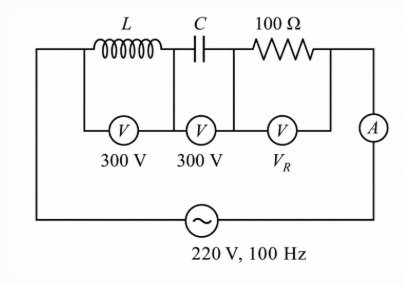
The electrical power delivered to the primary side of a transformer is given by the product of voltage and current, that is the formula
$$P_{\text{in}} = V_p \, I_p.$$
Substituting the given values,
$$P_{\text{in}} = 2300 \times 5 = 11500\ \text{W}.$$
The transformer is not ideal; its efficiency is stated to be $$\eta = 90\% = 0.90.$$ By definition of efficiency,
$$\eta = \frac{P_{\text{out}}}{P_{\text{in}}}.$$
Re-arranging to obtain the output power,
$$P_{\text{out}} = \eta \, P_{\text{in}}.$$
Substituting the known quantities,
$$P_{\text{out}} = 0.90 \times 11500 = 10350\ \text{W}.$$
The secondary (output) voltage is given as $$V_s = 230\ \text{V}.$$ The power leaving the secondary is also the product of this voltage and the secondary current $$I_s$$, so
$$P_{\text{out}} = V_s \, I_s.$$
Solving for the unknown current $$I_s$$, we write
$$I_s = \frac{P_{\text{out}}}{V_s}.$$
Substituting the calculated output power and the given secondary voltage,
$$I_s = \frac{10350}{230} = 45\ \text{A}.$$
Hence, the correct answer is Option A.
For an RLC circuit driven with voltage of amplitude $$v_m$$ and frequency $$\omega_0 = \frac{1}{\sqrt{LC}}$$, the current exhibits resonance. The quality factor, Q is given by:
We begin with the standard series RLC circuit, in which the resistor $$R$$, inductor $$L$$ and capacitor $$C$$ are connected in series and are driven by a sinusoidal voltage source of angular frequency $$\omega$$ and peak (amplitude) value $$v_m$$.
For any series RLC circuit the total impedance is written as
$$Z = R + j\left(\omega L - \frac{1}{\omega C}\right),$$
where the symbol $$j$$ represents the imaginary unit $$\sqrt{-1}$$. The magnitude of this impedance is therefore
$$|Z| = \sqrt{R^{2} + \left(\omega L - \frac{1}{\omega C}\right)^{2}}.$$
Resonance in a series circuit occurs at that frequency $$\omega_0$$ at which the net reactance vanishes, i.e.
$$\omega_0 L - \frac{1}{\omega_0 C} = 0.$$
Solving this equation for the resonant angular frequency, we get
$$\omega_0 L = \frac{1}{\omega_0 C} \quad \Longrightarrow \quad \omega_0^2 = \frac{1}{LC} \quad \Longrightarrow \quad \omega_0 = \frac{1}{\sqrt{LC}}.$$
At resonance the impedance magnitude reduces to its purely resistive part, namely $$|Z| = R$$, and hence the current amplitude becomes maximum, signifying the phenomenon of current resonance.
Now we introduce the quality factor, denoted by $$Q$$. For a series resonant circuit, the definition used in most elementary courses is
$$Q = \frac{\text{Energy stored per cycle (maximum)}}{\text{Energy dissipated per cycle}}.$$
An alternative and very convenient expression—derived from that definition and widely quoted—is
$$Q = \frac{\omega_0 L}{R}.$$
We will show why this result holds. In an inductor the peak magnetic energy stored equals
$$U_L^{\text{(max)}} = \frac{1}{2} L I_m^{2},$$
while in a capacitor the peak electric energy stored is
$$U_C^{\text{(max)}} = \frac{1}{2} C V_m^{2}.$$
Because the inductor and capacitor exchange energy sinusoidally with each other, the total maximum energy stored in the reactive elements at resonance can be represented (for one half-cycle) by either of the above forms; customarily we use the inductive one, yielding
$$U_{\text{stored}}^{\text{(max)}} = \frac{1}{2} L I_m^{2}.$$
The average power dissipated in the resistor over a complete cycle is
$$P_{\text{avg}} = I_{\text{rms}}^{2} R,$$
and for a sinusoidal current the relation between peak and rms values is $$I_m = \sqrt{2}\,I_{\text{rms}}$$, so that
$$P_{\text{avg}} = \frac{I_m^{2}}{2}\,R.$$
The energy dissipated per cycle is therefore
$$W_{\text{diss}} = P_{\text{avg}} \times T,$$
where $$T = \tfrac{2\pi}{\omega_0}$$ is the period at resonance. Substituting, we obtain
$$W_{\text{diss}} = \frac{I_m^{2}}{2}\,R \times \frac{2\pi}{\omega_0} = \frac{\pi I_m^{2} R}{\omega_0}.$$
Using the definition $$Q = \dfrac{2\pi \times (\text{Maximum energy stored})}{\text{Energy dissipated per cycle}},$$ we write
$$Q = \frac{2\pi \times \frac{1}{2} L I_m^{2}}{\dfrac{\pi I_m^{2} R}{\omega_0}} = \frac{2\pi \times \frac{1}{2} L I_m^{2} \times \omega_0}{\pi I_m^{2} R} = \frac{\omega_0 L}{R}.$$
The current and its amplitude $$I_m$$ cancel out, leaving a remarkably simple relationship that ties together the three element parameters. This final algebraic form,
$$Q = \frac{\omega_0 L}{R},$$
is exactly the same as Option B in the list given.
None of the other options reproduces the factor $$\omega_0 L$$ in the numerator with $$R$$ in the denominator, so they are incorrect for a series RLC circuit at resonance.
Hence, the correct answer is Option B.
In an A.C. circuit, the instantaneous e.m.f. and current are given by, $$E = 100 \sin 30t$$, $$I = 20 \sin\left(30t - \frac{\pi}{4}\right)$$. In one cycle of A.C., the average power consumed by the circuit (in watt) and the watt-less current (in ampere) are, respectively:
We have an alternating e.m.f. (voltage) and current described by
$$E(t)=100\sin 30t,\qquad I(t)=20\sin\!\left(30t-\frac{\pi}{4}\right).$$
The amplitude (maximum value) of the voltage is therefore
$$E_{0}=100,$$
and the amplitude of the current is
$$I_{0}=20.$$
First we convert these amplitudes to their r.m.s. (root-mean-square) values. The standard relation is
$$\text{r.m.s. value}=\frac{\text{amplitude}}{\sqrt{2}}.$$
So for the voltage
$$V_{\text{rms}}=\frac{E_{0}}{\sqrt{2}}=\frac{100}{\sqrt{2}},$$
and for the current
$$I_{\text{rms}}=\frac{I_{0}}{\sqrt{2}}=\frac{20}{\sqrt{2}}.$$
Next we identify the phase difference between the voltage and the current. From the given expressions, the voltage is $$\sin 30t$$ while the current is $$\sin(30t-\pi/4).$$ The current therefore lags the voltage by
$$\phi=\frac{\pi}{4}\;(\text{that is, }45^{\circ}).$$
The average (or real) power consumed by an a.c. circuit is found with the formula
$$P_{\text{avg}}=V_{\text{rms}}\,I_{\text{rms}}\cos\phi.$$
Substituting the numerical values we have just obtained:
$$P_{\text{avg}}=\left(\frac{100}{\sqrt{2}}\right)\!\left(\frac{20}{\sqrt{2}}\right)\cos\!\left(\frac{\pi}{4}\right).$$
Now evaluate step by step:
First multiply the numerators:
$$100\times20=2000.$$
Multiply the denominators:
$$\sqrt{2}\times\sqrt{2}=2.$$
Thus the product of the two r.m.s. values is
$$\frac{2000}{2}=1000.$$
Next, recall the trigonometric value
$$\cos\!\left(\frac{\pi}{4}\right)=\frac{1}{\sqrt{2}}.$$
So the average power becomes
$$P_{\text{avg}}=1000\times\frac{1}{\sqrt{2}}=\frac{1000}{\sqrt{2}}\ \text{watt}.$$
This completes the calculation of the real (average) power.
Now we determine the watt-less (reactive) component of the current. The reactive current is the component that is out of phase by 90° with the voltage. Its magnitude is
$$I_{\text{watt-less}}=I_{\text{rms}}\sin\phi.$$
Again substituting the numbers:
$$I_{\text{watt-less}}=\left(\frac{20}{\sqrt{2}}\right)\sin\!\left(\frac{\pi}{4}\right).$$
We use the trigonometric value
$$\sin\!\left(\frac{\pi}{4}\right)=\frac{1}{\sqrt{2}}.$$
Therefore
$$I_{\text{watt-less}}=\frac{20}{\sqrt{2}}\times\frac{1}{\sqrt{2}}=\frac{20}{2}=10\ \text{ampere}.$$
Thus, in one complete cycle of the given a.c. the circuit consumes an average power of $$\dfrac{1000}{\sqrt{2}}\,$$ watt and carries a watt-less current of $$10$$ ampere.
Hence, the correct answer is Option C.
A sinusoidal voltage of peak value 283 V and angular frequency 320 s$$^{-1}$$ is applied to a series LCR circuit. Given that $$R = 5 \; \Omega$$, $$L = 25$$ mH and $$C = 1000 \; \mu$$F. The total impedance and phase difference between the voltage across the source and the current will respectively be-
We begin by recalling the basic relations for a series $$LCR$$ circuit driven by an alternating voltage of angular frequency $$\omega$$.
Inductive reactance is given by the formula $$X_L=\omega L$$.
Capacitive reactance is given by the formula $$X_C=\dfrac{1}{\omega C}$$.
The net (effective) reactance is the difference of the two because the inductor and capacitor contribute opposite phasors:
$$X = X_L - X_C\;.$$
The magnitude of the total impedance is then obtained from the resistance $$R$$ and the net reactance $$X$$ via the impedance formula for a right-angled phasor triangle, i.e.
$$Z=\sqrt{R^2+X^2}\;.$$
The phase angle $$\phi$$ between the source voltage and the current follows from
$$\tan\phi=\dfrac{X}{R}\;.$$
Now we substitute the numerical values one by one.
The data are
$$R = 5\;\Omega,\;\; L = 25\text{ mH} = 25\times10^{-3}\text{ H},\;\; C = 1000\;\mu\text{F} = 1000\times10^{-6}\text{ F}=0.001\text{ F},\;\; \omega = 320\;\text{s}^{-1}.$$
First we calculate the individual reactances.
Inductive reactance:
$$X_L = \omega L = 320 \times 0.025 = 8.0\;\Omega.$$
Capacitive reactance:
$$X_C = \dfrac{1}{\omega C} = \dfrac{1}{320 \times 0.001} = \dfrac{1}{0.32} = 3.125\;\Omega.$$
Hence the net reactance is
$$X = X_L - X_C = 8.0 - 3.125 = 4.875\;\Omega.$$
Substituting $$R=5\;\Omega$$ and $$X=4.875\;\Omega$$ in the impedance expression, we have
$$Z = \sqrt{R^2 + X^2} = \sqrt{5^2 + (4.875)^2} = \sqrt{25 + 23.7656} = \sqrt{48.7656}\;\Omega.$$
Evaluating the square root,
$$Z \approx 6.99\;\Omega \approx 7\;\Omega.$$
For the phase angle, we insert the same values into $$\tan\phi=\dfrac{X}{R}$$:
$$\tan\phi = \dfrac{4.875}{5} = 0.975.$$
The arctangent of 0.975 is very close to $$45^\circ$$ (more precisely about $$44.2^\circ$$), so to the nearest whole degree we may write
$$\phi \approx 45^\circ.$$
Thus, the total impedance of the given series $$LCR$$ circuit is approximately $$7\;\Omega$$ and the phase difference between source voltage and current is about $$45^\circ$$.
Hence, the correct answer is Option B.
An arc lamp requires a direct current of 10 A at 80 V to function. If it is connected to a 220 V (rms), 50 Hz AC supply, the series inductor needed for it to work is close to:
First note what the arc-lamp itself needs. On direct current it draws $$I = 10 \text{ A}$$ when the potential difference across it is $$V = 80 \text{ V}$$. For a purely resistive device the resistance is defined by Ohm’s law
$$R = \dfrac{V}{I}.$$
Substituting the given values, we have
$$R = \dfrac{80}{10} = 8 \;\Omega.$$
Now the lamp must be operated from a sinusoidal mains supply of $$220 \text{ V(rms)},\; 50 \text{ Hz}$$, yet we still want the current through the lamp to be only $$10 \text{ A(rms)}$$. Because the mains voltage is higher than 80 V, an additional impedance must be placed in series to limit the current. The problem asks for an inductor, so that extra impedance will be the inductive reactance $$X_L$$ of the coil.
For a series circuit containing a resistance $$R$$ and an inductive reactance $$X_L$$, the magnitude of the total impedance $$Z$$ is given by
$$Z = \sqrt{R^{2} + X_L^{2}}.$$
But on alternating current we also have, from Ohm’s law extended to impedances,
$$Z = \dfrac{V_{\text{rms}}}{I_{\text{rms}}}.$$
Substituting the required rms values,
$$Z = \dfrac{220}{10} = 22 \;\Omega.$$
Equating the two expressions for $$Z$$ gives
$$\sqrt{R^{2} + X_L^{2}} = 22.$$
We already found $$R = 8 \;\Omega$$, so
$$\sqrt{8^{2} + X_L^{2}} = 22,$$
$$\sqrt{64 + X_L^{2}} = 22.$$
Now square both sides to remove the square root:
$$64 + X_L^{2} = 22^{2} = 484.$$
Solving for $$X_L^{2}$$, we obtain
$$X_L^{2} = 484 - 64 = 420,$$
so
$$X_L = \sqrt{420} \approx 20.49 \;\Omega.$$
The inductive reactance is related to the inductance $$L$$ by the formula
$$X_L = \omega L,$$
where $$\omega$$ is the angular frequency $$\omega = 2\pi f$$. For a supply frequency of $$f = 50 \text{ Hz}$$, we have
$$\omega = 2\pi \times 50 = 100\pi \;\text{rad s}^{-1} \approx 314.16 \;\text{rad s}^{-1}.$$
Substituting into the reactance formula gives
$$L = \dfrac{X_L}{\omega} = \dfrac{20.49}{314.16} \;\text{H}.$$
Carrying out the division,
$$L \approx 0.0652 \;\text{H}.$$
This value rounds to $$0.065 \text{ H}$$, matching option B.
Hence, the correct answer is Option B.
A series $$LR$$ circuit is connected to a voltage source with $$V(t) = V_0\sin(\omega t)$$. After a very large time, current $$I(t)$$ behaves as $$(t_0 \gg \frac{L}{R})$$:
In an $$LR$$ circuit, the ratio $$\tau = \frac{L}{R}$$ is known as the inductive time constant.
The total current in such a circuit consists of two parts: the transient response (which decays exponentially) and the steady-state response.
The condition $$t_0 \gg \tau$$ means that several time constants have passed, causing the transient component ($$e^{-t/\tau}$$) to die out completely.
Once the transients have vanished, the circuit reaches a steady state where the current oscillates at the same frequency as the source voltage $$V(t) = V_0 \sin(\omega t)$$.
The impedance ($$Z$$) of the series $$LR$$ circuit is $$Z = \sqrt{R^2 + X_L^2} = \sqrt{R^2 + (\omega L)^2}$$
The steady-state current $$I(t)$$ is given by $$I(t) = I_0 \sin(\omega t - \phi)$$
Where Amplitude ($$I_0$$): $$I_0 = \frac{V_0}{Z}$$ (a constant value), and Phase Lag ($$\phi$$): $$\phi = \tan^{-1}\left(\frac{\omega L}{R}\right)$$.
After a very large time ($$t_0 \gg L/R$$), the current becomes a stable sinusoidal oscillation. Therefore, Option D is the correct graphical representation.
An LCR circuit is equivalent to a damped pendulum. In an LCR circuit the capacitor is charged to $$Q_0$$ and then connected to the L and R as shown below:
If a student plots graphs of the square of maximum charge $$(Q_{Max}^2)$$ on the capacitor with time (t) for two different values $$L_1$$ and $$L_2$$ ($$L_1 > L_2$$) of L then which of the following represents this graph correctly? (plots are schematic and not drawn to scale)
The discharging of a capacitor in a series LCR circuit is analogous to a damped harmonic oscillator, such as a damped pendulum. The resistor $$R$$ acts as the damping element, dissipating energy and causing the amplitude of the charge to decay exponentially over time.
The maximum charge $$Q_{Max}$$ on the capacitor at any time $$t$$ represents the envelope of the damped oscillation:
$$Q_{Max} = Q_0 e^{-\frac{Rt}{2L}}$$
$$Q_{Max}^2 = \left( Q_0 e^{-\frac{Rt}{2L}} \right)^2 = Q_0^2 e^{-\frac{Rt}{L}}$$
A larger inductance results in a smaller decay constant ($$\frac{R}{L}$$), meaning the charge amplitude decreases more slowly (slower decay).
Given that $$L_1 > L_2$$, the decay for $$L_1$$ is slower than for $$L_2$$. Consequently, for any time $$t > 0$$, the curve for $$L_1$$ will remain at a higher value than the curve for $$L_2$$.
The AC voltage across a resistance can be measured using a:
The problem asks which instrument can measure an alternating-current (AC) voltage that appears across a pure resistance. To decide, we examine the working principle of each listed device, keeping in mind the special nature of AC signals.
First, recall that an AC quantity such as the current through the resistance can be written as $$i(t)=I_0\sin\omega t$$. The instantaneous value of $$i(t)$$ swings symmetrically above and below zero, so over a complete cycle the algebraic average of $$i(t)$$ itself is
$$\langle i(t)\rangle=\frac{1}{T}\int_0^T I_0\sin\omega t \,dt=0$$
However, the heating (thermal) effect of the current is determined by the mean square value, because the power converted to heat is
$$P=i^2 R$$
and the cycle average of $$i^2(t)$$ is
$$\langle i^2(t)\rangle=\frac{1}{T}\int_0^T I_0^2\sin^2\omega t\,dt=\frac{I_0^2}{2}=I_{\text{rms}}^2$$
So an instrument that depends on the heating effect of current will respond to $$I_{\text{rms}}$$ (and, correspondingly, to the rms value of the AC voltage across the resistance), whereas an instrument that attempts to respond to the instantaneous direction of the current will average out to zero.
Now we inspect each option.
Option A: Moving magnet galvanometer. A moving magnet or tangent galvanometer relies on the torque produced by a steady magnetic field generated by a direct current. Because the torque changes sign with the alternating direction of AC, the average torque over a cycle is zero, giving no deflection. Therefore, it cannot measure AC.
Option B: Moving coil galvanometer. A moving coil galvanometer (d'Arsonval type) likewise needs a unidirectional current through its coil. For an AC input $$i(t)=I_0\sin\omega t$$, the torque $$\tau\propto i(t)$$ changes sign every half cycle, again producing an average torque of zero. Hence, the pointer stays at rest and AC is not indicated.
Option C: Hot wire voltmeter. A hot wire voltmeter works on the principle that the wire’s expansion depends on the temperature rise caused by the heating power $$P=i^2R$$. As shown above, $$\langle i^2\rangle$$ is non-zero for AC; in fact it equals $$I_{\text{rms}}^2$$. Therefore the length of the hot wire (and thus the pointer reading) depends on the rms value of the alternating voltage, giving a correct measurement regardless of current direction. It can therefore measure AC as well as DC.
Option D: Potentiometer. A potentiometer is a null-balance device that compares an unknown emf to a known steady DC source. The balance condition requires a constant potential difference; if an AC source is connected, the potential difference reverses polarity, so balancing is impossible. Hence, a conventional potentiometer cannot measure AC.
From the above examination, only the hot wire voltmeter (Option C) operates on a principle—heating effect proportional to $$i^2$$—that yields a meaningful, non-zero indication for an AC voltage.
Hence, the correct answer is Option C.
For the LCR circuit, shown here, the current is observed to lead the applied voltage. An additional capacitor $$C'$$, when joined with the capacitor C present in the circuit, makes the power factor of the circuit unity. The capacitor $$C'$$, must have been connected in:
A unity power factor ($$\cos \phi = 1$$) occurs when the circuit is in resonance.
$$X_L = X_{C_{eq}}$$
$$\omega L = \frac{1}{\omega C_{eq}}$$
$$C_{eq} = \frac{1}{\omega^2 L}$$
It is given that the current leads the applied voltage. This indicates that the circuit is predominantly capacitive.
The capacitive reactance ($$X_C$$) is greater than the inductive reactance ($$X_L$$)
$$X_C > X_L$$
$$\frac{1}{\omega C} > \omega L \implies 1 > \omega^2 LC$$
Since the initial capacitance $$C$$ satisfies $$C < \frac{1}{\omega^2 L}$$, we need to increase the total capacitance to reach the resonance value $$C_{eq}$$.
To increase total capacitance, the additional capacitor $$C'$$ must be connected in parallel with $$C$$.
$$C_{eq} = C + C'$$
$$C + C' = \frac{1}{\omega^2 L}$$
$$C' = \frac{1}{\omega^2 L} - C$$
$$C' = \frac{1 - \omega^2 LC}{\omega^2 L}$$
When the rms voltages $$V_L$$, $$V_C$$ and $$V_R$$ are measured respectively across the inductor L, the capacitor C and the resistor R in a series LCR circuit connected to an AC source, it is found that the ratio $$V_L : V_C : V_R = 1 : 2 : 3$$. If the rms voltage of the AC source is 100 V, then $$V_R$$ is close to:
$$V = \sqrt{V_R^2 + (V_C - V_L)^2}$$
The given ratio of the RMS voltages is $$V_L : V_C : V_R = 1 : 2 : 3$$.
$$V_L = \frac{1}{3}V_R$$ and $$V_C = \frac{2}{3}V_R$$
$$V = \sqrt{V_R^2 + \left(\frac{2}{3}V_R - \frac{1}{3}V_R\right)^2}$$
$$V = \sqrt{V_R^2 + \frac{1}{9}V_R^2} = \sqrt{\frac{10}{9}V_R^2} = \frac{\sqrt{10}}{3}V_R$$
$$100 = \frac{\sqrt{10}}{3}V_R$$
$$V_R = 30 \times 3.162 \approx 94.86\text{ V}$$ (close to 95 V)
When resonance is produced in a series LCR circuit, then which of the following is not correct?
In a series LCR circuit, resonance occurs when the inductive reactance $$X_L$$ equals the capacitive reactance $$X_C$$. At this frequency, the circuit behaves purely resistively. Let's evaluate each option step by step.
Option A states that the current in the circuit is in phase with the applied voltage. At resonance, the phase angle $$\phi$$ is given by $$\phi = \tan^{-1}\left(\frac{X_L - X_C}{R}\right)$$. Since $$X_L = X_C$$, $$\phi = 0$$, meaning the current and voltage are in phase. Thus, option A is correct.
Option B states that inductive and capacitive reactances are equal. This is the defining condition for resonance in a series LCR circuit, so $$X_L = X_C$$. Therefore, option B is correct.
Option C states that if resistance $$R$$ is reduced, the voltage across the capacitor will increase. At resonance, the impedance $$Z = R$$ (minimum), so the current amplitude $$I_0 = \frac{V_0}{R}$$, where $$V_0$$ is the peak applied voltage. The voltage across the capacitor is $$V_C = I \cdot X_C$$. Substituting, $$V_C = \left(\frac{V_0}{R}\right) \cdot X_C$$. Since $$X_C = \frac{1}{\omega C}$$ remains constant at the same resonant frequency, $$V_C$$ is inversely proportional to $$R$$. If $$R$$ decreases, $$V_C$$ increases. Thus, option C is correct.
Option D states that the impedance of the circuit is maximum. The impedance in a series LCR circuit is $$Z = \sqrt{R^2 + (X_L - X_C)^2}$$. At resonance, $$X_L = X_C$$, so $$Z = \sqrt{R^2 + 0} = R$$. This is the minimum possible impedance, not the maximum. Therefore, option D is not correct.
Hence, the correct answer is Option D.
A series LR circuit is connected to an ac source of frequency $$\omega$$ and the inductive reactance is equal to 2R. A capacitance of capacitive reactance equal to R is added in series with L and R. The ratio of the new power factor to the old one is :
First, we have a series LR circuit connected to an AC source of frequency ω. The inductive reactance $$X_L$$ is given as 2R, where R is the resistance. We need to find the power factor for this original circuit.
The power factor is defined as $$\cos \phi$$, where $$\phi$$ is the phase angle between the voltage and current. For a series LR circuit, the impedance $$Z_1$$ is calculated as:
$$ Z_1 = \sqrt{R^2 + X_L^2} $$
Substituting $$X_L = 2R$$:
$$ Z_1 = \sqrt{R^2 + (2R)^2} = \sqrt{R^2 + 4R^2} = \sqrt{5R^2} = R\sqrt{5} $$
The power factor for the original circuit is:
$$ \cos \phi_1 = \frac{R}{Z_1} = \frac{R}{R\sqrt{5}} = \frac{1}{\sqrt{5}} $$
Now, a capacitor is added in series with capacitive reactance $$X_C = R$$. The new circuit is an LCR series circuit with resistance R, inductive reactance $$X_L = 2R$$, and capacitive reactance $$X_C = R$$.
The net reactance $$X$$ is:
$$ X = X_L - X_C = 2R - R = R $$
The impedance $$Z_2$$ for the new circuit is:
$$ Z_2 = \sqrt{R^2 + X^2} = \sqrt{R^2 + (R)^2} = \sqrt{R^2 + R^2} = \sqrt{2R^2} = R\sqrt{2} $$
The power factor for the new circuit is:
$$ \cos \phi_2 = \frac{R}{Z_2} = \frac{R}{R\sqrt{2}} = \frac{1}{\sqrt{2}} $$
We need the ratio of the new power factor to the old power factor:
$$ \text{Ratio} = \frac{\cos \phi_2}{\cos \phi_1} = \frac{\frac{1}{\sqrt{2}}}{\frac{1}{\sqrt{5}}} = \frac{1}{\sqrt{2}} \times \sqrt{5} = \frac{\sqrt{5}}{\sqrt{2}} = \sqrt{\frac{5}{2}} $$
Comparing with the options, $$\sqrt{\frac{5}{2}}$$ corresponds to option D.
Hence, the correct answer is Option D.
An LCR circuit as shown in the figure is connected to a voltage source $$V_{ac}$$ whose frequency can be varied. The frequency, at which the voltage across the resistor is maximum, is :
$$f = \frac{1}{2\pi\sqrt{LC}}$$ (Resonant Frequency)
$$f = \frac{1}{2 \times \pi \times \sqrt{24 \times 2 \times 10^{-6}}}$$
$$f = \frac{1}{2\pi \times \sqrt{48} \times 10^{-3}}$$
$$f \approx \frac{1000}{2 \times 3.14159 \times 6.928}$$
$$f \approx \frac{1000}{43.53}$$
$$f \approx 22.97 \text{ Hz}$$
The plot given below is of the average power delivered to an LRC circuit versus frequency. The quality factor of the circuit is :
The lower cutoff frequency ($$f_1$$) is halfway between $$3.5$$ and $$4.0$$, which is $$3.75\text{ kHz}$$.
The upper cutoff frequency ($$f_2$$) is halfway between $$6.0$$ and $$6.5$$, which is $$6.25\text{ kHz}$$
$$\Delta f = f_2 - f_1 = 6.25\text{ kHz} - 3.75\text{ kHz} = 2.5\text{ kHz}$$
The maximum power occurs exactly at $$f_0 = 5\text{ kHz}$$
$$Q = \frac{f_0}{\Delta f}$$
$$Q = \frac{5\text{ kHz}}{2.5\text{ kHz}} = 2.0$$
In a series L - C - R circuit, $$C = 10^{-11}$$ Farad, $$L = 10^{-5}$$ Henry and $$R = 100$$ Ohm, when a constant D.C. voltage E is applied to the circuit, the capacitor acquires a charge $$10^{-9}$$ C. The D.C. source is replaced by a sinusoidal voltage source in which the peak voltage $$E_0$$ is equal to the constant D.C. voltage E. At resonance the peak value of the charge acquired by the capacitor will be :
In the given series L-C-R circuit, the capacitance $$ C = 10^{-11} $$ Farad, inductance $$ L = 10^{-5} $$ Henry, and resistance $$ R = 100 $$ Ohm. Initially, a constant DC voltage $$ E $$ is applied, and the capacitor acquires a charge of $$ 10^{-9} $$ C. For a capacitor, the charge $$ Q $$ is related to the voltage $$ E $$ by the formula $$ Q = C \cdot E $$. Substituting the known values:
$$ 10^{-9} = (10^{-11}) \cdot E $$
Solving for $$ E $$:
$$ E = \frac{10^{-9}}{10^{-11}} = 10^{-9} \cdot 10^{11} = 10^{2} = 100 \, \text{Volts} $$
Thus, the DC voltage $$ E $$ is 100 Volts.
The DC source is replaced by a sinusoidal voltage source with peak voltage $$ E_0 $$ equal to the DC voltage $$ E $$, so $$ E_0 = 100 $$ V. We need to find the peak charge on the capacitor at resonance.
At resonance in a series L-C-R circuit, the impedance is minimum and purely resistive, equal to $$ R $$. The peak current $$ I_0 $$ is given by:
$$ I_0 = \frac{E_0}{R} = \frac{100}{100} = 1 \, \text{A} \, (\text{peak}) $$
At resonance, the capacitive reactance $$ X_C $$ is calculated using the resonant frequency $$ \omega_0 = \frac{1}{\sqrt{LC}} $$. The capacitive reactance is:
$$ X_C = \frac{1}{\omega_0 C} = \frac{1}{\left( \frac{1}{\sqrt{LC}} \right) C} = \frac{\sqrt{LC}}{C} = \sqrt{\frac{L}{C}} $$
Substituting the given values:
$$ \frac{L}{C} = \frac{10^{-5}}{10^{-11}} = 10^{-5} \cdot 10^{11} = 10^{6} $$
$$ \sqrt{\frac{L}{C}} = \sqrt{10^{6}} = 10^{3} \, \Omega $$
So, $$ X_C = 1000 \, \Omega $$.
The peak voltage across the capacitor $$ V_{C0} $$ is:
$$ V_{C0} = I_0 \cdot X_C = (1) \cdot (1000) = 1000 \, \text{V} \, (\text{peak}) $$
The peak charge $$ Q_0 $$ on the capacitor is given by $$ Q_0 = C \cdot V_{C0} $$:
$$ Q_0 = (10^{-11}) \cdot (1000) = 10^{-11} \cdot 10^{3} = 10^{-8} \, \text{C} $$
Therefore, at resonance, the peak value of the charge acquired by the capacitor is $$ 10^{-8} $$ C.
Comparing with the options:
A. $$ 10^{-15} $$ C
B. $$ 10^{-6} $$ C
C. $$ 10^{-10} $$ C
D. $$ 10^{-8} $$ C
Hence, the correct answer is Option D.
In the circuit shown here, the voltage across E and C are respectively 300 V and 400 V. The voltage E of the ac source is :
The resultant source voltage $$E$$ is the magnitude of the phasor difference between $$V_L$$ and $$V_C$$: $$E = |V_L - V_C|$$
$$E = |300 - 400|$$
$$E = 100\text{ V}$$
In an $$LCR$$ circuit shown in the following figure, what will be the readings of the voltmeter across the resistor and ammeter if an a.c. source of 220 V and 100 Hz is connected to it as shown?
A fully charged capacitor $$C$$ with initial charge $$q_0$$ is connected to a coil of self inductance $$L$$ at $$t = 0$$. The time at which the energy is stored equally between the electric and the magnetic fields is:
In a series LCR circuit $$R = 200\,\Omega$$ and the voltage and the frequency of the main supply is $$220$$ V and $$50$$ Hz respectively. On taking out the capacitance from the circuit the current lags behind the voltage by $$30^\circ$$. On taking out the inductor from the circuit the current leads the voltage by $$30^\circ$$. The power dissipated in the LCR circuit is
In an a.c. circuit the voltage applied is $$E = E_0 \sin \omega t$$. The resulting current in the circuit is $$I = I_0 \sin\left(\omega t - \frac{\pi}{2}\right)$$. The power consumption in the circuit is given by
In a series resonant LCR circuit, the voltage across $$R$$ is $$100$$ volts and $$R = 1\,k\Omega$$ with $$C = 2\,\mu F$$. The resonant frequency $$\omega$$ is $$200\,rad/s$$. At resonance the voltage across $$L$$ is
The self inductance of the motor of an electric fan is $$10$$ H. In order to impart maximum power at $$50$$ Hz, it should be connected to a capacitance of
A circuit has a resistance of $$12 \Omega$$ and an impedance of $$15 \Omega$$. The power factor of the circuit will be
The phase difference between the alternating current and emf is $$\pi/2$$. Which of the following cannot be the constituent of the circuit?
Alternating current can not be measured by D.C. ammeter because
In an LCR series a.c. circuit, the voltage across each of the components, $$L, C$$ and $$R$$ is $$50$$ V. The voltage across the LC combination will be
In a LCR circuit capacitance is changed from $$C$$ to $$2C$$. For the resonant frequency to remain unchanged, the inductance should be changed from $$L$$ to