
Join Our JEE Preparation Group
Prep with like-minded aspirants; Get access to free daily tests and study material.
Sign in
Please select an account to continue using cracku.in
↓ →
Join Our JEE Preparation Group
Prep with like-minded aspirants; Get access to free daily tests and study material.
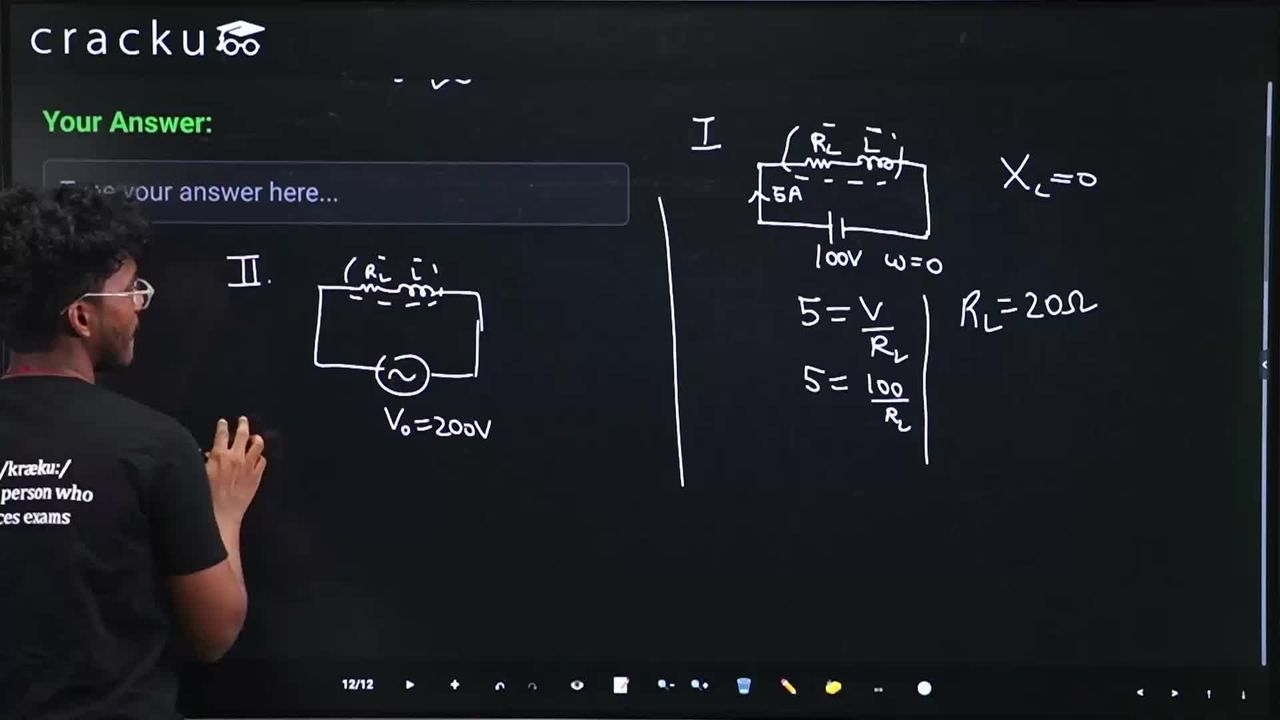
When a dc voltage of $$100 \text{ V}$$ is applied to an inductor, a dc current of $$5 \text{ A}$$ flows through it. When an ac voltage of peak value $$200 \text{ V}$$ is connected to inductor, its inductive reactance is found to be $$20\sqrt{3} \Omega$$. The power dissipated in the circuit is _______ W.
Correct Answer: 250
An inductor is connected first to DC (100 V, 5 A) and then to AC (peak 200 V, $$X_L = 20\sqrt{3} \Omega$$). Under DC the inductor acts as a pure resistance at zero frequency, so the resistance is $$ R = \frac{V_{DC}}{I_{DC}} = \frac{100}{5} = 20 \,\Omega $$.
Under AC the impedance is $$ Z = \sqrt{R^2 + X_L^2} = \sqrt{20^2 + (20\sqrt{3})^2} = \sqrt{400 + 1200} = \sqrt{1600} = 40 \,\Omega $$.
The RMS voltage is $$V_{rms} = \frac{V_0}{\sqrt{2}} = \frac{200}{\sqrt{2}}$$ V, so the RMS current is $$ I_{rms} = \frac{V_{rms}}{Z} = \frac{200}{\sqrt{2}\times 40} = \frac{200}{40\sqrt{2}} = \frac{5}{\sqrt{2}} \text{ A} $$.
Since power is dissipated only in the resistance, $$ P = I_{rms}^2 \times R = \frac{25}{2} \times 20 = 250 \text{ W} $$. Therefore the answer is $$250$$ W.
Was this solution helpful?
Click on the Email ☝️ to Watch the Video Solution
Create a FREE account and get:
_1.webp)

Educational materials for JEE preparation

Ask our AI anything

AI can make mistakes. Please verify important information.
AI can make mistakes. Please verify important information.
