
Join Our JEE Preparation Group
Prep with like-minded aspirants; Get access to free daily tests and study material.
Sign in
Please select an account to continue using cracku.in
↓ →
Join Our JEE Preparation Group
Prep with like-minded aspirants; Get access to free daily tests and study material.
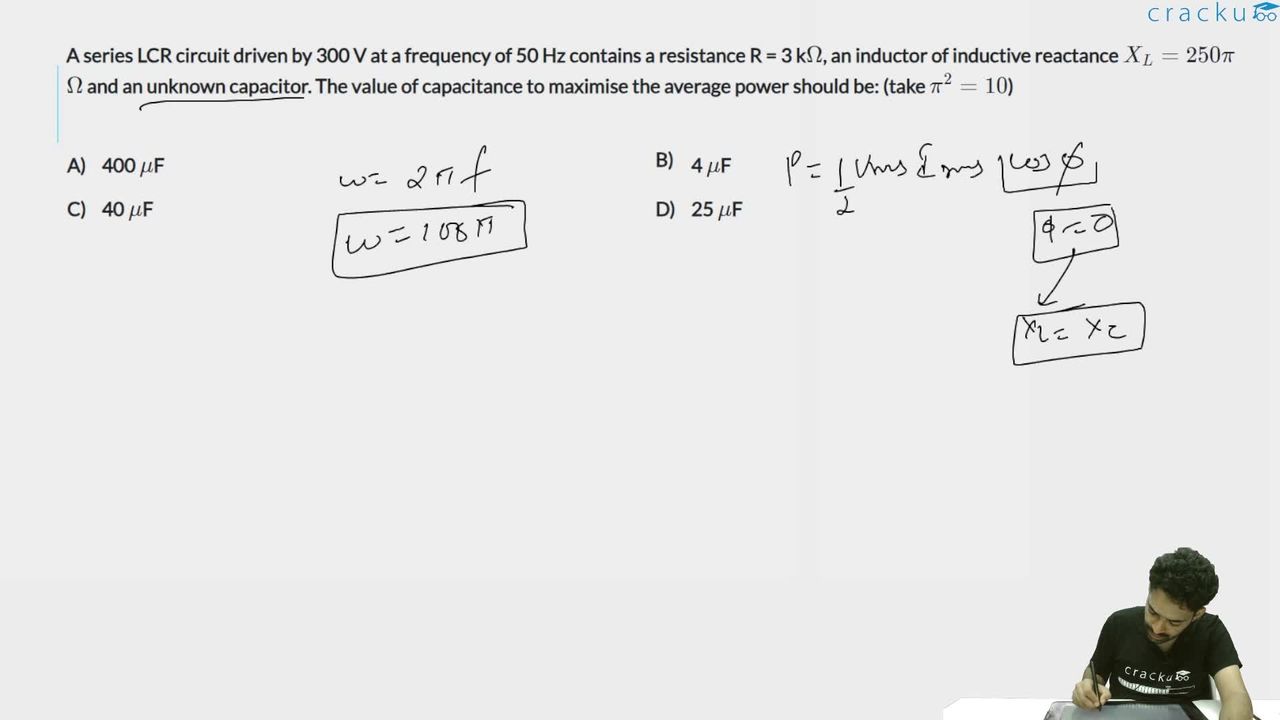
A series LCR circuit driven by 300 V at a frequency of 50 Hz contains a resistance R = 3 k$$\Omega$$, an inductor of inductive reactance $$X_L = 250\pi$$ $$\Omega$$ and an unknown capacitor. The value of capacitance to maximise the average power should be: (take $$\pi^2 = 10$$)
We begin with the expression for the impedance of a series $$LCR$$ circuit
$$Z=\sqrt{R^{2}+\left(X_L-X_C\right)^{2}}.$$
The rms current is $$I=\dfrac{V}{Z},$$ so the average (true) power delivered to the circuit is
$$P_{\text{avg}} = V_{\text{rms}}\,I_{\text{rms}}\cos\phi = V_{\text{rms}} \left(\dfrac{V_{\text{rms}}}{Z}\right)\left(\dfrac{R}{Z}\right) = \dfrac{V_{\text{rms}}^{2}\,R}{Z^{2}}.$$
Because $$R$$ is fixed, $$P_{\text{avg}}$$ becomes maximum when the impedance $$Z$$ is minimum. Looking at the formula for $$Z,$$ the minimum value occurs when the bracketed term vanishes, that is, when
$$X_L = X_C.$$
This condition is called resonance, and at resonance the circuit behaves as a pure resistance: the phase angle $$\phi$$ becomes zero and $$\cos\phi = 1,$$ giving the greatest possible average power.
We are given the inductive reactance
$$X_L = 250\pi\; \Omega.$$
To satisfy $$X_L = X_C,$$ we must have
$$X_C = 250\pi\; \Omega.$$
The capacitive reactance is related to the capacitance by the formula
$$X_C = \frac{1}{\omega C},$$
where the angular frequency $$\omega$$ equals $$2\pi f.$$ The supply frequency is $$f = 50\;\text{Hz},$$ so
$$\omega = 2\pi f = 2\pi \times 50 = 100\pi\;\text{rad s}^{-1}.$$
Substituting $$X_C = 250\pi$$ and $$\omega = 100\pi$$ into $$X_C = \dfrac{1}{\omega C},$$ we get
$$250\pi = \frac{1}{100\pi\,C}.$$
Rearranging for $$C$$ gives
$$C = \frac{1}{100\pi \times 250\pi} = \frac{1}{25000\pi^{2}}\;\text{farad}.$$
The problem states that $$\pi^{2} = 10,$$ so
$$C = \frac{1}{25000 \times 10} = \frac{1}{250000}\;\text{F}.$$
To convert to microfarads, recall that $$1\;\text{F} = 10^{6}\;\mu\text{F},$$ therefore
$$C = \frac{10^{6}}{250000}\;\mu\text{F} = 4\;\mu\text{F}.$$
Hence, the correct answer is Option B.
Was this solution helpful?
Click on the Email ☝️ to Watch the Video Solution
Create a FREE account and get:
_1.webp)

Educational materials for JEE preparation

Ask our AI anything

AI can make mistakes. Please verify important information.
AI can make mistakes. Please verify important information.
