
Join Our JEE Preparation Group
Prep with like-minded aspirants; Get access to free daily tests and study material.
Sign in
Please select an account to continue using cracku.in
↓ →
Join Our JEE Preparation Group
Prep with like-minded aspirants; Get access to free daily tests and study material.
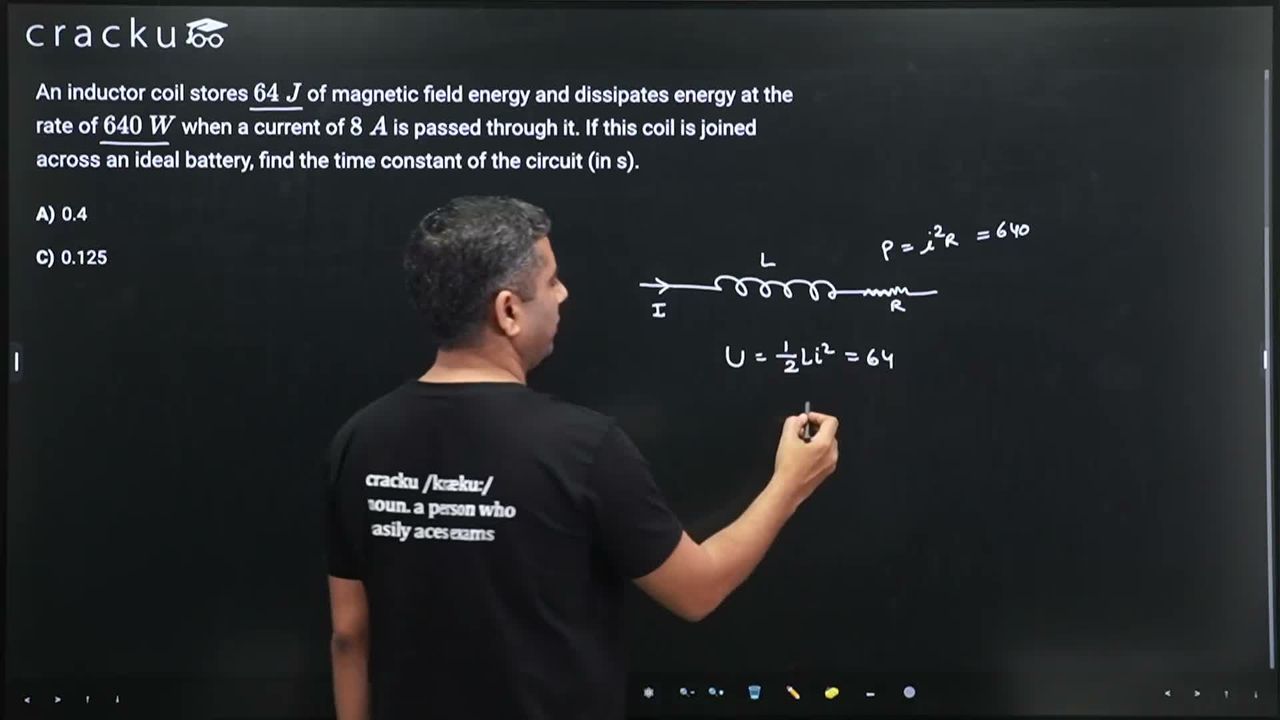
An inductor coil stores $$64\ J$$ of magnetic field energy and dissipates energy at the rate of $$640\ W$$ when a current of $$8\ A$$ is passed through it. If this coil is joined across an ideal battery, find the time constant of the circuit (in s).
We know that the magnetic energy stored in an inductor is given by the formula $$U=\dfrac12\,L\,I^{2}$$, where $$U$$ is the energy, $$L$$ the inductance and $$I$$ the current through the inductor.
Here the stored energy is $$U=64\ \text{J}$$ and the steady current is $$I=8\ \text{A}$$. Substituting these values, we get
$$64=\dfrac12\,L\,(8)^{2}$$
First square the current: $$(8)^{2}=64.$$ So the equation becomes
$$64=\dfrac12\,L\,\times 64$$
Multiply both sides by $$2$$ to remove the fraction:
$$128=L\times 64$$
Now divide by $$64$$ to isolate $$L$$:
$$L=\dfrac{128}{64}=2\ \text{H}$$
Thus the inductance of the coil is $$L=2\ \text{H}.$$
Next, the rate at which electrical energy is dissipated as heat in the resistance of the coil is the electric power $$P$$, and for a resistor this power is given by the formula $$P=I^{2}R,$$ where $$R$$ is the resistance.
The problem states that the coil dissipates energy at the rate $$P=640\ \text{W}$$ when the same current $$I=8\ \text{A}$$ flows. Substituting these values, we have
$$640=(8)^{2}\,R$$
Again $$ (8)^{2}=64 $$, so
$$640=64\,R$$
Dividing both sides by $$64$$ gives
$$R=\dfrac{640}{64}=10\ \Omega$$
Hence the resistance of the coil is $$R=10\ \Omega.$$
When this coil is connected across an ideal battery, the circuit behaves as an $$LR$$ circuit. The time constant $$\tau$$ of such a circuit is defined by the relation $$\tau=\dfrac{L}{R}.$$ Stating the formula explicitly: the time constant is the ratio of the inductance to the resistance.
Substituting $$L=2\ \text{H}$$ and $$R=10\ \Omega$$, we obtain
$$\tau=\dfrac{2\ \text{H}}{10\ \Omega}=0.2\ \text{s}$$
Therefore, the time constant of the circuit is $$0.2\ \text{s}.$$
Hence, the correct answer is Option B.
Was this solution helpful?
Click on the Email ☝️ to Watch the Video Solution
Create a FREE account and get:
_1.webp)

Educational materials for JEE preparation

Ask our AI anything

AI can make mistakes. Please verify important information.
AI can make mistakes. Please verify important information.
