
Join Our JEE Preparation Group
Prep with like-minded aspirants; Get access to free daily tests and study material.
Sign in
Please select an account to continue using cracku.in
↓ →
Join Our JEE Preparation Group
Prep with like-minded aspirants; Get access to free daily tests and study material.
Given below are two statements: Statement I: In an LCR series circuit, current is maximum at resonance. Statement II: Current in a purely resistive circuit can never be less than that in a series LCR circuit when connected to same voltage source. In the light of the above statements, choose the correct from the options given below:
We need to evaluate two statements about LCR circuits and resistive circuits.
Analysis of Statement I: "In an LCR series circuit, current is maximum at resonance."
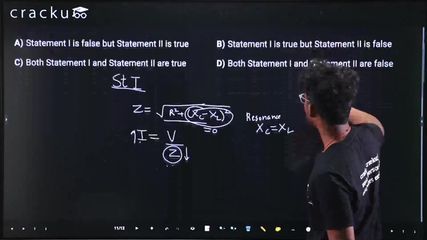
At resonance in a series LCR circuit, the inductive reactance equals the capacitive reactance: $$X_L = X_C$$. The impedance becomes: $$Z = \sqrt{R^2 + (X_L - X_C)^2} = \sqrt{R^2 + 0} = R$$. Since impedance is minimum (equal to R alone), the current $$I = V/Z = V/R$$ is maximum. Statement I is TRUE.
Analysis of Statement II: "Current in a purely resistive circuit can never be less than that in a series LCR circuit when connected to same voltage source."
For a purely resistive circuit: $$I_R = V/R$$
For a series LCR circuit: $$I_{LCR} = V/Z = V/\sqrt{R^2 + (X_L - X_C)^2}$$
Since $$Z = \sqrt{R^2 + (X_L - X_C)^2} \geq R$$ for all values of $$X_L$$ and $$X_C$$, we always have $$I_R \geq I_{LCR}$$. The equality holds only at resonance when $$X_L = X_C$$. Statement II is TRUE.
The correct answer is Option (3): Both Statement I and Statement II are true.
Was this solution helpful?
Click on the Email ☝️ to Watch the Video Solution
Create a FREE account and get:
_1.webp)

Educational materials for JEE preparation

Ask our AI anything

AI can make mistakes. Please verify important information.
AI can make mistakes. Please verify important information.
