
Join Our JEE Preparation Group
Prep with like-minded aspirants; Get access to free daily tests and study material.
Sign in
Please select an account to continue using cracku.in
↓ →
Join Our JEE Preparation Group
Prep with like-minded aspirants; Get access to free daily tests and study material.
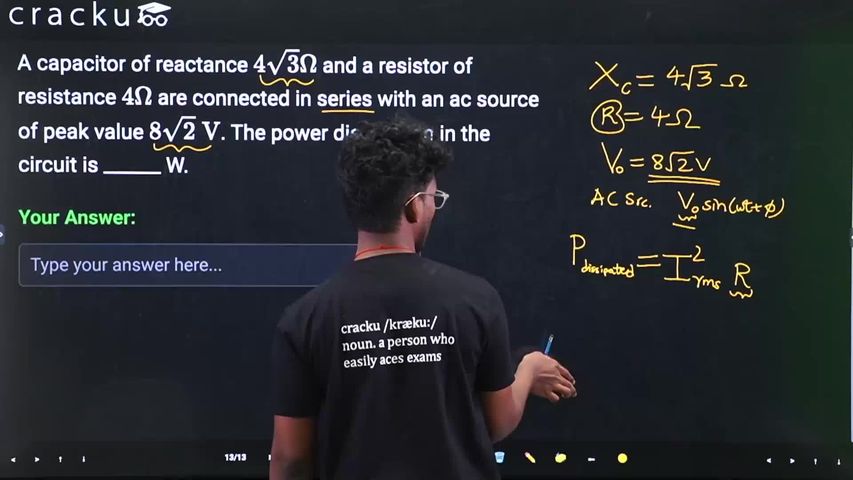
A capacitor of reactance $$4\sqrt{3} \Omega$$ and a resistor of resistance $$4\Omega$$ are connected in series with an ac source of peak value $$8\sqrt{2} \text{ V}$$. The power dissipation in the circuit is ______ W.
Correct Answer: 4
We need to find the power dissipation in a series RC circuit connected to an AC source.
Capacitive reactance: $$X_C = 4\sqrt{3} \text{ } \Omega$$
Resistance: $$R = 4 \text{ } \Omega$$
Peak voltage: $$V_0 = 8\sqrt{2} \text{ V}$$
For a series RC circuit, the impedance is given by:
$$Z = \sqrt{R^2 + X_C^2}$$
Substituting the values:
$$Z = \sqrt{(4)^2 + (4\sqrt{3})^2} = \sqrt{16 + 48} = \sqrt{64} = 8 \text{ } \Omega$$
The relationship between peak and RMS voltage is:
$$V_{rms} = \frac{V_0}{\sqrt{2}} = \frac{8\sqrt{2}}{\sqrt{2}} = 8 \text{ V}$$
Using Ohm's law for AC circuits:
$$I_{rms} = \frac{V_{rms}}{Z} = \frac{8}{8} = 1 \text{ A}$$
In an AC circuit, power is dissipated only in the resistive component (capacitors and inductors do not dissipate power on average). The power dissipation formula is:
$$P = I_{rms}^2 \times R$$
This can also be written as $$P = V_{rms} \cdot I_{rms} \cdot \cos\phi$$, where $$\cos\phi = R/Z$$ is the power factor. Both forms give the same result.
$$P = (1)^2 \times 4 = 4 \text{ W}$$
Verification using power factor:
$$\cos\phi = \frac{R}{Z} = \frac{4}{8} = 0.5$$
$$P = V_{rms} \times I_{rms} \times \cos\phi = 8 \times 1 \times 0.5 = 4$$ W. This confirms our answer.
The answer is 4 W.
Was this solution helpful?
Click on the Email ☝️ to Watch the Video Solution
Create a FREE account and get:
_1.webp)

Educational materials for JEE preparation

Ask our AI anything

AI can make mistakes. Please verify important information.
AI can make mistakes. Please verify important information.
