
Join Our JEE Preparation Group
Prep with like-minded aspirants; Get access to free daily tests and study material.
Sign in
Please select an account to continue using cracku.in
↓ →
Join Our JEE Preparation Group
Prep with like-minded aspirants; Get access to free daily tests and study material.
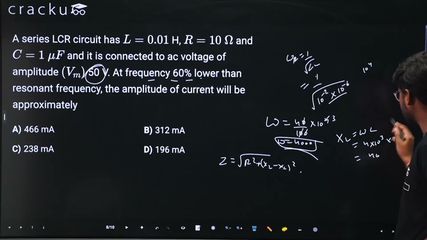
A series LCR circuit has $$L = 0.01$$ H, $$R = 10 \ \Omega$$ and $$C = 1 \ \mu F$$ and it is connected to ac voltage of amplitude $$(V_m)$$ 50 V. At frequency 60% lower than resonant frequency, the amplitude of current will be approximately
A series LCR circuit has $$L = 0.01$$ H, $$R = 10 \ \Omega$$, $$C = 1 \ \mu F$$, and amplitude $$V_m = 50$$ V. We are asked to find the current amplitude at a frequency 60% lower than the resonant frequency.
Since the resonant angular frequency is given by $$\omega_0 = \frac{1}{\sqrt{LC}},$$ substituting $$L = 0.01$$ and $$C = 10^{-6}$$ yields $$\omega_0 = \frac{1}{\sqrt{0.01 \times 10^{-6}}} = \frac{1}{\sqrt{10^{-8}}} = \frac{1}{10^{-4}} = 10^4 \text{ rad/s}.$$
Because the frequency of interest is 60% lower than resonance, we have $$\omega = \omega_0 - 0.6\omega_0 = 0.4\omega_0 = 0.4 \times 10^4 = 4000 \text{ rad/s}.$$
Next, the inductive reactance is $$X_L = \omega L = 4000 \times 0.01 = 40 \ \Omega,$$ and the capacitive reactance is $$X_C = \frac{1}{\omega C} = \frac{1}{4000 \times 10^{-6}} = \frac{1}{4 \times 10^{-3}} = 250 \ \Omega.$$
From the above reactances, the impedance of the circuit follows as $$Z = \sqrt{R^2 + (X_L - X_C)^2} = \sqrt{10^2 + (40 - 250)^2} = \sqrt{100 + (-210)^2} = \sqrt{100 + 44100} = \sqrt{44200} \approx 210.24 \ \Omega.$$
Therefore, the amplitude of the current is $$I_m = \frac{V_m}{Z} = \frac{50}{210.24} \approx 0.2378 \text{ A} \approx 238 \text{ mA}.$$
Answer: Option C: 238 mA
Was this solution helpful?
Click on the Email ☝️ to Watch the Video Solution
Create a FREE account and get:
_1.webp)

Educational materials for JEE preparation

Ask our AI anything

AI can make mistakes. Please verify important information.
AI can make mistakes. Please verify important information.
