
Join Our JEE Preparation Group
Prep with like-minded aspirants; Get access to free daily tests and study material.
Sign in
Please select an account to continue using cracku.in
↓ →
Join Our JEE Preparation Group
Prep with like-minded aspirants; Get access to free daily tests and study material.
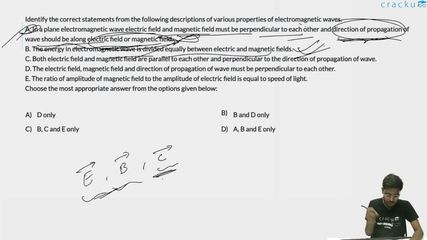
Identify the correct statements from the following descriptions of various properties of electromagnetic waves.
A. In a plane electromagnetic wave electric field and magnetic field must be perpendicular to each other and direction of propagation of wave should be along electric field or magnetic field.
B. The energy in electromagnetic wave is divided equally between electric and magnetic fields.
C. Both electric field and magnetic field are parallel to each other and perpendicular to the direction of propagation of wave.
D. The electric field, magnetic field and direction of propagation of wave must be perpendicular to each other.
E. The ratio of amplitude of magnetic field to the amplitude of electric field is equal to speed of light.
Choose the most appropriate answer from the options given below:
We need to identify the correct statements about electromagnetic waves from the given options.
Key Properties of Electromagnetic Waves:
In a plane electromagnetic wave propagating in free space:
1. The electric field $$\vec{E}$$, magnetic field $$\vec{B}$$, and direction of propagation $$\vec{k}$$ are mutually perpendicular.
2. The direction of propagation is given by $$\vec{E} \times \vec{B}$$ (Poynting vector direction).
3. The relation between amplitudes is $$\frac{E_0}{B_0} = c$$ (speed of light).
4. The average energy density in electric field = average energy density in magnetic field, i.e., $$\frac{1}{2}\epsilon_0 E_0^2 = \frac{B_0^2}{2\mu_0}$$ (on average).
Statement A: "Electric field and magnetic field must be perpendicular to each other and direction of propagation should be along electric field or magnetic field."
The first part is correct: $$\vec{E} \perp \vec{B}$$.
The second part is wrong: the direction of propagation is perpendicular to BOTH $$\vec{E}$$ and $$\vec{B}$$, not along either of them. The propagation direction is along $$\vec{E} \times \vec{B}$$.
Statement A is INCORRECT.
Statement B: "The energy in electromagnetic wave is divided equally between electric and magnetic fields."
The average electric energy density is $$u_E = \frac{1}{2}\epsilon_0 E_{rms}^2 = \frac{1}{4}\epsilon_0 E_0^2$$.
The average magnetic energy density is $$u_B = \frac{B_{rms}^2}{2\mu_0} = \frac{B_0^2}{4\mu_0}$$.
Using the relation $$E_0 = cB_0$$ and $$c = \frac{1}{\sqrt{\mu_0\epsilon_0}}$$:
$$u_E = \frac{1}{4}\epsilon_0 E_0^2 = \frac{1}{4}\epsilon_0 c^2 B_0^2 = \frac{1}{4}\epsilon_0 \cdot \frac{1}{\mu_0\epsilon_0} \cdot B_0^2 = \frac{B_0^2}{4\mu_0} = u_B$$
So the energy is indeed equally divided between the electric and magnetic fields.
Statement B is CORRECT.
Statement C: "Both electric field and magnetic field are parallel to each other and perpendicular to the direction of propagation."
While both $$\vec{E}$$ and $$\vec{B}$$ are perpendicular to the direction of propagation (they are transverse waves), they are NOT parallel to each other. They are perpendicular to each other.
Statement C is INCORRECT.
Statement D: "The electric field, magnetic field and direction of propagation must be perpendicular to each other."
This is exactly the defining property of plane EM waves: $$\vec{E}$$, $$\vec{B}$$, and $$\hat{k}$$ (propagation direction) form a right-handed mutually perpendicular set.
Statement D is CORRECT.
Statement E: "The ratio of amplitude of magnetic field to the amplitude of electric field is equal to speed of light."
The correct relation is: $$\frac{E_0}{B_0} = c$$
This means the ratio of electric field amplitude to magnetic field amplitude equals the speed of light.
The statement claims $$\frac{B_0}{E_0} = c$$, which is the inverse of the correct relation. Since $$\frac{B_0}{E_0} = \frac{1}{c}$$, this statement is wrong.
Statement E is INCORRECT.
The correct statements are B and D.
Answer: Option B: B and D only
Was this solution helpful?
Click on the Email ☝️ to Watch the Video Solution
Create a FREE account and get:
_1.webp)

Educational materials for JEE preparation

Ask our AI anything

AI can make mistakes. Please verify important information.
AI can make mistakes. Please verify important information.
