
Join Our JEE Preparation Group
Prep with like-minded aspirants; Get access to free daily tests and study material.
Sign in
Please select an account to continue using cracku.in
↓ →
Join Our JEE Preparation Group
Prep with like-minded aspirants; Get access to free daily tests and study material.
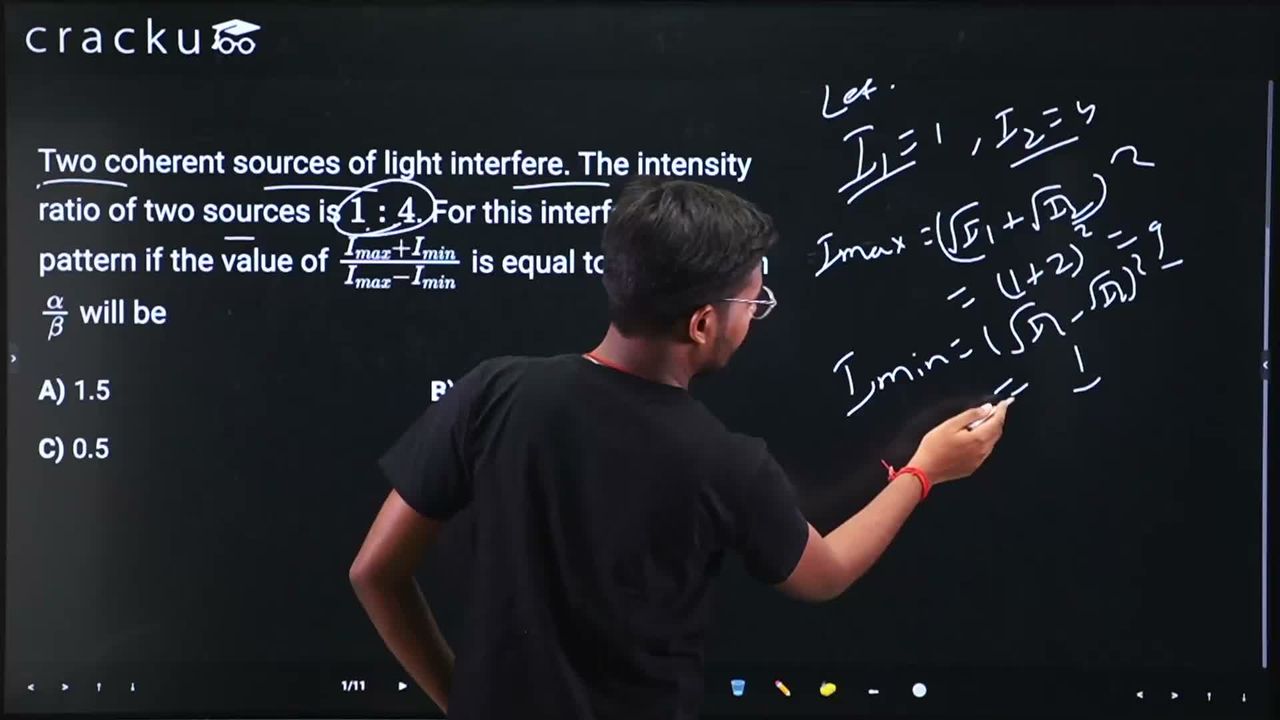
Two coherent sources of light interfere. The intensity ratio of two sources is $$1 : 4$$. For this interference pattern if the value of $$\frac{I_{max}+I_{min}}{I_{max}-I_{min}}$$ is equal to $$\frac{2\alpha+1}{\beta+3}$$, then $$\frac{\alpha}{\beta}$$ will be
Two coherent sources have an intensity ratio of $$1:4$$, and we are required to determine $$\frac{\alpha}{\beta}$$ given that $$\frac{I_{max}+I_{min}}{I_{max}-I_{min}} = \frac{2\alpha+1}{\beta+3}$$.
Let us denote the intensities by $$I_1 = I$$ and $$I_2 = 4I$$; since amplitude is proportional to the square root of intensity, we set $$a_1 = a$$ and $$a_2 = 2a$$.
For constructive interference, the amplitudes add, giving
$$I_{max} = (\sqrt{I_1} + \sqrt{I_2})^2 = (\sqrt{I} + 2\sqrt{I})^2 = 9I\,. $$
Conversely, destructive interference yields
$$I_{min} = (\sqrt{I_1} - \sqrt{I_2})^2 = (\sqrt{I} - 2\sqrt{I})^2 = I\,. $$
Substituting these expressions into the given ratio gives
$$\frac{I_{max}+I_{min}}{I_{max}-I_{min}} = \frac{9I + I}{9I - I} = \frac{10I}{8I} = \frac{5}{4}\,. $$
Therefore,
$$\frac{2\alpha+1}{\beta+3} = \frac{5}{4}\,. $$
By equating numerators and denominators separately, we obtain
$$2\alpha + 1 = 5 \implies \alpha = 2$$
and
$$\beta + 3 = 4 \implies \beta = 1\,. $$
Hence, the required ratio is
$$\frac{\alpha}{\beta} = \frac{2}{1} = 2\,. $$
Answer: Option B: 2
Was this solution helpful?
Click on the Email ☝️ to Watch the Video Solution
Create a FREE account and get:
_1.webp)

Educational materials for JEE preparation

Ask our AI anything

AI can make mistakes. Please verify important information.
AI can make mistakes. Please verify important information.
