
Join Our JEE Preparation Group
Prep with like-minded aspirants; Get access to free daily tests and study material.
Sign in
Please select an account to continue using cracku.in
↓ →
Join Our JEE Preparation Group
Prep with like-minded aspirants; Get access to free daily tests and study material.
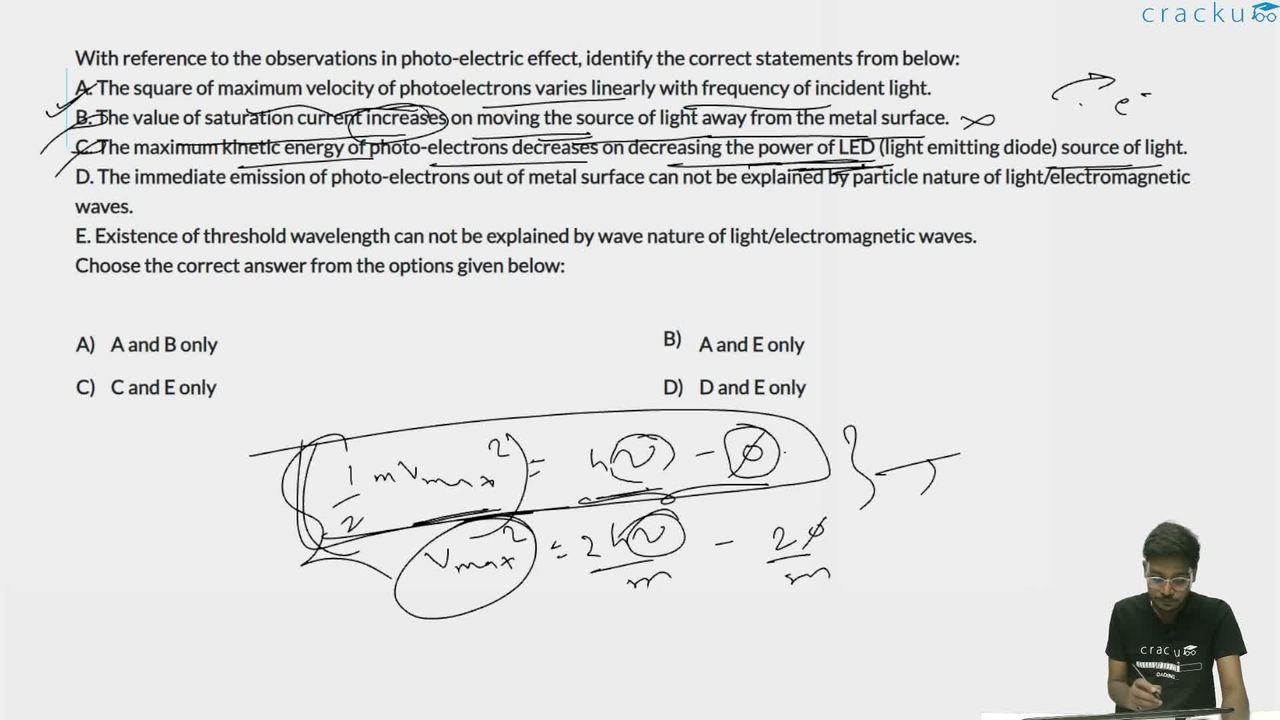
With reference to the observations in photo-electric effect, identify the correct statements from below:
A. The square of maximum velocity of photoelectrons varies linearly with frequency of incident light.
B. The value of saturation current increases on moving the source of light away from the metal surface.
C. The maximum kinetic energy of photo-electrons decreases on decreasing the power of LED (light emitting diode) source of light.
D. The immediate emission of photo-electrons out of metal surface can not be explained by particle nature of light/electromagnetic waves.
E. Existence of threshold wavelength can not be explained by wave nature of light/electromagnetic waves.
Choose the correct answer from the options given below:
We need to identify the correct statements about the photo-electric effect.
The square of maximum velocity of photoelectrons varies linearly with frequency of incident light. From Einstein's photoelectric equation:
$$\frac{1}{2}mv_{max}^2 = h\nu - \phi$$
$$v_{max}^2 = \frac{2h\nu}{m} - \frac{2\phi}{m}$$
This is of the form $$v_{max}^2 = a\nu + b$$, which is linear in frequency $$\nu$$. Statement A is CORRECT.
The value of saturation current increases on moving the source of light away from the metal surface. When the source moves away, the intensity of light at the surface decreases. Lower intensity means fewer photons strike the surface per unit time, so fewer photoelectrons are emitted. Hence, the saturation current decreases. Statement B is INCORRECT.
The maximum kinetic energy of photo-electrons decreases on decreasing the power of LED source. The maximum kinetic energy depends on the frequency of incident light, not on the intensity (or power). For an LED, the frequency remains the same regardless of power. Decreasing power only reduces the number of photons, not their individual energy. Statement C is INCORRECT.
The immediate emission of photo-electrons cannot be explained by particle nature of light. The particle (photon) nature of light easily explains instantaneous emission: a single photon transfers all its energy to one electron at once. It is the wave theory that cannot explain this. Statement D is INCORRECT.
The existence of threshold wavelength cannot be explained by wave nature of light. According to wave theory, any frequency of light should be able to eject electrons given enough intensity. The existence of a threshold wavelength (minimum frequency) below which no emission occurs cannot be explained by wave theory. Statement E is CORRECT.
The correct statements are A and E only.
The correct answer is Option B.
Was this solution helpful?
Click on the Email ☝️ to Watch the Video Solution
Create a FREE account and get:
_1.webp)

Educational materials for JEE preparation

Ask our AI anything

AI can make mistakes. Please verify important information.
AI can make mistakes. Please verify important information.
