
Join Our JEE Preparation Group
Prep with like-minded aspirants; Get access to free daily tests and study material.
Sign in
Please select an account to continue using cracku.in
↓ →
Join Our JEE Preparation Group
Prep with like-minded aspirants; Get access to free daily tests and study material.
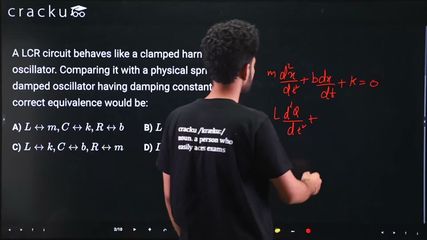
A LCR circuit behaves like a clamped harmonic oscillator. Comparing it with a physical spring-mass damped oscillator having damping constant 'b', the correct equivalence would be:
We first recall the loop equation for a series $$L\,C\,R$$ circuit. Applying Kirchhoff’s voltage law around the closed loop, the algebraic sum of the potential drops across the inductor, resistor and capacitor is zero, i.e.
$$V_L+V_R+V_C = 0.$$
For each element we write its constitutive relation: the inductor obeys $$V_L = L\,\dfrac{dI}{dt},$$ the resistor obeys Ohm’s law $$V_R = R\,I,$$ and the capacitor obeys $$V_C = \dfrac{q}{C},$$ where $$q$$ is the charge on the capacitor and $$I=\dfrac{dq}{dt}$$ is the circuit current. Substituting these three expressions into the loop equation gives
$$L\,\dfrac{dI}{dt}+R\,I+\dfrac{q}{C}=0.$$
Now we eliminate the current in favour of charge. Because $$I=\dfrac{dq}{dt},$$ we have $$\dfrac{dI}{dt}=\dfrac{d^2q}{dt^2}.$$ Writing everything in terms of $$q(t)$$ yields the second-order differential equation
$$L\,\dfrac{d^2q}{dt^2}+R\,\dfrac{dq}{dt}+\dfrac{1}{C}\,q=0.\qquad(1)$$
This equation is the electrical analogue of the mechanical damped spring-mass system. For the mechanical oscillator of mass $$m,$$ damping constant $$b$$ and spring constant $$k,$$ Newton’s second law gives
$$m\,\dfrac{d^2x}{dt^2}+b\,\dfrac{dx}{dt}+k\,x=0.\qquad(2)$$
Comparing equation (1) term by term with equation (2), we match the coefficients of the second derivative, the first derivative and the displacement/charge terms. We obtain
$$\begin{aligned} \text{Coefficient of }\dfrac{d^2}{dt^2}:&\quad L \longleftrightarrow m,\\[6pt] \text{Coefficient of }\dfrac{d}{dt}:&\quad R \longleftrightarrow b,\\[6pt] \text{Coefficient of the variable itself}:&\quad \dfrac{1}{C} \longleftrightarrow k. \end{aligned}$$
The last line tells us that $$\dfrac{1}{C}=k,$$ or equivalently $$C=\dfrac{1}{k}.$$ Therefore the complete correspondence is
$$L \leftrightarrow m,\qquad C \leftrightarrow \dfrac{1}{k},\qquad R \leftrightarrow b.$$
This mapping is precisely the one stated in Option D.
Hence, the correct answer is Option D.
Was this solution helpful?
Click on the Email ☝️ to Watch the Video Solution
Create a FREE account and get:
_1.webp)

Educational materials for JEE preparation

Ask our AI anything

AI can make mistakes. Please verify important information.
AI can make mistakes. Please verify important information.


