
Join Our JEE Preparation Group
Prep with like-minded aspirants; Get access to free daily tests and study material.
Sign in
Please select an account to continue using cracku.in
↓ →
Join Our JEE Preparation Group
Prep with like-minded aspirants; Get access to free daily tests and study material.
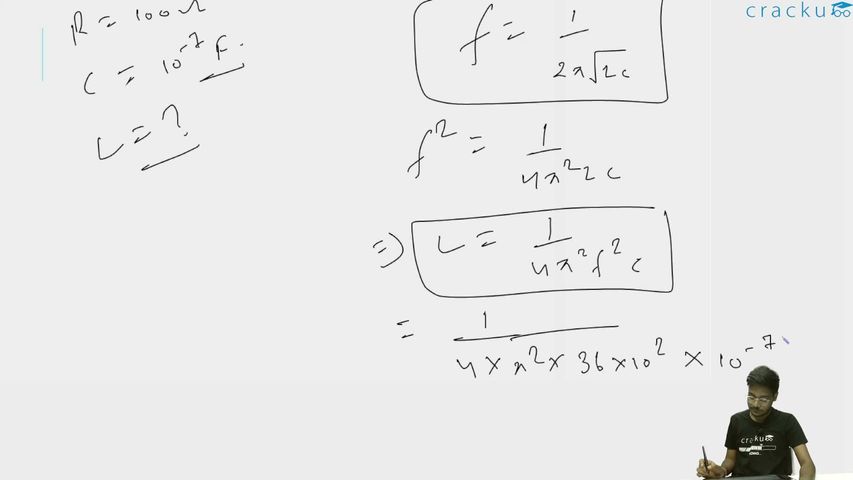
A 100$$\Omega$$ resistance, a 0.1$$\mu$$F capacitor and an inductor are connected in series across a 250 V supply at variable frequency. Calculate the value of inductance of inductor at which resonance will occur. Given that the resonant frequency is 60 Hz.
At resonance in a series $$RLC$$ circuit the inductive reactance equals the capacitive reactance. We first state this resonance condition:
$$X_L = X_C \quad\Longrightarrow\quad \omega L = \dfrac{1}{\omega C}$$
Here $$\omega$$ is the angular resonant frequency, related to the ordinary frequency $$f$$ by the well-known formula $$\omega = 2\pi f$$. Solving the above equality for the inductance $$L$$ gives
$$L = \dfrac{1}{\omega^{2} C}.$$
We are given
$$f = 60\ \text{Hz}, \qquad C = 0.1\ \mu\text{F}.$$
First we convert the capacitance into farads, remembering that $$1\ \mu\text{F} = 10^{-6}\ \text{F}:$$
$$C = 0.1\ \mu\text{F} = 0.1 \times 10^{-6}\ \text{F} = 1 \times 10^{-7}\ \text{F}.$$
Now we calculate the angular frequency:
$$\omega = 2\pi f = 2\pi \times 60\ \text{rad s}^{-1} = 120\pi\ \text{rad s}^{-1}.$$
For numerical work we use $$\pi \approx 3.1416$$, so
$$\omega = 120 \times 3.1416\ \text{rad s}^{-1} \approx 376.99\ \text{rad s}^{-1}.$$
Next we square this angular frequency, showing each step:
$$\omega^{2} = (376.99)^{2}\ \text{rad}^{2}\text{s}^{-2}.$$
Working out the square:
$$376.99^{2} = 376.99 \times 376.99 = 142\,129\ (\text{to the nearest unit}).$$
So
$$\omega^{2} \approx 1.42129 \times 10^{5}\ \text{rad}^{2}\text{s}^{-2}.$$
We now substitute $$\omega^{2}$$ and $$C$$ into the inductance formula:
$$L = \dfrac{1}{\omega^{2} C} = \dfrac{1}{\left(1.42129 \times 10^{5}\right) \left(1 \times 10^{-7}\right)}.$$
First multiply the denominator:
$$(1.42129 \times 10^{5})(1 \times 10^{-7}) = 1.42129 \times 10^{5-7} = 1.42129 \times 10^{-2}.$$
So we have
$$L = \dfrac{1}{1.42129 \times 10^{-2}}\ \text{henry}.$$
The reciprocal is obtained as follows:
$$\dfrac{1}{1.42129 \times 10^{-2}} = \dfrac{1}{0.0142129} \approx 70.36\ \text{H}.$$
Rounding to three significant figures gives
$$L \approx 70.3\ \text{H}.$$
Hence, the correct answer is Option D.
Was this solution helpful?
Click on the Email ☝️ to Watch the Video Solution
Create a FREE account and get:
_1.webp)

Educational materials for JEE preparation

Ask our AI anything

AI can make mistakes. Please verify important information.
AI can make mistakes. Please verify important information.
