
Join Our JEE Preparation Group
Prep with like-minded aspirants; Get access to free daily tests and study material.
Sign in
Please select an account to continue using cracku.in
↓ →
Join Our JEE Preparation Group
Prep with like-minded aspirants; Get access to free daily tests and study material.
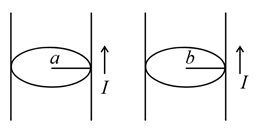
Figure A and B shown two long straight wires of circular cross-section ($$a$$ and $$b$$ with $$a < b$$), carrying current $$I$$ which is uniformly distributed across the cross-section. The magnitude of magnetic field $$B$$ varies with radius $$r$$ and can be represented as:
Upon reviewing the mathematical syntax in the previous derivation, a formatting error was found in the "Inside the Wire" bullet point where the enclosed current fraction failed to render properly. Here is the fully corrected, clean solution:
For a long straight wire of radius $$R$$ carrying a uniformly distributed current $$I$$:
$$I_{\text{enc}} = I \left( \frac{\pi r^2}{\pi R^2} \right) = I \frac{r^2}{R^2}$$
Applying Ampere's Law ($$\oint \vec{B} \cdot d\vec{l} = \mu_0 I_{\text{enc}}$$):$$B_{\text{in}} \cdot 2\pi r = \mu_0 I \left(\frac{r^2}{R^2}\right) \implies B_{\text{in}} = \left(\frac{\mu_0 I}{2\pi R^2}\right) r$$
This shows that inside the wire, the magnetic field increases linearly with radius ($$B \propto r$$).$$B_{\text{out}} \cdot 2\pi r = \mu_0 I \implies B_{\text{out}} = \frac{\mu_0 I}{2\pi r}$$
This shows that outside the wire, the magnetic field decreases hyperbolically ($$B \propto \frac{1}{r}$$).$$B_{\text{max}} = \frac{\mu_0 I}{2\pi R}$$
Since $$B_{\text{max}}$$ is inversely proportional to the wire's radius ($$B_{\text{max}} \propto \frac{1}{R}$$), the thinner wire ($$a$$) will reach a higher peak magnetic field than the thicker wire ($$b$$) because $$a < b$$.Let's compile the features our graph must show:
Reviewing the choices
The correct graphical representation of the magnetic field variation is given by Option A.
Was this solution helpful?
Create a FREE account and get:
_1.webp)

Educational materials for JEE preparation

Ask our AI anything

AI can make mistakes. Please verify important information.
AI can make mistakes. Please verify important information.
