
Join Our JEE Preparation Group
Prep with like-minded aspirants; Get access to free daily tests and study material.
Sign in
Please select an account to continue using cracku.in
↓ →
Join Our JEE Preparation Group
Prep with like-minded aspirants; Get access to free daily tests and study material.
The resistance of a conductor at 15°C is 16 $$\Omega$$ and at 100°C is 20 $$\Omega$$. What will be the temperature coefficient of resistance of the conductor?
We are given that the resistance of the conductor is $$R_1 = 16\;\Omega$$ at the initial temperature $$T_1 = 15^{\circ}\text{C}$$ and becomes $$R_2 = 20\;\Omega$$ at the higher temperature $$T_2 = 100^{\circ}\text{C}$$.
For a metallic conductor, the variation of resistance with temperature is described by the linear relation
$$R = R_0\left[1 + \alpha\,(T - T_0)\right],$$
where
$$R_0$$ = resistance at the reference temperature $$T_0,$$
$$R$$ = resistance at temperature $$T,$$
$$\alpha$$ = temperature coefficient of resistance (per °C).
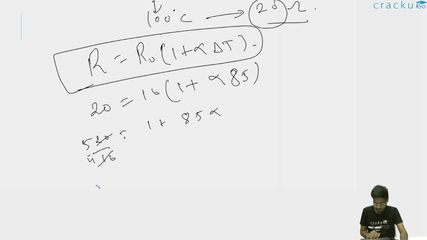
Applying this formula to our data, we write
$$R_2 = R_1\left[1 + \alpha\,(T_2 - T_1)\right].$$
Substituting the known values, we get
$$20 = 16\left[1 + \alpha\,(100 - 15)\right].$$
First evaluate the temperature difference:
$$100 - 15 = 85^{\circ}\text{C}.$$
So the equation becomes
$$20 = 16\left[1 + 85\,\alpha\right].$$
Now divide both sides by 16 to isolate the bracketed term:
$$\frac{20}{16} = 1 + 85\,\alpha.$$
Simplify the left-hand fraction:
$$\frac{20}{16} = 1.25.$$
Thus we have
$$1.25 = 1 + 85\,\alpha.$$
Subtract 1 from both sides:
$$1.25 - 1 = 85\,\alpha.$$
$$0.25 = 85\,\alpha.$$
Finally, divide by 85 to solve for $$\alpha$$:
$$\alpha = \frac{0.25}{85}.$$
Perform the division step by step:
$$\alpha = \frac{25}{8500} = \frac{1}{340} \;\text{per}\;^{\circ}\text{C}.$$
Numerically,
$$\alpha \approx 0.00294\;^{\circ}\text{C}^{-1} \approx 0.003\;^{\circ}\text{C}^{-1}.$$
This matches the third option given in the list.
Hence, the correct answer is Option C.
Was this solution helpful?
Click on the Email ☝️ to Watch the Video Solution
Create a FREE account and get:
_1.webp)

Educational materials for JEE preparation

Ask our AI anything

AI can make mistakes. Please verify important information.
AI can make mistakes. Please verify important information.
