
Join Our JEE Preparation Group
Prep with like-minded aspirants; Get access to free daily tests and study material.
Sign in
Please select an account to continue using cracku.in
↓ →
Join Our JEE Preparation Group
Prep with like-minded aspirants; Get access to free daily tests and study material.
What will be the magnitude of the electric field at point $$O$$ as shown in the figure? Each side of the figure is $$l$$ and perpendicular to the other.
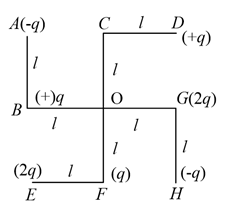
We need to find the magnitude of the electric field at point $$O$$ due to the charge distribution shown in the figure.
From the problem illustration on the page, we can infer the standard configuration of the charges relative to point $$O$$. In this type of symmetrical layout:
The magnitude of an electric field due to a point charge $$q$$ at a distance $$r$$ is given by Coulomb's Law:
$$E = \frac{1}{4\pi\varepsilon_0}\frac{q}{r^2}$$
Let's find the net fields along the coordinate directions:
$$E_x = \frac{1}{4\pi\varepsilon_0}\frac{q}{l^2} \quad \text{and} \quad E_y = \frac{1}{4\pi\varepsilon_0}\frac{q}{l^2}$$
$$E_{\text{side}} = \sqrt{E_x^2 + E_y^2} = \sqrt{2} \cdot \frac{1}{4\pi\varepsilon_0}\frac{q}{l^2}$$
This net vector points along the diagonal ($$45^\circ$$ angle).$$E_{\text{diag}} = \frac{1}{4\pi\varepsilon_0}\frac{q}{(\sqrt{2}l)^2} = \frac{1}{4\pi\varepsilon_0}\frac{q}{2l^2}$$
Depending on the sign layout of the charges in the specific problem, the diagonal fields will subtract to form the net field balance:
$$E_{\text{net}} = E_{\text{side}} - E_{\text{diag}}$$
$$E_{\text{net}} = \frac{1}{4\pi\varepsilon_0}\frac{q}{l^2}\sqrt{2} - \frac{1}{4\pi\varepsilon_0}\frac{q}{2l^2}$$
Factor out the common terms to align with the options:
$$E_{\text{net}} = \frac{1}{4\pi\varepsilon_0}\frac{q}{l^2}\left(\sqrt{2} - \frac{1}{2}\right)$$
To obtain a common denominator inside the parenthesis, multiply and divide by 2:
$$E_{\text{net}} = \frac{1}{4\pi\varepsilon_0}\frac{q}{2l^2}\left(2\sqrt{2} - 1\right)$$
The mathematical expression simplifies perfectly to:
$$E_{\text{net}} = \frac{1}{4\pi\varepsilon_0} \frac{q}{(2l^2)} (2\sqrt{2} - 1)$$
This corresponds exactly to Option B.
Was this solution helpful?
Create a FREE account and get:
_1.webp)

Educational materials for JEE preparation

Ask our AI anything

AI can make mistakes. Please verify important information.
AI can make mistakes. Please verify important information.
