
Join Our JEE Preparation Group
Prep with like-minded aspirants; Get access to free daily tests and study material.
Sign in
Please select an account to continue using cracku.in
↓ →
Join Our JEE Preparation Group
Prep with like-minded aspirants; Get access to free daily tests and study material.
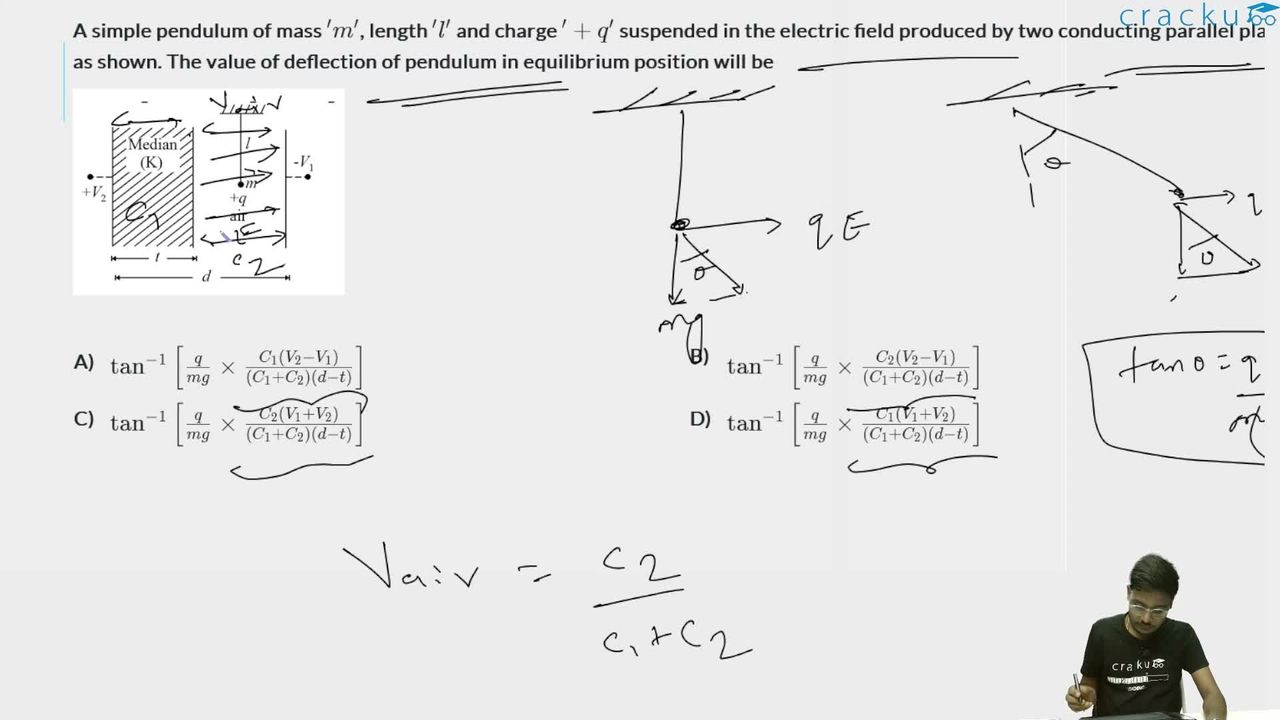
A simple pendulum of mass $$'m'$$, length $$'l'$$ and charge $$'+q'$$ suspended in the electric field produced by two conducting parallel plates as shown. The value of deflection of pendulum in equilibrium position will be
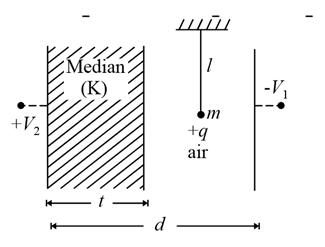
We need to determine the angle of deflection ($$\theta$$) for a simple pendulum of mass $$m$$, length $$l$$, and charge $$+q$$ suspended in equilibrium inside a complex parallel-plate system.
When the pendulum is in its deflected equilibrium position, it experiences three primary forces:
Balancing the horizontal and vertical components of these forces gives:
$$T \sin\theta = qE$$
$$T \cos\theta = mg$$
Dividing the two equations yields the standard relationship for the deflection angle:
$$\tan\theta = \frac{qE}{mg} \implies \theta = \tan^{-1}\left[ \frac{q}{mg} \times E \right]$$
From the problem geometry , the system consists of a dielectric or plate combination setup between conducting parallel boundaries split across thicknesses $$t$$ and $$d-t$$. This arrangement acts equivalent to two capacitors, $$C_1$$ and $$C_2$$, connected in series across a total potential difference.
The total net potential difference driving the system is the sum of the magnitudes of the boundary voltages:
$$V_{\text{total}} = V_1 + V_2$$
In a series combination of capacitors, the potential difference across a single component (let's find the voltage $$V$$ across the active region hosting the pendulum) is inversely proportional to its capacitance:
$$V = \left( \frac{C_2}{C_1 + C_2} \right) V_{\text{total}} = \frac{C_2(V_1 + V_2)}{C_1 + C_2}$$
The uniform electric field $$E$$ in a region of space with a remaining gap thickness of $$(d - t)$$ is defined as:
$$E = \frac{V}{\text{thickness}} = \frac{C_2(V_1 + V_2)}{(C_1 + C_2)(d - t)}$$
Now, substitute this expression for the electric field $$E$$ back into our equilibrium equation:
$$\theta = \tan^{-1}\left[ \frac{q}{mg} \times \frac{C_2(V_1 + V_2)}{(C_1 + C_2)(d - t)} \right]$$
The exact value of the deflection of the pendulum at its equilibrium position matches Option C:
$$\theta = \tan^{-1}\left[ \frac{q}{mg} \times \frac{C_2(V_1 + V_2)}{(C_1 + C_2)(d - t)} \right]$$
Was this solution helpful?
Click on the Email ☝️ to Watch the Video Solution
Create a FREE account and get:
_1.webp)

Educational materials for JEE preparation

Ask our AI anything

AI can make mistakes. Please verify important information.
AI can make mistakes. Please verify important information.
