
Join Our JEE Preparation Group
Prep with like-minded aspirants; Get access to free daily tests and study material.
Sign in
Please select an account to continue using cracku.in
↓ →
Join Our JEE Preparation Group
Prep with like-minded aspirants; Get access to free daily tests and study material.
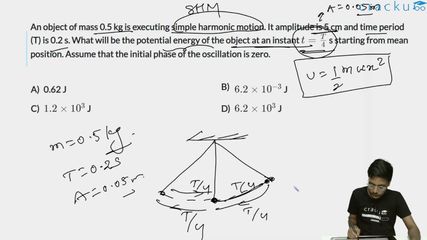
An object of mass 0.5 kg is executing simple harmonic motion. It amplitude is 5 cm and time period (T) is 0.2 s. What will be the potential energy of the object at an instant $$t = \frac{T}{4}$$ s starting from mean position. Assume that the initial phase of the oscillation is zero.
We have an object of mass $$m = 0.5\;{\rm kg}$$ executing simple harmonic motion (S.H.M.).
Its amplitude is given as $$A = 5\;{\rm cm}$$. Converting centimetres to metres,
$$A = 5\;{\rm cm} = 5 \times 10^{-2}\;{\rm m} = 0.05\;{\rm m}.$$
The time-period is $$T = 0.2\;{\rm s}.$$ For S.H.M. the angular frequency is related to the period by the formula
$$\omega = \frac{2\pi}{T}.$$
Substituting the given value of $$T$$, we get
$$\omega = \frac{2\pi}{0.2} = 10\pi\;{\rm rad\,s^{-1}}.$$
Since the motion starts from the mean position with zero initial phase, the displacement as a function of time is
$$x(t) = A \sin(\omega t).$$
At the instant $$t = \dfrac{T}{4}$$, we have
$$\omega t = \omega \left(\frac{T}{4}\right) = \frac{2\pi}{T}\,\frac{T}{4} = \frac{2\pi}{4} = \frac{\pi}{2}.$$
So the displacement becomes
$$x\!\left(\frac{T}{4}\right) = A \sin\!\left(\frac{\pi}{2}\right) = A \times 1 = A = 0.05\;{\rm m}.$$
Thus, at $$t = \dfrac{T}{4}$$ the particle has reached the extreme position; its kinetic energy is zero and its potential energy equals the total mechanical energy of the oscillation.
The total mechanical energy $$E$$ stored in S.H.M. is given by the formula
$$E = \frac{1}{2} k A^{2},$$
where $$k$$ is the force constant. Using the relation $$k = m\omega^{2},$$ the energy can also be written as
$$E = \frac{1}{2} m \omega^{2} A^{2}.$$
Substituting the known values step by step:
$$\omega^{2} = (10\pi)^{2} = 100\pi^{2} \approx 100 \times 9.8696 = 986.96,$$
$$A^{2} = (0.05)^{2} = 0.0025,$$
$$m \omega^{2} A^{2} = 0.5 \times 986.96 \times 0.0025 = 0.5 \times 2.4674 = 1.2337.$$
Now applying the factor $$\dfrac{1}{2}$$ in the formula,
$$E = \frac{1}{2} \times 1.2337 = 0.6169\;{\rm J}.$$
This is approximately $$0.62\;{\rm J}.$$ Because all the mechanical energy at this instant is stored as potential energy, we have
$$U\!\left(t = \frac{T}{4}\right) \approx 0.62\;{\rm J}.$$
Hence, the correct answer is Option A.
Was this solution helpful?
Click on the Email ☝️ to Watch the Video Solution
Create a FREE account and get:
_1.webp)

Educational materials for JEE preparation

Ask our AI anything

AI can make mistakes. Please verify important information.
AI can make mistakes. Please verify important information.
