

 Group
Group
 Group
Group


 Preferred Source

 Google Discover

JEE EMF & Circuit Analysis PYQs
JEE EMF & Circuit Analysis PYQs are an important part of the JEE Physics syllabus. Practising these questions helps you understand key concepts such as electromotive force, internal resistance, terminal voltage, current distribution, Kirchhoff’s laws, series and parallel combinations, cells, resistors, and electrical circuits.
Questions from EMF and circuit analysis can appear in JEE as direct numericals, concept-based questions, or circuit-solving problems. At first, this topic may feel a little confusing because a single circuit can contain several cells, resistors, loops, and junctions. However, once you learn how to read the circuit properly and apply the correct sign convention, the questions become much easier.
There is no need to memorise every circuit result without understanding it. Regular revision, clear circuit diagrams, and steady practice with EMF & Circuit Analysis Questions can make a big difference. Solving chapter-wise JEE Questions, attempting a JEE Mains Mock Test, and practising from a JEE Mains Previous Paper can also help you improve your speed and confidence.
In this blog, you will find an EMF & Circuit Analysis Formula Sheet, important JEE EMF & Circuit Analysis PYQs in downloadable format, practice questions with answers, and a few extra problems for self-practice. You will also learn about common mistakes students make while solving circuit questions and some simple ways to avoid them in the exam.
JEE EMF & Circuit Analysis Important PYQs PDF
This PDF can include some of the most useful previous-year questions from EMF and circuit analysis. The questions may cover electromotive force, internal resistance, terminal potential difference, combinations of cells, Kirchhoff’s junction and loop laws, Wheatstone bridge, metre bridge, equivalent resistance, and electrical power.
Practising these EMF & Circuit Analysis Questions will help you understand the type of problems commonly asked in JEE. It can also improve your calculation speed, accuracy, and ability to choose the right method. Solving questions from a JEE Mains Previous Paper will give you a better idea of the actual exam pattern.
Important Formulas for JEE EMF & Circuit Analysis PYQs
You only need a limited number of important formulas to solve most questions from this topic. These formulas are mainly used to calculate current, terminal voltage, internal resistance, equivalent resistance, and electrical power.
You can download the complete EMF & Circuit Analysis Formula Sheet from the link above. Here is a quick revision of some commonly used formulas:
| Concept | Formula |
|---|---|
| Electromotive Force | $$E = \frac{W}{q}$$ |
| Current in a Circuit | $$I = \frac{E}{R + r}$$ |
| Terminal Voltage | $$V = E - Ir$$ |
| Internal Resistance | $$r = \frac{E - V}{I}$$ |
| Resistors in Series | $$R = R_1 + R_2 + R_3$$ |
| Resistors in Parallel | $$\frac{1}{R} = \frac{1}{R_1} + \frac{1}{R_2} + \frac{1}{R_3}$$ |
| Electrical Power | $$P = VI = I^2R = \frac{V^2}{R}$$ |
| Kirchhoff’s Junction Law | $$\sum I = 0$$ |
| Kirchhoff’s Loop Law | $$\sum V = 0$$ |
| Balanced Wheatstone Bridge | $$\frac{P}{Q} = \frac{R}{S}$$ |
These formulas are frequently used in JEE Questions based on cells, resistance combinations, electrical networks, terminal voltage, Kirchhoff’s laws, and power. Revising the EMF & Circuit Analysis Formula Sheet before solving questions can help you avoid small mistakes and save time.
Top 5 Common Mistakes to Avoid in JEE EMF & Circuit Analysis PYQs
Many students find this topic difficult because of small sign, formula, or circuit-reading errors. Here are some common mistakes you should avoid:
Confusing EMF with terminal voltage
EMF and terminal voltage are not always equal. When a cell supplies current, some voltage is lost across its internal resistance. Always check which quantity the question is asking for.
Using the wrong sign in Kirchhoff’s loop law
While moving around a closed loop, you must carefully mark each potential rise and potential drop. One wrong sign can change the entire answer.
Combining resistors incorrectly
Before calculating equivalent resistance, check whether the resistors are actually connected in series or parallel. Resistors that look parallel in a diagram may not share the same two end points.
Ignoring the internal resistance of a cell
Students sometimes calculate current using only the external resistance. If internal resistance is given, it must also be included unless the cell is considered ideal.
Changing the assumed current direction midway
In a complex circuit, you can assume any direction for current. If the answer comes out negative, it simply means the actual direction is opposite. There is no need to change the direction during the calculation.
Regular practice with EMF & Circuit Analysis Questions, a JEE Mains Mock Test, and problems from a JEE Mains Previous Paper can help you reduce these errors and improve your accuracy.
List of JEE EMF & Circuit Analysis PYQs
Below is a test-style set of EMF & Circuit Analysis Questions covering internal resistance, terminal voltage, Kirchhoff’s laws, resistor combinations, cells, and electrical power. Solve each question before checking the answer.
Question 1
A series LCR circuit with $$L = \frac{100}{\pi}$$ mH, $$C = \frac{10^{-3}}{\pi}$$ F and $$R = 10$$ $$\Omega$$, is connected across an AC source of 220 V, 50 Hz supply. The power factor of the circuit would be _____.
correct answer:- 1
Question 2
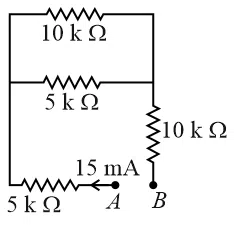
A current of $$15 \text{ mA}$$ flows in the circuit as shown in figure. The value of potential difference between the points $$A$$ and $$B$$ will be
correct answer:- 4
Question 3
A galvanometer of resistance $$G$$ is converted into a voltmeter of range $$0 - 1\,\text{V}$$ by connecting a resistance $$R$$ in series with it. The additional resistance that should be connected in series with $$R_1$$ to increase the range of the voltmeter to $$0 - 2\,\text{V}$$ will be:
correct answer:- 4
Question 4
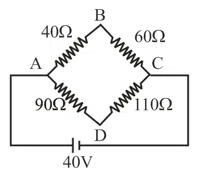
Four resistances 40 $$\Omega$$, 60 $$\Omega$$, 90 $$\Omega$$, 110 $$\Omega$$ and make the arms of a quadrilateral ABCD. Across AC is a battery of emf 40 V and internal resistance negligible. The potential difference across BD in V is __________
correct answer:- 2
Question 5
To compare EMF of two cells using potentiometer the balancing lengths obtained are 200 cm and 150 cm. The least count of scale is 1 cm. The percentage error in the ratio of EMFs is______
correct answer:- 4

Question 6
The net current flowing in the given circuit is_______ A.
image
correct answer:- 1
Question 7
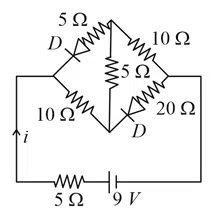
The current $$i$$ in the network is:
correct answer:- 3
Question 8
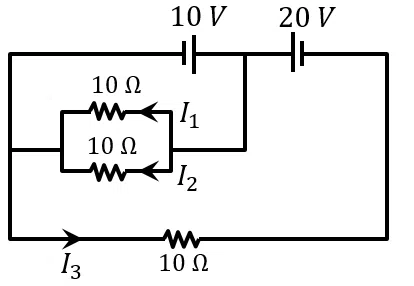
In the given circuit the value of $$\left|\frac{I_1+I_3}{I_2}\right|$$ is:
correct answer:- 3
Question 9
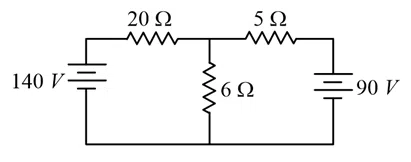
The value of current in the 6 $$\Omega$$ resistance is:
correct answer:- 3
Question 10
A cell of emf 90 V is connected across series combination of two resistors each of 100 $$\Omega$$ resistance. A voltmeter of resistance 400 $$\Omega$$ is used to measure the potential difference across each resistor. The reading of the voltmeter will be:
correct answer:- 1

Question 11
A galvanometer, whose resistance is 50 ohm, has 25 divisions in it. When a current of $$4 \times 10^{-4}$$ A passes through it, its needle (pointer) deflects by one division. To use this galvanometer as a voltmeter of range 2.5 V it should be connected to a resistance of:
correct answer:- 4
Question 12
A battery of $$6 \text{ V}$$ is connected to the circuit as shown below. The current $$I$$ drawn from the battery is
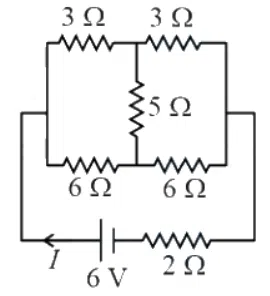
correct answer:- 1
Question 13
The total current supplied to the circuit as shown in the figure by the $$5$$ V battery is ______ A.
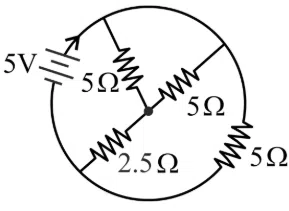
correct answer:- 2
Question 14
The value of current $$i_1$$ flowing from A to C in the circuit diagram is:
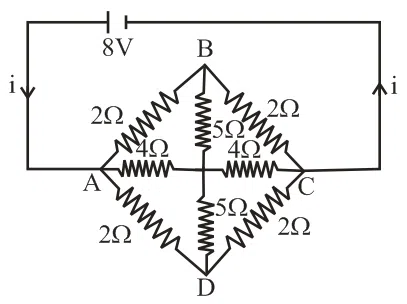
correct answer:- 4
Question 15
In the figure shown, the current in the $$10\,\text{V}$$ battery is close to:
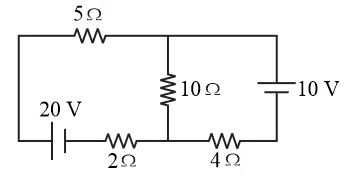
correct answer:- 3

Question 16
First, a set of $$n$$ equal resistors of 10 $$\Omega$$ each are connected in series to a battery of E.M.F. 20 V and internal resistance 10 $$\Omega$$. A current $$I$$ is observed to flow. Then, the $$n$$ resistors are connected in parallel to the same battery. It is observed that the current is increased 20 times, then the value of $$n$$ is _________.
correct answer:- 20
Question 17
Which of the following statements is false?
correct answer:- 3
Question 18
In the following circuit $$C_1 = 12$$ $$\mu F$$, $$C_2 = C_3 = 4$$ $$\mu F$$ and $$C_4 = C_5 = 2$$ $$\mu F$$. The charge stored in $$C_3$$ is ______ $$\mu C$$.
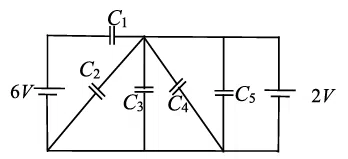
correct answer:- 8
Question 19
A moving coil galvanometer has resistance 50 $$\Omega$$ and it indicates full deflection at 4 mA current. A voltmeter is made using this galvanometer and a 5 k$$\Omega$$ resistance. The maximum voltage, that can be measured using this voltmeter, will be close to:
correct answer:- 3
Question 20
A galvanometer of resistance 100 Ω has 50 divisions on its scale and has sensitivity of 20 μA/division. It is to be converted to voltmeter with three ranges, of 0 - 2 V, 0 - 10 V and 0 - 20 V. The appropriate circuit to do so is:
correct answer:- 4

Question 21
In a circuit shown in the figure, the capacitor $$C$$ is initially uncharged and the key $$K$$ is open. In this condition, a current of 1 A flows through the 1 $$\Omega$$ resistor. The key is closed at time $$t = t_0$$. Which of the following statement(s) is(are) correct?
[Given: $$e^{-1} = 0.36$$]
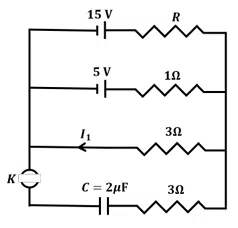
correct answer:- 1
Question 22
The resistance of a galvanometer is 50 ohm and the maximum current which can be passed through it is 0.002 A. What resistance must be connected to it in order to convert it into an ammeter of range 0 - 0.5 A?
correct answer:- 1
Question 23
The circuit shown here has two batteries of 8.0 V and 16.0 V and three resistors 3$$\Omega$$, 9$$\Omega$$ and 9$$\Omega$$ and a capacitor of 5.0 $$\mu$$F. How much is the current I in the circuit in steady state?
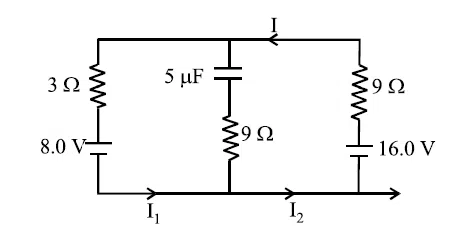
correct answer:- 2
Question 24
On interchanging the resistances, the balance point of a meter bridge shifts to the left by 10 cm. The resistance of their series combination is 1 k$$\Omega$$. How much was the resistance on the left slot before interchanging the resistances?
correct answer:- 4
Question 25
Two batteries with e.m.f. 12 V and 13 V are connected in parallel across a load resistor of 10 $$\Omega$$. The internal resistance of the two batteries are 1 $$\Omega$$ and 2 $$\Omega$$ respectively. The voltage across the load lies between,
correct answer:- 3

Question 26
An ideal battery of emf 4V and resistance R are connected in series in the primary circuit of a potentiometer of length 1 m and resistance $$5\Omega$$. The value of R, to give a potential difference of 5 mV across 10 cm of potentiometer wire, is:
correct answer:- 3
Question 27
Consider a 72 cm long wire AB as shown in the figure. The galvanometer jockey is placed at P on AB at a distance $$x$$ cm from A. The galvanometer shows zero deflection.
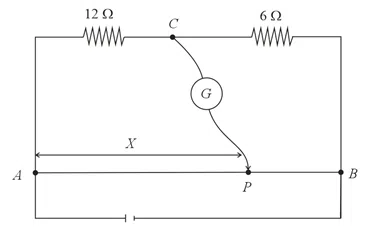
The value of $$x$$, to the nearest integer, is ___.
correct answer:- 48
Question 28
A 16 $$\Omega$$ wire is bent to form a square loop. A 9 V supply having an internal resistance of 1 $$\Omega$$ is connected across one of its sides. The potential drop across the diagonals of the square loop is _________ $$\times 10^{-1}$$ V.
correct answer:- 45
Question 29
In the following circuit, the battery has an emf of 2 V and an internal resistance of $$\frac{2}{3}$$ $$\Omega$$. The power consumption in the entire circuit is ______ W.
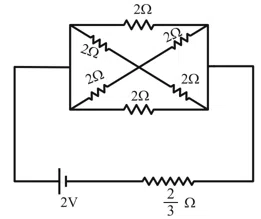
correct answer:- 3
Question 30
Refer to the circuit diagram given below. The heat generated across the 6 $$\Omega$$ resistance in 100 second is $$\frac{\alpha}{100}$$ J. The value of $$\alpha$$ is _______. (Nearest integer)
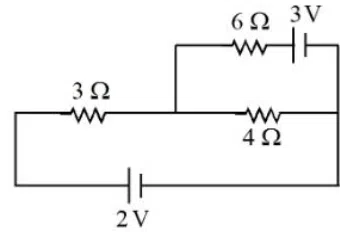
correct answer:- 3477
.webp)