
Join Our JEE Preparation Group
Prep with like-minded aspirants; Get access to free daily tests and study material.
Sign in
Please select an account to continue using cracku.in
↓ →
Join Our JEE Preparation Group
Prep with like-minded aspirants; Get access to free daily tests and study material.
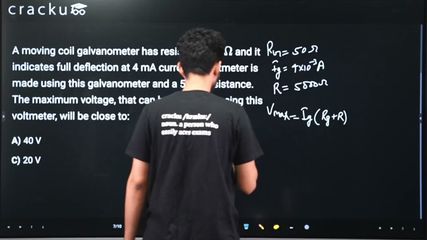
A moving coil galvanometer has resistance 50 $$\Omega$$ and it indicates full deflection at 4 mA current. A voltmeter is made using this galvanometer and a 5 k$$\Omega$$ resistance. The maximum voltage, that can be measured using this voltmeter, will be close to:
We first note the data given in the question. The resistance of the moving-coil galvanometer is $$R_G = 50\;\Omega$$, and the current required for full-scale (full deflection) is $$I_G = 4\ \text{mA}$$. In SI units this current is
$$I_G = 4\ \text{mA} = 4 \times 10^{-3}\ \text{A} = 0.004\ \text{A}.$$
To convert this galvanometer into a voltmeter, a high resistance is connected in series with it. The question states that the series resistance used is $$5\ \text{k}\Omega$$, which in ohms is
$$R_S = 5\ \text{k}\Omega = 5 \times 10^{3}\ \Omega = 5000\ \Omega.$$
For a voltmeter, the total resistance present in the circuit becomes the sum of the galvanometer resistance and the series resistance, that is
$$R_{\text{total}} = R_G + R_S.$$
Substituting the numerical values, we get
$$R_{\text{total}} = 50\ \Omega + 5000\ \Omega = 5050\ \Omega.$$
Now we recall the relation that links the full-scale current of the galvanometer to the maximum voltage that the resulting voltmeter can measure. The formula is simply Ohm’s law applied to the full-scale current flowing through the entire resistance of the voltmeter:
$$V_{\text{max}} = I_G \times R_{\text{total}}.$$
Substituting the known values, we obtain
$$V_{\text{max}} = 0.004\ \text{A} \times 5050\ \Omega.$$
Carrying out the multiplication step by step,
$$0.004 \times 5050 = 0.004 \times (5000 + 50)$$ $$= 0.004 \times 5000 + 0.004 \times 50$$ $$= 20 + 0.2$$ $$= 20.2\ \text{V}.$$
The calculated maximum readable voltage is $$20.2\ \text{V}$$, which is very close to $$20\ \text{V}$$ given among the options.
Hence, the correct answer is Option C.
Was this solution helpful?
Click on the Email ☝️ to Watch the Video Solution
Create a FREE account and get:
_1.webp)

Educational materials for JEE preparation

Ask our AI anything

AI can make mistakes. Please verify important information.
AI can make mistakes. Please verify important information.
