
Join Our JEE Preparation Group
Prep with like-minded aspirants; Get access to free daily tests and study material.
Sign in
Please select an account to continue using cracku.in
↓ →
Join Our JEE Preparation Group
Prep with like-minded aspirants; Get access to free daily tests and study material.
A rigid square loop of side 'a' and carrying current $$I_2$$ is lying on a horizontal surface near a long current $$I_1$$ carrying wire in the same plane as shown in figure. The net force on the loop due to the wire will be:
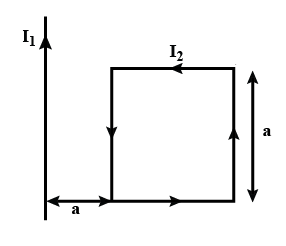
The net force on a rectangular loop near a long straight wire carrying current $$I_1$$ is calculated by considering the forces on each segment of the loop:
1. Forces on Horizontal Segments (QR and SP):
The magnetic field due to $$I_1$$ is perpendicular to these segments. However, for every small element on QR, there is a corresponding element on SP experiencing an equal and opposite force. Thus, these forces cancel each other out.
2. Force on Segment PQ (Distance a):
The magnetic field at distance a is $$B_1 = \frac{\mu_0 I_1}{2\pi a}$$. The force $$F_1$$ on segment PQ (length a) is:
$$F_1 = I_2 B_1 a = I_2 \left( \frac{\mu_0 I_1}{2\pi a} \right) a = \frac{\mu_0 I_1 I_2}{2\pi}$$
Since the currents $$I_1$$ and $$I_2$$ in PQ are in the same direction, this is an attractive force (towards the wire).
3. Force on Segment RS (Distance 2a):
The magnetic field at distance 2a is $$B_2 = \frac{\mu_0 I_1}{2\pi (2a)}$$. The force $$F_2$$ on segment RS is:
$$F_2 = I_2 B_2 a = I_2 \left( \frac{\mu_0 I_1}{4\pi a} \right) a = \frac{\mu_0 I_1 I_2}{4\pi}$$
Since the currents are in opposite directions, this is a repulsive force (away from the wire).
4. Net Force ($$F_{net}$$):
The net force is the difference between the attractive and repulsive forces:
$$F_{net} = F_1 - F_2$$$$F_{net} = \frac{\mu_0 I_1 I_2}{2\pi} - \frac{\mu_0 I_1 I_2}{4\pi}$$
$$F_{net} = \frac{\mu_0 I_1 I_2}{4\pi}$$
Since $$F_1 > F_2$$, the net force is attractive (directed toward the wire).
$$\boxed{F_{net} = \frac{\mu_0 I_1 I_2}{4\pi}}$$
Was this solution helpful?
Click on the Email ☝️ to Watch the Video Solution
Create a FREE account and get:
_1.webp)

Educational materials for JEE preparation

Ask our AI anything

AI can make mistakes. Please verify important information.
AI can make mistakes. Please verify important information.
