Join Our JEE Preparation Group
Prep with like-minded aspirants; Get access to free daily tests and study material.
Sign in
Please select an account to continue using cracku.in
↓ →
Join Our JEE Preparation Group
Prep with like-minded aspirants; Get access to free daily tests and study material.
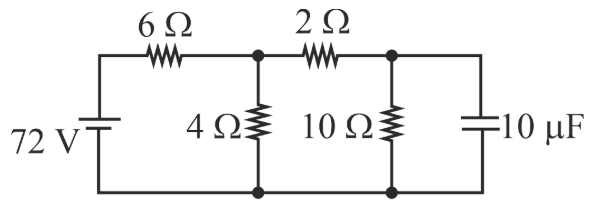
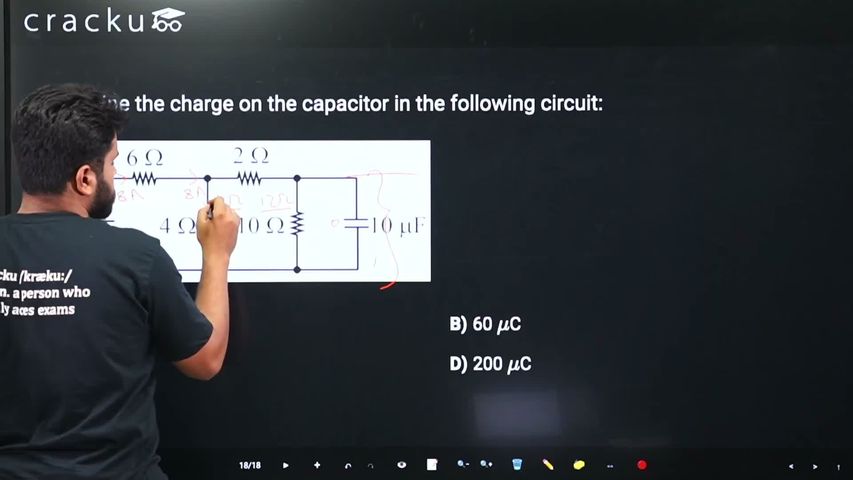
The branch containing the middle resistor is in parallel with the series combination of the upper-right resistor and the $$10\ \mu\text{F}$$ capacitor.
From the solution parameters provided:
$$V = 20\text{ V}$$
In steady-state, since no current flows through the resistor in series with the capacitor, there is zero potential drop across that upper-right resistor ($$V = I \cdot R = 0 \cdot R = 0$$).
Therefore, the entire parallel node voltage appears directly across the capacitor:
$$V_{\text{capacitor}} = 20\text{ V}$$
Using the capacitance formula $$q = C \cdot V$$:
$$q = 10\ \mu\text{F} \times 20\text{ V}$$
$$q = 200\ \mu\text{C}$$
Conclusion
option(D)
Was this solution helpful?
Click on the Email ☝️ to Watch the Video Solution
Create a FREE account and get:
_1.webp)

Educational materials for JEE preparation

Ask our AI anything

AI can make mistakes. Please verify important information.
AI can make mistakes. Please verify important information.