
Join Our JEE Preparation Group
Prep with like-minded aspirants; Get access to free daily tests and study material.
Sign in
Please select an account to continue using cracku.in
↓ →
Join Our JEE Preparation Group
Prep with like-minded aspirants; Get access to free daily tests and study material.
A wire of resistance R is bent to form a square ABCD as shown in the figure. The effective resistance between E and C is: (E is mid-point of arm CD)
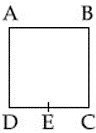
The total resistance of the wire is R. Since it is bent into a square ABCD, each side has a resistance of R/4.
Point E is the midpoint of side $CD$. This divides the side CD into two segments, DE and EC, each having a resistance of:
$$R_{DE} = R_{EC} = \frac{1}{2} \left( \frac{R}{4} \right) = \frac{R}{8}$$
To find the effective resistance between E and C, we identify two parallel paths:
The effective resistance $R_{eq}$ is calculated using the parallel formula:
$$\frac{1}{R_{eq}} = \frac{1}{R_1} + \frac{1}{R_2}$$
$$\frac{1}{R_{eq}} = \frac{1}{R/8} + \frac{1}{7R/8}$$
$$\frac{1}{R_{eq}} = \frac{8}{R} + \frac{8}{7R}$$
Taking the common denominator $7R$:
$$\frac{1}{R_{eq}} = \frac{56 + 8}{7R} = \frac{64}{7R}$$
Solving for $$R_{eq}$$:
$$\boxed{R_{eq} = \frac{7}{64}R}$$
Was this solution helpful?
Create a FREE account and get:
_1.webp)

Educational materials for JEE preparation

Ask our AI anything

AI can make mistakes. Please verify important information.
AI can make mistakes. Please verify important information.
