
Join Our JEE Preparation Group
Prep with like-minded aspirants; Get access to free daily tests and study material.
Sign in
Please select an account to continue using cracku.in
↓ →
Join Our JEE Preparation Group
Prep with like-minded aspirants; Get access to free daily tests and study material.
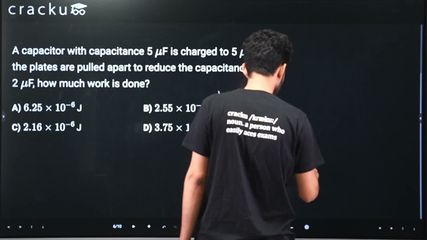
A capacitor with capacitance 5 $$\mu$$F is charged to 5 $$\mu$$C. If the plates are pulled apart to reduce the capacitance to 2 $$\mu$$F, how much work is done?
We begin by noting that the charge on the capacitor is kept constant, because the plates are merely pulled apart without any external circuit connected. So throughout the process we have $$Q = 5\;\mu\text{C} = 5 \times 10^{-6}\;\text{C}.$$
The electrostatic energy stored in a charged capacitor in terms of its charge and capacitance is given by the formula
$$U = \frac{Q^{2}}{2C}.$$
Initially, the capacitance is $$C_i = 5\;\mu\text{F} = 5 \times 10^{-6}\;\text{F}.$$ Substituting the known values into the energy formula, we find
$$U_i \;=\; \frac{Q^{2}}{2C_i} \;=\; \frac{(5 \times 10^{-6})^{2}}{2 \times 5 \times 10^{-6}}\; \text{J}.$$
Carrying out the algebra step by step, first square the charge:
$$Q^{2} = (5 \times 10^{-6})^{2} = 25 \times 10^{-12}.$$
Now form the denominator:
$$2 \times C_i = 2 \times 5 \times 10^{-6} = 10 \times 10^{-6} = 1 \times 10^{-5}.$$
So
$$U_i = \frac{25 \times 10^{-12}}{1 \times 10^{-5}} = 25 \times 10^{-12}\times 10^{5} = 25 \times 10^{-7}\;\text{J} = 2.5 \times 10^{-6}\;\text{J}.$$
Next, the plates are separated so that the capacitance becomes $$C_f = 2\;\mu\text{F} = 2 \times 10^{-6}\;\text{F}.$$ The charge is still $$Q = 5 \times 10^{-6}\;\text{C},$$ so the final energy is
$$U_f \;=\; \frac{Q^{2}}{2C_f} \;=\; \frac{25 \times 10^{-12}}{2 \times 2 \times 10^{-6}}\; \text{J}.$$
Simplifying the denominator gives
$$2 \times 2 \times 10^{-6} = 4 \times 10^{-6},$$
and therefore
$$U_f = \frac{25 \times 10^{-12}}{4 \times 10^{-6}} = 25 \times 10^{-12} \times \frac{1}{4} \times 10^{6} = \frac{25}{4} \times 10^{-6}\;\text{J} = 6.25 \times 10^{-6}\;\text{J}.$$
The work done by the external agent in pulling the plates apart equals the increase in the electrostatic energy, because the system gains this additional energy:
$$W = U_f - U_i.$$
Substituting the computed energies, we have
$$W = 6.25 \times 10^{-6}\;\text{J} \;-\; 2.5 \times 10^{-6}\;\text{J} = 3.75 \times 10^{-6}\;\text{J}.$$
Hence, the correct answer is Option D.
Was this solution helpful?
Click on the Email ☝️ to Watch the Video Solution
Create a FREE account and get:
_1.webp)

Educational materials for JEE preparation

Ask our AI anything

AI can make mistakes. Please verify important information.
AI can make mistakes. Please verify important information.
