
Join Our JEE Preparation Group
Prep with like-minded aspirants; Get access to free daily tests and study material.
Sign in
Please select an account to continue using cracku.in
↓ →
Join Our JEE Preparation Group
Prep with like-minded aspirants; Get access to free daily tests and study material.
A system of three charges are placed as shown in the figure:
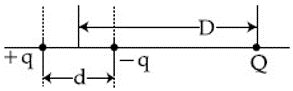
If $$D >> d$$, the potential energy of the system is best given by:
Problem Statement
A system of three charges is placed as shown in the figure. If $$D \gg d$$, the potential energy of the system is best given by:
Step-by-Step Solution
1. Identify the Exact Positions of the Charges
Let the midpoint between the charges $$+q$$ and $$-q$$ be the origin ($$x = 0$$).
The distances between the pairs of interacting charges are:
2. Set Up the Total Electrostatic Potential Energy Equation
The total potential energy $$U$$ of a three-charge system is the sum of the potential energies of all unique pairs:
$$U = \frac{1}{4\pi\epsilon_0} \left[ \frac{(+q)(-q)}{r_{12}} + \frac{(+q)(Q)}{r_{13}} + \frac{(-q)(Q)}{r_{23}} \right]$$
Substitute the distances into the equation:
$$U = \frac{1}{4\pi\epsilon_0} \left[ -\frac{q^2}{d} + \frac{qQ}{D + \frac{d}{2}} - \frac{qQ}{D - \frac{d}{2}} \right]$$
3. Simplify using Binomial Approximation
Take out $$D$$ from the denominators of the second and third terms to utilize the condition $$D \gg d$$:
$$U = \frac{1}{4\pi\epsilon_0} \left[ -\frac{q^2}{d} + \frac{qQ}{D}\left(1 + \frac{d}{2D}\right)^{-1} - \frac{qQ}{D}\left(1 - \frac{d}{2D}\right)^{-1} \right]$$
Since $$\frac{d}{2D} \ll 1$$, we apply the binomial expansion $$(1 \pm x)^{-1} \approx 1 \mp x$$:
$$U \approx \frac{1}{4\pi\epsilon_0} \left[ -\frac{q^2}{d} + \frac{qQ}{D}\left(1 - \frac{d}{2D}\right) - \frac{qQ}{D}\left(1 + \frac{d}{2D}\right) \right]$$
Expand the terms inside the bracket:
$$U \approx \frac{1}{4\pi\epsilon_0} \left[ -\frac{q^2}{d} + \frac{qQ}{D} - \frac{qQd}{2D^2} - \frac{qQ}{D} - \frac{qQd}{2D^2} \right]$$
The $$\frac{qQ}{D}$$ and $$-\frac{qQ}{D}$$ terms cancel each other out:
$$U \approx \frac{1}{4\pi\epsilon_0} \left[ -\frac{q^2}{d} - \frac{2qQd}{2D^2} \right]$$
$$U \approx \frac{1}{4\pi\epsilon_0} \left[ -\frac{q^2}{d} - \frac{qQd}{D^2} \right]$$
Correct Answer
The correct option is (1).
Was this solution helpful?
Create a FREE account and get:
_1.webp)

Educational materials for JEE preparation

Ask our AI anything

AI can make mistakes. Please verify important information.
AI can make mistakes. Please verify important information.
