
Join Our JEE Preparation Group
Prep with like-minded aspirants; Get access to free daily tests and study material.
Sign in
Please select an account to continue using cracku.in
↓ →
Join Our JEE Preparation Group
Prep with like-minded aspirants; Get access to free daily tests and study material.
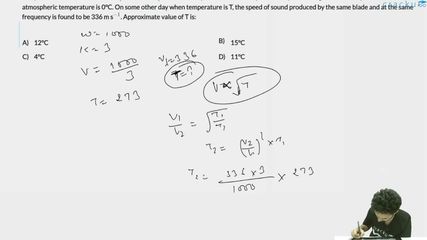
The pressure wave, $$P = 0.01 \sin[1000t - 3x]$$ N m$$^{-2}$$, corresponds to the sound produced by a vibrating blade on a day when atmospheric temperature is 0°C. On some other day when temperature is T, the speed of sound produced by the same blade and at the same frequency is found to be 336 m s$$^{-1}$$. Approximate value of T is:
We are given the pressure (sound) wave
$$P \;=\;0.01\;\sin\!\left[\,1000\,t\;-\;3\,x\,\right] \text{ N m}^{-2}$$
for the day on which the atmospheric temperature is $$0^{\circ}\text{C}$$. In the standard form of a travelling wave
$$P \;=\;P_{0}\;\sin\!\bigl(\omega t - kx\bigr),$$
the coefficient of $$t$$ is the angular frequency $$\omega$$ and the coefficient of $$x$$ is the wave-number $$k$$. Hence, by simple comparison, we have
$$\omega \;=\;1000\ \text{rad s}^{-1},\qquad k \;=\;3\ \text{m}^{-1}.$$
For any wave, the speed $$v$$ is related to $$\omega$$ and $$k$$ by the formula
$$v \;=\;\frac{\omega}{k}.$$
Substituting the above numerical values,
$$v_{0} \;=\;\frac{1000}{3}\;\text{m s}^{-1} \;=\;333.33\ \text{m s}^{-1}\;(\text{approximately}).$$
This is the speed of sound in air at the initial temperature $$0^{\circ}\text{C}$$.
Now, on another day, the same vibrating blade produces sound of the same frequency (because the source has not changed), but the measured speed of sound is
$$v_{T} \;=\;336\ \text{m s}^{-1}.$$
For a given gas, the theoretical relation between the speed of sound and the absolute temperature is
$$v \;\propto\;\sqrt{T_{\text{abs}}},$$
where the absolute temperature is $$T_{\text{abs}} = T({^{\circ}\text{C}})+273\;\text{K}.$$
Because the gas (air) is the same on both days, we can write
$$\frac{v_{T}}{v_{0}} \;=\;\sqrt{\frac{T_{\text{abs},\,T}}{T_{\text{abs},\,0}}}.$$
Squaring both sides gives
$$\left(\frac{v_{T}}{v_{0}}\right)^{2} \;=\;\frac{T_{\text{abs},\,T}}{T_{\text{abs},\,0}}.$$
We already know $$T_{\text{abs},\,0}=273\ \text{K}$$ (because $$0^{\circ}\text{C}=273\text{ K}$$), so let us substitute every known quantity step by step.
First the ratio of speeds:
$$\frac{v_{T}}{v_{0}} \;=\;\frac{336}{333.33} \;=\;1.008\;(\text{approximately}).$$
Now square this ratio:
$$\left(\frac{v_{T}}{v_{0}}\right)^{2} \;=\;(1.008)^{2} \;=\;1.0161.$$
Therefore,
$$\frac{T_{\text{abs},\,T}}{273} \;=\;1.0161,$$
and hence
$$T_{\text{abs},\,T} \;=\;1.0161 \times 273 \;=\;277.4\ \text{K}.$$
Finally convert this absolute temperature back to the Celsius scale:
$$T({^{\circ}\text{C}}) \;=\;T_{\text{abs},\,T}\;-\;273 \;=\;277.4\;-\;273 \;=\;4.4^{\circ}\text{C}.$$
On approximation to the nearest whole number, the temperature is about $$4^{\circ}\text{C}$$.
Hence, the correct answer is Option C.
Was this solution helpful?
Click on the Email ☝️ to Watch the Video Solution
Create a FREE account and get:
_1.webp)

Educational materials for JEE preparation

Ask our AI anything

AI can make mistakes. Please verify important information.
AI can make mistakes. Please verify important information.
