
Join Our JEE Preparation Group
Prep with like-minded aspirants; Get access to free daily tests and study material.
Sign in
Please select an account to continue using cracku.in
↓ →
Join Our JEE Preparation Group
Prep with like-minded aspirants; Get access to free daily tests and study material.
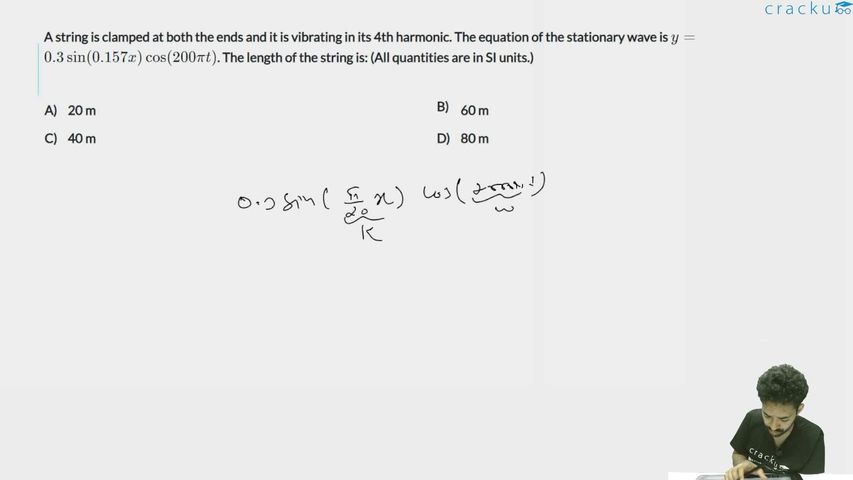
A string is clamped at both the ends and it is vibrating in its 4th harmonic. The equation of the stationary wave is $$y = 0.3 \sin(0.157x) \cos(200\pi t)$$. The length of the string is: (All quantities are in SI units.)
We have a stationary wave on a string whose ends are fixed, and its mathematical form is given as
$$y \;=\; 0.3 \,\sin(0.157\,x)\,\cos(200\pi\,t).$$
For a string that is clamped at both ends, the general expression of a standing wave is usually written as
$$y \;=\; 2A\,\sin(kx)\,\cos(\omega t),$$
where $$k$$ is the wave-number and $$\omega$$ is the angular frequency. The boundary conditions at the two fixed ends $$x = 0$$ and $$x = L$$ force the displacement to be zero at those points. Mathematically, we must have
$$\sin(kx) = 0 \quad\text{when}\quad x = 0 \quad\text{and}\quad x = L.$$
This is satisfied if
$$kL = m\pi,$$
where $$m$$ is a positive integer. The integer $$m$$ counts the harmonic number; in particular,
$$k = \frac{m\pi}{L}.$$
Now, the problem states that the string is vibrating in its 4th harmonic. Therefore we set $$m = 4$$. The theoretical relation for the wave-number in this mode is
$$k \;=\; \frac{4\pi}{L}.$$
Next, we compare this with the actual wave-number that appears in the given equation. From
$$y \;=\; 0.3\,\sin\!\bigl(0.157\,x\bigr)\,\cos(200\pi\,t),$$
we can directly read off
$$k_{\text{given}} \;=\; 0.157\;\text{rad m}^{-1}.$$
By equating the two expressions for $$k$$, we get
$$0.157 \;=\; \frac{4\pi}{L}.$$
Solving for $$L$$: first multiply both sides by $$L$$, then divide by $$0.157$$:
$$L \;=\; \frac{4\pi}{0.157}.$$
Evaluating the numerator, we find
$$4\pi \;=\; 4 \times 3.1416 \;=\; 12.5664.$$
Now perform the division:
$$L \;=\; \frac{12.5664}{0.157} \;\approx\; 80\;\text{m}.$$
Hence, the length of the string is 80 metres.
Hence, the correct answer is Option D.
Was this solution helpful?
Click on the Email ☝️ to Watch the Video Solution
Create a FREE account and get:
_1.webp)

Educational materials for JEE preparation

Ask our AI anything

AI can make mistakes. Please verify important information.
AI can make mistakes. Please verify important information.
