
Join Our JEE Preparation Group
Prep with like-minded aspirants; Get access to free daily tests and study material.
Sign in
Please select an account to continue using cracku.in
↓ →
Join Our JEE Preparation Group
Prep with like-minded aspirants; Get access to free daily tests and study material.
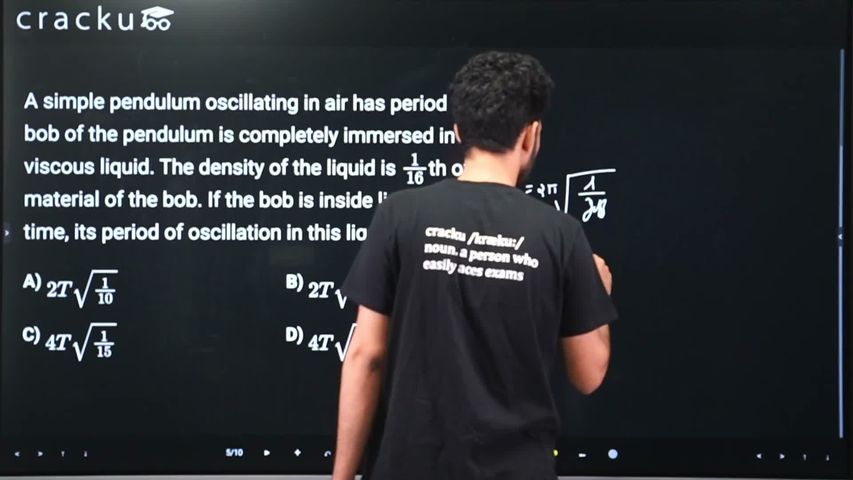
A simple pendulum oscillating in air has period T. The bob of the pendulum is completely immersed in a non-viscous liquid. The density of the liquid is $$\frac{1}{16}$$th of the material of the bob. If the bob is inside liquid all the time, its period of oscillation in this liquid is:
For a simple pendulum oscillating in air, the time period is given by the standard formula
$$T = 2\pi\sqrt{\dfrac{L}{g}}$$
where $$L$$ is the effective length of the pendulum and $$g$$ is the acceleration due to gravity.
When the bob is completely immersed in a non-viscous liquid, it experiences an upward buoyant force in addition to its weight. Because of this buoyancy, the restoring force acting on the bob is reduced, which effectively reduces the value of gravity appearing in the formula. We now calculate that reduction step by step.
Let $$\rho_b$$ be the density of the material of the bob and $$\rho_l$$ be the density of the liquid. The problem states that
$$\rho_l=\dfrac{1}{16}\,\rho_b.$$
If $$V$$ is the volume of the bob, then
mass of the bob, $$m=\rho_b V,$$
weight of the bob, $$W=mg=\rho_b V g,$$
buoyant force on the bob, $$B=\rho_l V g.$$
The effective weight acting downward while the bob is fully immersed is therefore
$$W_{\text{eff}} = W - B = (\rho_b V g) - (\rho_l V g)= (\rho_b-\rho_l)V g.$$
The motion of the pendulum depends on this effective weight, so we define an effective acceleration $$g_{\text{eff}}$$ by equating $$m g_{\text{eff}}$$ with the effective weight:
$$m g_{\text{eff}} = (\rho_b-\rho_l)V g.$$
Because $$m=\rho_b V,$$ we have
$$\rho_b V g_{\text{eff}} = (\rho_b-\rho_l)V g.$$
Canceling the common factor $$V$$ gives
$$g_{\text{eff}} = g\left(1-\dfrac{\rho_l}{\rho_b}\right).$$
Substituting the given ratio $$\rho_l/\rho_b = 1/16,$$ we find
$$g_{\text{eff}} = g\left(1-\dfrac{1}{16}\right) = g\left(\dfrac{15}{16}\right)=\dfrac{15g}{16}.$$
Now we use the time-period formula again, but with $$g_{\text{eff}}$$ in place of $$g$$:
$$T_{\text{liquid}} = 2\pi\sqrt{\dfrac{L}{g_{\text{eff}}}}.$$
Substituting $$g_{\text{eff}}=\dfrac{15g}{16},$$ we obtain
$$T_{\text{liquid}} = 2\pi\sqrt{\dfrac{L}{\dfrac{15g}{16}}}=2\pi\sqrt{\dfrac{16L}{15g}}.$$
We now express this in terms of the original period $$T$$. Because $$T = 2\pi\sqrt{\dfrac{L}{g}},$$ we write
$$T_{\text{liquid}} = 2\pi\sqrt{\dfrac{L}{g}}\;\sqrt{\dfrac{16}{15}} = T\sqrt{\dfrac{16}{15}}.$$
Recognizing that $$\sqrt{16}=4,$$ the result simplifies to
$$T_{\text{liquid}} = T\cdot\dfrac{4}{\sqrt{15}} = 4T\sqrt{\dfrac{1}{15}}.$$
This is exactly the expression given in Option C.
Hence, the correct answer is Option C.
Was this solution helpful?
Click on the Email ☝️ to Watch the Video Solution
Create a FREE account and get:
_1.webp)

Educational materials for JEE preparation

Ask our AI anything

AI can make mistakes. Please verify important information.
AI can make mistakes. Please verify important information.
